
Aylesbury High School
Subjects
This page contains links to each subject area. Each subject page contains the following information:
- Links to any resources used by each subject area and to extension materials.
- Subject content.
- The learning journey for most subject areas – mapping out the course.
- Attainment & grade descriptors – these explain how grades are awarded at Key Stage 3 and explain how assessments work at GCSE and A Level.
- School values information – how each subject ties into this aspect of school life.
- The types of feedback that can be expected for the subject.
On this page, you will also find generic information about our curriculum and our data and attainment process.
Key Stage 3 |
GCSE |
A Level |
|
At Key Stage 3, our students have the opportunity to have lessons in about 20 different subjects. Some will be entirely new to them, whereas others will build directly onto knowledge gained at primary school. In addition to the core subjects of English, Maths and Science, students get to experience different humanities, languages, a range of sports and creative options.
|
Our students take 10 GCSEs. In addition to the six core subjects of English Language, English Literature, Maths, Biology, Chemistry and Physics, we ensure the breadth of curriculum is maintained by asking students to select one Creative subject, one Humanity subject and one MFL subject from a wide variety of subjects on offer. Some students will be entered for Further Maths GCSE in addition to their other choices. In addition to their examined curriculum, students will have four lessons of Core PE and one lesson of L4L (including RS) per fortnight. |
In Years 12 and 13, the majority of our students take three A Levels, chosen from the broad range of subjects on offer. Some students will take four A Levels and, in exceptional cases, Further Mathematicians may take five A Levels. We aim to deliver a range of A Levels to give students the opportunity to pursue a wide range of career aspirations. The majority of our A Level subjects are taught over 8 hours per fortnight in Year 12 and in Year 13. |
These links provide overviews to subject content summaries in each year group.
Curriculum intent
Our curriculum:
- Will enable the school to deliver its vision of developing uniquely talented young adults who are independent, strong and confident
- Will provide a broad and balanced education for all students, which is ambitious, particularly for disadvantaged students, forward-looking, innovative and of the highest academic quality
- Will be planned and sequenced to:
- Enable students to acquire knowledge, understand concepts and develop skills, and be able to answer subject-specific questions
- Support students’ spiritual, moral, social and cultural development
- Support students’ physical development and responsibility for their own health, and enable them to be active
- Promote a positive attitude towards lifelong learning, teaching skills which will be transferable beyond life at AHS
- Ensure equitable access to learning, with high expectations for every student and appropriate levels of challenge and support
- Build on what has been taught before, to promote success for all students
- Account for delays and gaps in learning that have arisen and continue to arise as a result of the pandemic
- Will provide subject choices that support students’ learning and progression, and enable them to work towards achieving their goals
- Will provide rigour, and so develop students’ independent learning skills and resilience, to equip them for further/higher education and employment
- Will prepare students to be the problem solvers of the future in a fast-changing world
Curriculum Implementation
Key Stage 3 (Years 7–9)
In Years 7, 8 and 9 we aim for a broad curriculum. We want our students to have the opportunity to experience many of the subjects on offer to them in KS4. We value the skills obtained from creative subjects and nearly a third of a Key Stage 3 student timetable is made up of the creatives – Art, Computing, Dance, Drama, Music, PE and Technology. All students have swimming lessons throughout KS3, and we have the benefit of a shared pool with AGS to facilitate this. Our Year 7 students learn three languages – French, German and Spanish and choose two of these to continue with in Year 8 and Year 9. In Science, our students will start learning GCSE material just before Christmas of Year 9 as this ensures they can cover the content to an appropriate depth by the end of Year 11. It also gives them an opportunity to appreciate the three separate sciences before starting Year 10. Because of this, Year 9 Science is taught as Biology, Chemistry and Physics with specialist teachers.
Our Learning for Life (L4L) programme delivers areas of the curriculum that are not covered by academic subjects as well as complementing some of the skills they will learn in their other lessons. It allows us to cover Relationships and Sex Education (RSE), Spiritual, Moral, Social and Cultural development, British Values and Careers education. Throughout our L4L curriculum, we aim to create confident, resilient individuals capable of making informed decisions and making the most of opportunities that will help them to live happy, healthy lives.
Key Stage 3 Plans
Click here to see what students learn in Years 7,8, & 9.
Key Stage 4 (Years 10-11)
In Years 10 and 11 our students will take 10 GCSEs. In addition to the six core subjects of English Language, English Literature, Maths, Biology, Chemistry and Physics, we ensure the breadth of curriculum is maintained by asking students to select one Creative subject, one Humanity subject and one MFL subject from a wide variety of subjects on offer:
- Creatives include Art, Computing, Dance, Drama, Design & Technology, Food, Music, PE, and Textiles
- Humanities include Business, Economics, Geography, History, and RS
- MFL subjects include French, German, and Spanish
Their tenth subject is a free choice from the last three categories. Some students will be entered for Further Maths GCSE in addition to their other choices.
In addition to their examined curriculum, students will have four lessons of Core PE and one lesson of L4L (including RS) per fortnight.
Further details about the Options process can be found here on the AHS website.
Key Stage 4 Plans
Click here to see how many lessons students have for each of their subjects.
Key Stage 5 – Sixth Form
In Years 12 and 13, the majority of our students will take three A Levels, chosen from the broad range of subjects on offer. Some students will take four A Levels and, in exceptional cases, Further Mathematicians may take five A Levels. We aim to deliver a range of A Levels to give students the opportunity to pursue a wide range of career aspirations. The majority of our A Level subjects are taught over 10 hours per fortnight in Year 12 and 8 hours per fortnight in Year 13. However, some smaller classes that have lower student to teacher ratios will have 8 hours per fortnight in each year.
Students taking three A Levels are expected to take an Extension Study in Year 12. This is usually a non-examined course taught in 2 hours per fortnight, but two AS options and the Extended Project Qualification (EPQ) are also available which have a higher number of teaching hours – 8 hours per fortnight for an AS and 4 hours per fortnight for EPQ. Additionally, some Year 13 students who have not completed an EPQ in Year 12 have another opportunity to do so.
In addition to their chosen curriculum, throughout their time in the Sixth Form, students will have one lesson of Personal Development per fortnight. They also participate in Sixth Form Games sessions, which are compulsory for Year 12 and optional for Year 13.
There is a carefully planned Next Steps programme to complement the Sixth Form curriculum. This starts in Year 12 and continues until our students leave school. The programme covers aspects such as UCAS, apprenticeship, competitive entry courses, interview skills and considerations for living independently, amongst many others. In Year 13, our students spend an hour each fortnight in a timetabled lesson with their tutor to help support them with their next steps.
Further details about the subjects available in the Sixth Form can be found here on the AHS website.
Curriculum impact
The school will measure the impact of the curriculum in a number of ways including:
- External examination results at GCSE and A Level, with a focus on progress
- Tracking, through termly data drops and annual reporting
- Participation of students in co-curricular activities
- Destinations of leavers, both in Year 11 and Year 13
- Retention of Year 11 students into Year 12
- Quality assurance through Leadership Team monitoring
- Attendance
- Option trends
The Headmistress is responsible for ensuring that all required elements of the curriculum have aims and objectives which reflect the aims of the school and indicate how the needs of individual students will be met. The Leadership Team will monitor the curriculum through data summits, lesson observations, learning walks, Quality Assurance Reviews, student and staff surveys, student focus groups and conversations in fortnightly line management meetings.
Governors will monitor whether the school is complying with its funding agreement and teaching a broad and balanced curriculum which includes the required subjects, through school visits and reports made to the T&L Committee or the FGB. (Full Governing Body.)
Termly data
All year groups receive a termly data report. These data reports contain 3 pieces of information about each subject they take.
Engagement in class
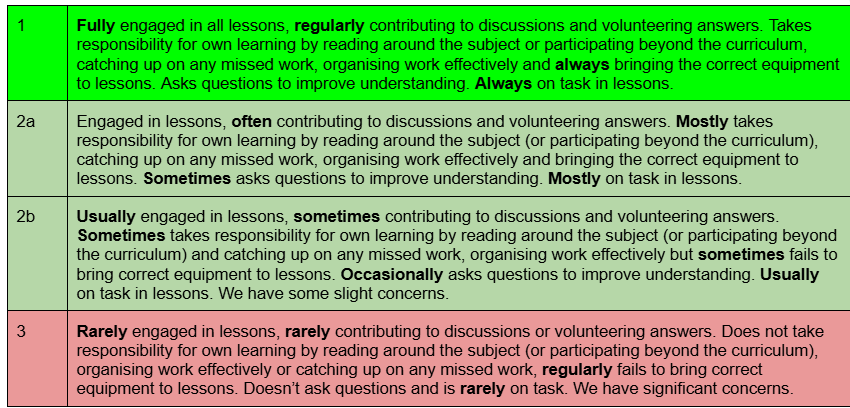
Students receive two “engagement” descriptors each term. One is for engagement with the subject in lessons and one for homework. These descriptors remain the same from years 7–13 to ease understanding.
It is unlikely that students will meet all the criteria in any given year group – this is a process of best fit which is determined by all subject teachers and then moderated by Heads of Department. We also hold 'data summits' for each year group where members of the leadership team, the relevant Head of Year and the SENDCO get together to discuss the data for each year group.
Our expectation as a school is that students are a 2 for both; 1s are given where students are engaged beyond expectation.
There is no linear progression for these descriptors; they can (and do) change each term and from year to year.
Engagement in class descriptors:
Engagement at home
Engagement at home descriptors:
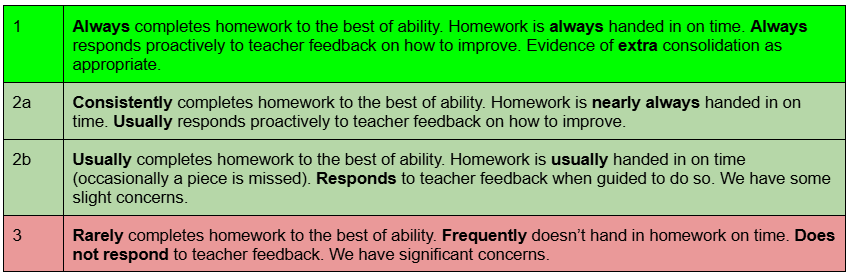
If a student receives a 2b in any subjects, their classroom teacher will initially speak to them about ways to improve. A 3 will result in teachers contacting home.
Subsequent discussions might involve Heads of Department. If there is evidence of wider issues, Form Tutors and Heads of Year might also become involved at a more holistic level.
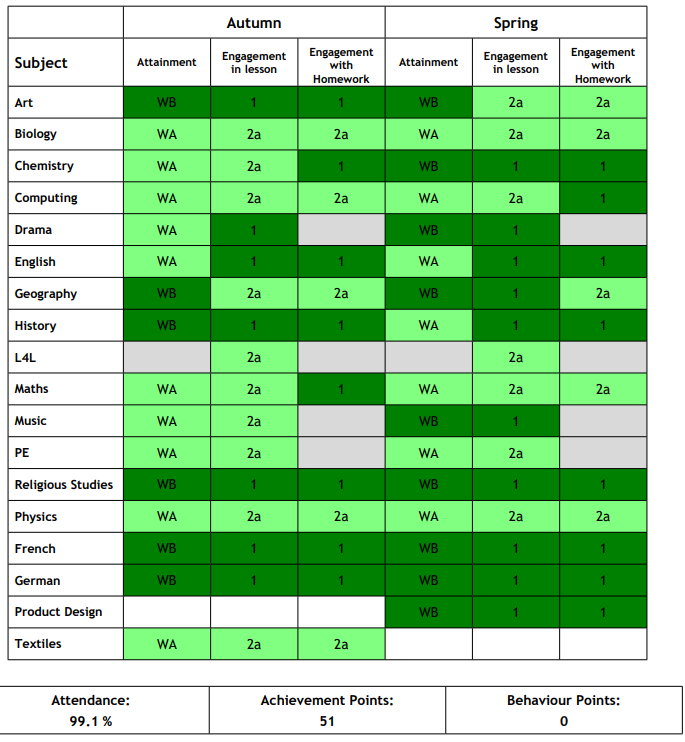
The Autumn data set will contain just that term’s information, but the Spring and Summer sets will include the data from each previous term also. Also included each term is data on attendance, achievement points gained and behaviour marks issued. On the next page is an example of what this might look like by the end of the year.
Subject teachers will contact home if they feel there is an issue which needs to be addressed. Students can, of course, speak to their teachers about data, or progress in general, if the need arises.
If parents want any clarification of the data given, or if they wish to ask for subject advice, their first port of call should be the subject teacher.
There is further information about how the data relates to each subject on each individual subject page.
Attainment
Attainment differs at each key stage.
1. Key Stage 3 (Years 7–9): WT/WA/WB
2. Key Stage 4 (Years 10-11): GCSE Grades 9-1
3. Key Stage 5 (Years 12–13): A Level Grades A*-E
Key Stage 3 attainment
This involves a 3-tier system with the following descriptors:
WT – Working Towards
WA – Working At
WB - Working Beyond
These descriptors are based upon where we expect our students to be in terms of attainment. When students join us in Year 7, they come from many different primary settings, and we have chosen a system that builds upon the types of descriptors many primary schools use.
These descriptors are not part of a national system; our system is tailored to the AHS curriculum. The descriptors, and the way in which we apply them, cannot be compared with a system at another school.
The majority of our students achieve WA descriptors. This means that they are where we expect them to be in each subject. Some will receive WB if they are making exceptional progress. Those who receive a WT descriptor are not currently achieving the level we expect, but we will work with them to help to improve this. It does not mean that they are 'failing'.
Subject teachers decide upon the descriptors to give to each student based upon performance in tests, but also with a more holistic view, taking into consideration general performance and homework, amongst other things. Heads of Department then look through the data to moderate it.
There is no expected linear progression through Years 7–9. i.e. We are not expecting students to get a WT in Year 7, a WA in Year 8 and a WB in Year 9.
Receiving a WB in one term, or year, does not mean that will automatically be the case in the next. The descriptors are relevant to each particular subject in each year group.
It is difficult to correlate these descriptors to eventual achievement at GCSE; a focus on grades will come later on. At Key Stage 3, we want students to develop a love of learning, to challenge themselves in every subject and to learn the skills necessary to allow them to make progress.
Example Summer data set for Key Stage 3.
Key Stage 3 Data and Assessment FAQs:
What do WT/WA/WB mean in Years 7–9?
WT stands for Working Towards, WA for Working At and WB for Working Beyond. We brought in these attainment descriptors for several reasons. We wanted to have continuity from primary school. AHS has over 70 primary feeder schools, the majority of which use descriptors similar to these. We want Years 7–9 to be about students learning new skills, gaining new knowledge, working out how they learn best and focusing on how to improve. We feel that grades/marks can distract from this process as students become fixated on them to the detriment of any feedback given. The WA is where we expect AHS students to be in each subject, in each year group, and it is specific to our school. If a student is given a WT descriptor, it doesn’t mean that they are failing, rather, it means that they haven’t yet hit the requirements of the WA descriptor. WB means that a student has gone beyond where we would expect them to be.
How do the 1-3 engagement descriptors work?
Teachers give one engagement grading of 1–3 once a term for work done in class, and one for homework for Years 7–13. The data report letter explains what the descriptors mean; what is expected of a Year 7 is obviously not the same as for a Year 13, but the descriptors do take this into account. Teachers read the descriptors and apply them according to a policy of best fit. Our expectation is for a 2a. Where students receive a 2b, this will be followed up internally. Where a student receives a 3, contact will be made with home. Students can and do achieve a 1. Judging the amount of effort that goes into homework is obviously difficult to do, but what is possible is assessing if it is always done, is it on time, what is its quality, and then, higher up in the school, does it show evidence of extra reading/effort.
How is data checked/followed up in school?
Heads of Department check the data for their own subject areas. They do this to see if there are any differences between different classes, and, where there are, they investigate them. At departmental meetings, data is regularly discussed to ensure that everybody is working to the same criteria. We use a data analysis tool in school to help do this in more depth. Heads of Department can also see the data for other departments to see how it compares. Heads of Year also get involved in the process. Where there are any issues, subject teachers, heads of department, tutors or heads of year will have follow-up conversations with students, depending on the nature of the issue. At least once a year, we hold a ‘data summit’ for each year group. At these meetings, members of the leadership team responsible for data analysis, heads of year, the SENDCO and school safeguarding lead discuss the data from different points of view, and again there are interventions with students as appropriate.
How should I read the termly data sheets?
Students receive an attainment descriptor (WT/WA/WB) and two engagement grades each term. By the Summer term, the table has been filled, i.e. the data from the previous two terms can still be seen for comparison. When it comes to the engagement grades, we expect a grade 2a. If this is what students are achieving, this is fine. If they get a 1, that is fantastic, but we are perfectly happy with a 2a. It is natural for students to have more interest in some subjects than others, and getting 1s for both categories for all subjects isn’t realistic. If there is a drop-off in engagement, this will be followed up in school, but it is also something that students can talk about with their parents. The attainment descriptors/LAGs can also go up or down and can also be the starting point for conversations with parents. The LAGs can be compared to the target grades for either GCSE or A Level, which the students themselves were involved in setting (see below). If parents/students don’t understand any of the engagement grades/LAGs/attainment descriptors they have been given, they can, of course, ask teachers in class, or contact them to ask for an explanation.
Why are there no LAGs (Likely to Achieve Grades) in Years 7–9 as there are in Years 10-13?
In 2022-23, the school moved away from having GCSE style 9–1 grades from Year 7 to 9. We did this because we felt that we wanted students to concentrate much more on acquiring skills and knowledge, on how to improve and, most importantly, to enjoy their subjects in Years 7-9. It is also the case that, for some subjects, the curriculum requirements in Years 7-9 are very different from the GCSE requirements of those subjects, and therefore allocating grades wasn’t very realistic. We want students in Years 7–9 to focus on how to improve, without worrying about GCSE-style grades that aren’t ‘real’ until Years 10-11, when they have started their GCSE courses.
How are students assessed in Years 7–9?
The emphasis in Years 7–9 is on progress and enjoyment. However, students are still assessed both summative and formatively. Students can expect to have end-of-unit tests to check understanding and the feedback from those tests will allow students to see how they can improve. These end of unit tests can vary considerably from subject to subject, from a listening test in French to an algebra test in Maths. Students will be informed of what is in the tests and the skills/content they need to learn to be able to perform well in them. We have an end of year exam week for most subjects in June, for which students will be given a lot of guidance in advance. Rather, students are assessed at the appropriate times during the course of the year as decided by each subject area. The marks that students receive might be out of 10 or 20, they might be percentages, or they might be WT/WA/WB grades. This will be decided as appropriate by each department.
Key Stage 4 attainment
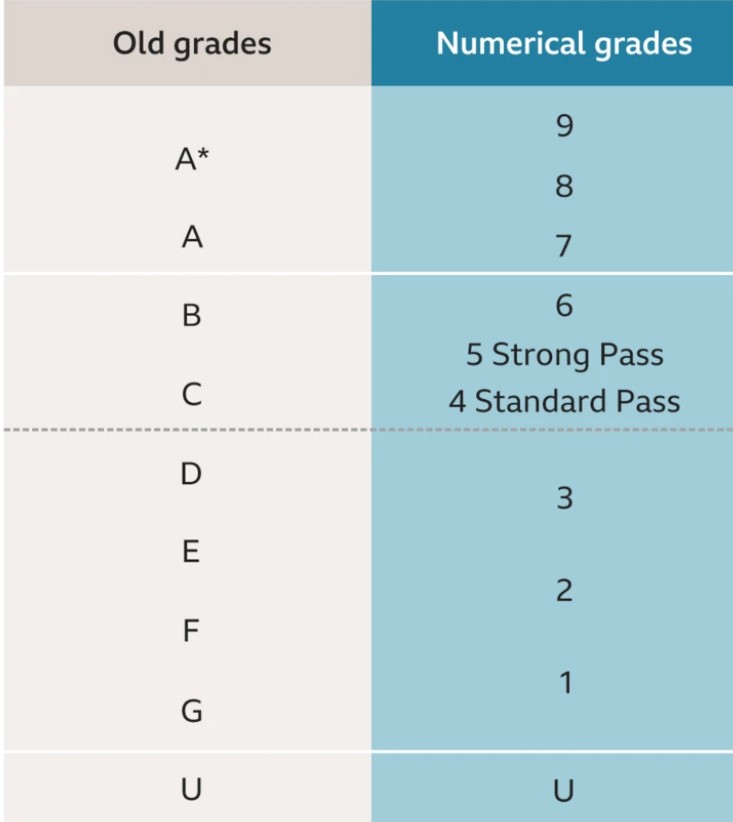
At Key Stage 4 we follow the national GCSE grading system of 9-1. This was brought in for English and Maths in 2017 and for other subjects in the 2 years that followed. It replaced the A*-G system that previously existed. Please see the chart for a comparison between the two systems.
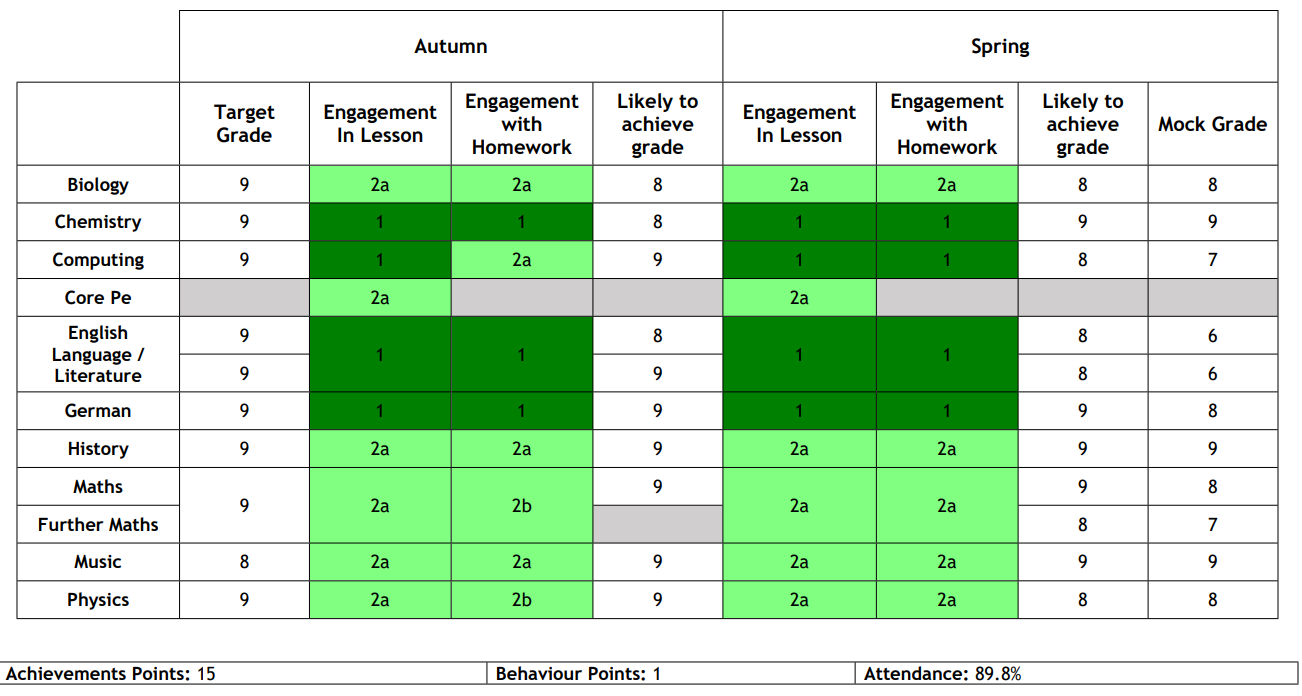
Each term, students will be given a 'LAG' for attainment. LAG stands for Likely to Achieve Grade. It is obviously the case that students aren't able to do final exams after just one or two terms. However, they will, of course, do assessments along the way. The LAGs that teachers give students for each subject are what we think they will achieve if they continue to progress in the same way by the end of the course. They are a predicted grade for the whole two years of the course. They can, and do, change as students get further into each course.
Students are also given grades for assessments taken in the Summer term of Year 10 and the mock exams in the Spring term of Year 11. Those grades are relevant to that individual point in time; i.e. they are not predicted grades like the LAGs. They do, of course, feed into the LAGs that teachers give.
Example Spring data set for Year 11.
Key Stage 4 Data and Assessment FAQs:
How do the 1–3 engagement grades work?
In contrast to the attainment descriptors and LAGs, where there are different systems in different year groups, the engagement grades are the same across the whole school. Teachers give one engagement grading of 1–3 once a term for work done in class, and one for homework. The data report letter explains what the descriptors mean; what is expected of a Year 7 is obviously not the same as for a Year 13, but the descriptors do take this into account. Teachers read the descriptors and apply them according to a policy of best fit. Our expectation is for a 2a. Where students receive a 2b, this will be followed up internally. A 3 will result in contact being made with home. Students can, of course, achieve a 1. Judging the amount of effort that goes into homework is obviously difficult to do, but what is possible is assessing if it is always done, is it on time, what its quality is, and then, higher up the school, does it show evidence of extra reading/effort.
How is data checked/followed up in school?
Heads of Department check the data for their own subject areas. They do this to see if there are any differences between different classes, and, where there are, they investigate them. At departmental meetings, data is regularly discussed to ensure that everybody is working to the same criteria. We use a data analysis tool in school to help do this in more depth. Heads of Department can also see the data for other departments to see how it compares. Heads of Year also get involved in the process. Where there are any issues, subject teachers, heads of department, tutors or heads of year will have follow-up conversations with students, depending on the nature of the issue. At least once a year, we hold a ‘data summit’ for each year group. At these meetings, members of the leadership team responsible for data analysis, heads of year, the SENDCO and school safeguarding lead discuss the data from different points of view, and again there are interventions with students as appropriate.
How should I read the termly data sheets?
Students receive a LAG and two engagement grades each term. By the summer term, the table has been filled, i.e. the data from the previous two terms can still be seen for comparison. When it comes to the engagement grades, we expect a grade 2a. If this is what students are achieving, this is fine. If they get 1s, that is fantastic, but we are perfectly happy with a 2a. It is natural for students to have more interest in some subjects than others, and getting a 1 for both categories for all subjects isn’t realistic. If there is a drop-off in engagement, this will be followed up in school, but it is also something that students can talk about with their parents. The attainment descriptors/LAGs can also go up or down and can also be the starting point for conversations with parents. The LAGs can be compared to the target grades for either GCSE or A Level. If parents/students don’t understand any of the engagement grades/LAGs/attainment descriptors they have been given, they can, of course, ask teachers in class, or contact them to ask for an explanation.
What are LAGs?
LAGs are Likely to Achieve Grades. When students are in Years 10-11, and then 12–13, they receive 5 LAGs over the 5 full terms they are in school for those courses. These are the grades that teachers think students are likely to achieve, if they carry on working in the same way, by the end of the course, GCSE or A Level. Students don’t know all the content and skills required to complete either GCSEs or A Levels until they have completed the courses. Teachers use their professional judgement to allocate LAGs, taking into account progress in class, homework, tests and assessments, in addition to comparable progress with previous cohorts of students. This is where our internal data analysis tools come in very helpful. These LAGs can go up or down depending on how students progress. They should be more accurate towards the end of the courses, as teachers have increasing amounts of information to go on.
How are targets set for students in Years 10 and 11?
When students are in Year 6, the majority of them do SATs. These tests are used not only to see how they are doing at primary school, but also by the government to predict what they will get at GCSE, so that their progress relative to their starting point (Year 7) and end point (Year 11) can be judged. Each student has a data profile based upon their performance in Reading and Maths which is compared to that of many thousands of students who went before them and used to come up with targets. It is important to recognise that a student’s data profile doesn’t reflect an ability or interest in a subject. It might also be the case that students work harder at GCSE for the subjects they are planning to take for A Level. These target grades do not pre-determine LAGs or GCSE grades; rather, they are used as a tool for students to challenge themselves and to have useful discussions with their teachers about their courses. For any students who didn’t do the SATs at primary school, we use CAT tests (Cognitive Aptitude Tests) to fill in the gaps.
What grades do students achieve for GCSE at AHS?
The average grade students at AHS achieve at GCSE across all subjects is a grade 7. This is a very high average, and illustrates just how much progress students make across all subjects.
How are students assessed in Years 10-11?
Students will still be assessed both summative and formatively when they start their GCSEs. They will be guided over the duration of their courses as to what they will be assessed on and how this will be done in each subject. There is a formal Year 10 exam week in the summer term where grades 9–1 are given. Grades 9–1 may be given at other times during the course of the year, depending on the department. What must be borne in mind is the fact that grades are only really 100% applicable at the end of a course – teachers use their professional judgement, moderate work internally and use exam board guidance when deciding on interim grades. Once in Year 11, students have a mock exam period shortly after the Christmas holidays. This will highlight strengths and areas to focus on for the remainder of their time in school. All departments provide access to past papers and guidance on exam technique.
Key Stage 5 attainment
At Key Stage 5, we follow the national A Level grading system of A*-E.
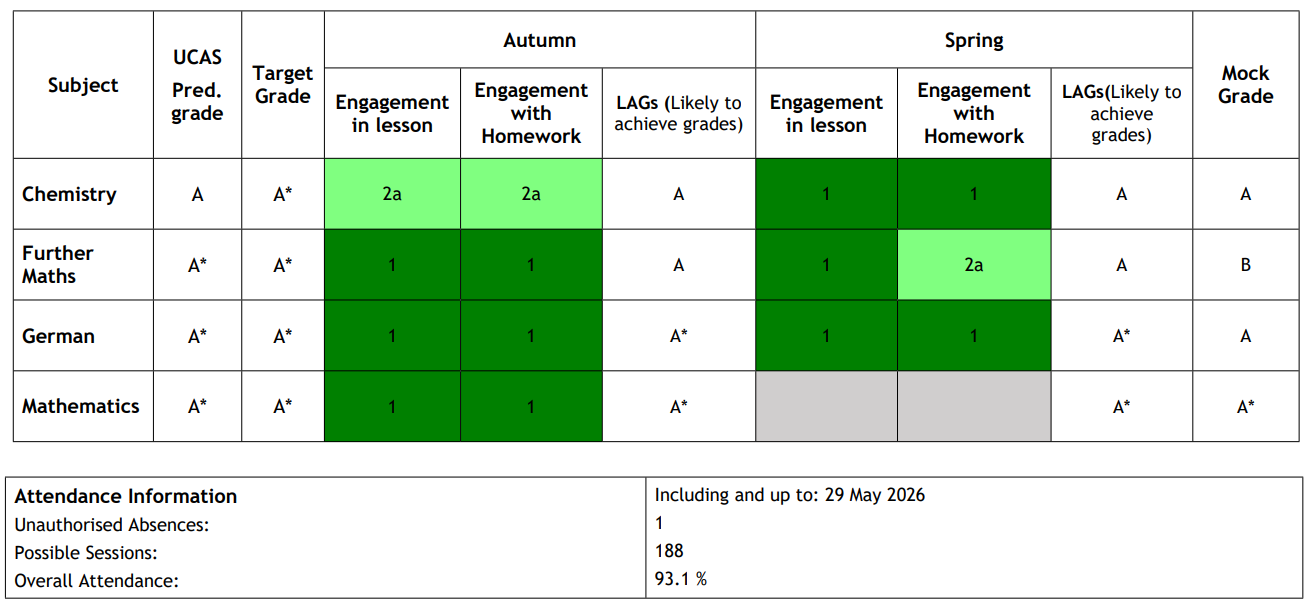
Each term, students will be given a 'LAG' for attainment. LAG stands for Likely to Achieve Grade. It is obviously the case that students aren't able to do final exams after just one or two terms. However, they will, of course, do assessments along the way. The LAGs that teachers give students for each subject are what we think they will achieve if they continue to progress in the same way by the end of the course. They are a predicted grade for the whole two years of the course. They can, and do, change as students get further into each course.
Students are also given grades for assessments taken in the summer term of Year 12 and the mock exams in the spring of Year 13. Those grades are relevant to that individual point in time; i.e. they are not predicted grades like the LAGs. They do, of course, feed into the LAGs that teachers give. Students are also given UCAS grades at the end of Year 12 which they can use with their university applications.
Key Stage 5 Example data set Spring Y13.
Key Stage 5 Data and Assessment FAQs:
How do the 1–3 engagement grades work?
In contrast to the attainment descriptors and LAGs, where there are different systems in different year groups, the engagement grades are the same across the whole school. Teachers give one engagement grading of 1–3 once a term for work done in class, and one for homework. The data report letter explains what the descriptors mean; what is expected of a Year 7 is obviously not the same as for a Year 13, but the descriptors do take this into account. Teachers read the descriptors and apply them according to a policy of best fit. Our expectation is for a 2a. Where students receive a 2b, this will be followed up internally. Where they receive a 3, contact will be made with home. Students can, of course, achieve a 1. Judging the amount of effort that goes into homework is obviously difficult to do, but what is possible is assessing if it is always done, is it on time, what its quality is, and then, higher up the school, does it show evidence of extra reading/effort.
How is data checked/followed up in school?
Heads of Department check the data for their own subject areas. They do this to see if there are any differences between different classes, and, where there are, they investigate them. At departmental meetings, data is regularly discussed to ensure that everybody is working to the same criteria. We use a data analysis tool in school to help do this in more depth. Heads of Department can also see the data for other departments to see how it compares. Heads of Year also get involved in the process. Where there are any issues, subject teachers, heads of department, tutors or heads of year will have follow-up conversations with students, depending on the nature of the issue. At least once a year, we hold a ‘data summit’ for each year group. At these meetings, members of the leadership team responsible for data analysis, heads of year, the SENDCO and school safeguarding lead discuss the data from different points of view, and again there are interventions with students as appropriate.
How should I read the termly data sheets?
Students receive a LAG and two engagement grades each term. By the summer term, the table has been filled, i.e. the data from the previous two terms can still be seen for comparison. When it comes to the engagement grades, we expect a grade 2a. If this is what students are achieving, this is fine. If they get a 1, that is fantastic, but we are perfectly happy with a 2a. If there is a drop-off in engagement, this will be followed up in school, but it is also something that students can talk about with their parents. The attainment descriptors/LAGs can also go up or down and can also be the starting point for conversations with parents. The LAGs can be compared to the target grades for either GCSE or A Level. If parents/students don’t understand any of the engagement grades/LAGs/attainment descriptors they have been given, they can, of course, ask teachers in class, or contact them to ask for an explanation.
What are LAGs?
LAGs are Likely to Achieve Grades. When students are in Years 10-11, and then 12–13, they receive 5 LAGs over the 5 full terms they are in school for those courses. These are the grades that teachers think students are likely to achieve, if they carry on working in the same way, by the end of the course, GCSE or A Level. Students don’t know all the content and skills required to complete either GCSEs or A Levels until they have completed the courses. Teachers use their professional judgement to allocate LAGs, taking into account progress in class, homework, tests and assessments, in addition to comparable progress with previous cohorts of students. This is where our internal data analysis tools come in very helpful. These LAGs can go up or down depending on how students progress. They should be more accurate towards the end of the courses, as teachers have increasing amounts of information to go on.
How are targets set for A Level students?
The grades that students get for their GCSEs are compared with the grades that many thousands of students before them got for their GCSEs in the same subjects. (Not just at AHS but across the whole country). The data is then crunched and predictions are made for each student in each subject. Even when students get 10 grade 9s at GCSE, it doesn’t guarantee A* predictions across the board. This might seem strange, but it is based upon the fact that A Levels are difficult and that for students to get the very top grades, which our students frequently do in all subjects, they have to make better than the expected progress. It is important to recognise that a student’s data profile doesn’t reflect an ability or interest in a subject. It might also be the case that students worked harder at GCSE for the subjects they were planning to take, and yet their data profile involves all of their subjects. These grades have no bearing on LAGs or UCAS grades, rather they are used as a tool for students to challenge themselves and to have useful discussions with their teachers about their courses.
How do we calculate UCAS grades, and are they final?
UCAS grades are given out at the end of the Summer term. These are the predicted grades which we send to universities when students are applying for places. Year 12 students do exams in the Summer term, and these exams do, of course, play a role in the allocation of the UCAS grades. However, classwork, homework and other assessments from the whole year are taken into account when teachers make their decisions. Teachers are encouraged to be ‘realistically optimistic’ about these grades. It is important to our reputation that our predicted grades are respected, i.e. if universities know that our predictions are made properly, they are more likely to take them seriously. UCAS grades are sometimes changed in the Autumn term if teachers feel that the appropriate progress has been made and can be evidenced.
What grades do students achieve for A Level at AHS?
The average grade students at AHS achieve at A Level is a grade B. This is a very high average, and again illustrates just how much progress students make across all subjects. Students achieve up to and including A* grades in all the different subjects that we offer. The grades students achieve mean that a very high percentage of them are able to accept their first choice university offers.
How are students assessed in the Sixth Form?
Students will continue to be assessed both summative and formatively once they start their A Levels. Students will once again be guided through their courses by their subject teachers, a principal difference at A Level being smaller class sizes which allow for greater student-teacher interaction. In November of the first Autumn term, students have a formal assessment point which we call November tests. These tests act as a useful way of highlighting strengths and areas for improvement. By this time, students should have settled into their courses and know what to expect from the types of assessment they will face. At the end of the Summer term, they have a formal exam period. At this time, they are given grades A*-E for their performance. These grades help to inform the UCAS grades which students need to get into university. They are not the only factor, however. Students' performance in tests, assessments, homework and class work will also play a role in the decision-making process. In the Spring term of Year 13, just before the February half-term, students will sit mock exams which are also graded. The information gleaned from these exams will allow students to focus on key areas ahead of their real exams in May and June.