Skip to content
  • Dance

    Dance is a dynamic and creative subject that enables students to develop both their physical and creative skills. Through Dance, students are able to explore how movement can be used as a powerful form of communication, helping them to understand storytelling, the ability to express ideas and also to deepen their understanding of emotions and human experiences. 

    Our Dance curriculum provides students with the opportunity to create and perform their own choreography as well as understand the importance of appreciating work. This encourages independence, imagination and self expression allowing for our students to become holistic learners. By making creative choices and developing original work, students gain confidence in expressing themselves while nurturing their artistic voice. 

    Dance is a highly valued subject that not only promotes creativity but also promotes a healthy and active lifestyle. This supports students' physical wellbeing alongside allowing them to build creativity, collaboration and resilience. The skills developed through Dance are highly transferable, enhancing learning across many other subjects and preparing students with valuable life skills that extend beyond the classroom. 

    Beyond the classroom, students have access to a wide range of extra curricular opportunities to allow them to further develop their skills and passion for Dance. These include House Dance competitions, Commercial Dance Club, School Productions, Local Dance Festivals and the participation in Great Big Dance Off. These experiences provide students with additional performance opportunities allowing them to build confidence, foster teamwork and inspire a life long love of Dance.

    Student resources

    The Google Drive and Clickview are only available for students and teachers of Aylesbury High School. The Google Drive contains all Google-based resources used in lessons. 

    The other quick links are to websites we subscribe to with extra resources, students have their own login details given to them by the school. 

    AHS only resources Web based quick links

    Web based quick links

    Dance links & resources

    Subject intent

    Key Stage 3 

    Key Stage 3 lessons aim to introduce and develop key performance and choreography skills that will form the basis of their Dance experience.

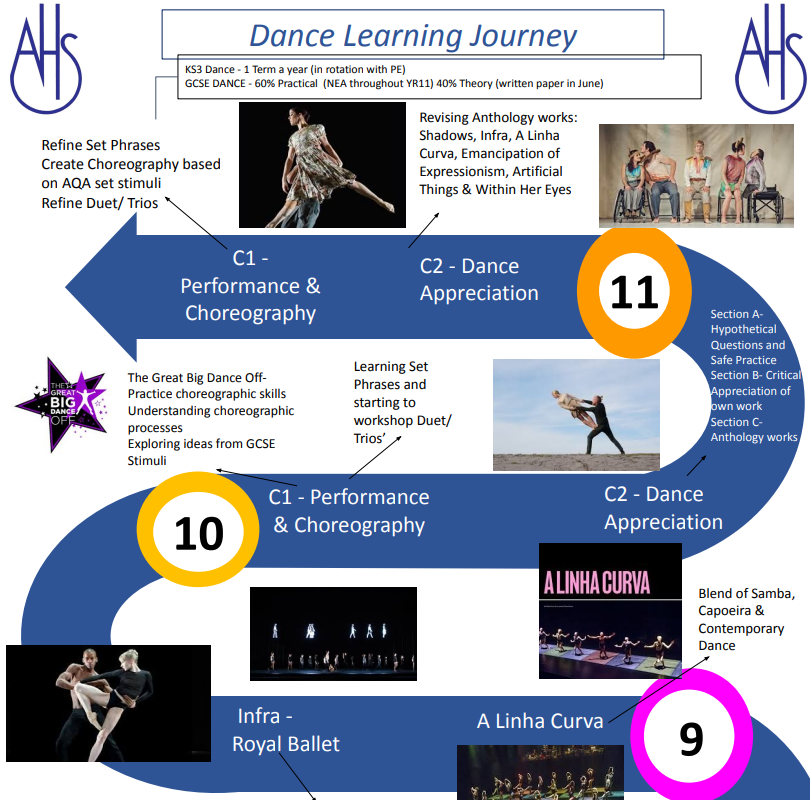
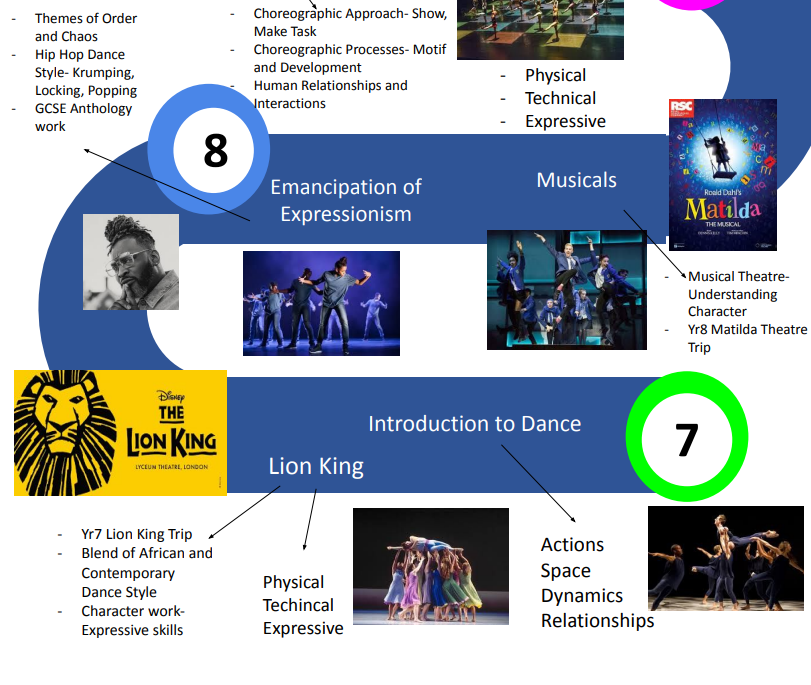
    Year 7 begins with ‘An Introduction to Dance’ which introduces them to the fundamentals of choreography such as action, space, dynamics, & relationships. Students build confidence and communication skills by exploring a variety of lifts and contact work. The students then take a mixture of taught choreography and their own work and contribute these ideas to an ensemble piece.

    Lessons in Year 8 and 9 aim to expand upon the skills introduced in Year 7 independently as they apply them to a range of new dance styles and professional works including The Lion King and Rambert.

    Co-curricular opportunities include; Key Stage 3 Dance Club (led by Sixth Form Dance ambassadors), Commercial Dance Club (led by dance coach Jo Odro) & House Dance.

    Key Stage 4

    Key Stage 4 lessons take key performance and choreography skills established within the Key Stage 3 curriculum and apply them to the demands of the GCSE specification.

    Year 10 works on building students' independent choreography skills and solo performance skills through solo choreography tasks and learning two solo set phrases. Students also learn the importance of performing as part of a large ensemble as well as a smaller trio, exploring a range of styles and choreographic intentions. Students also have the opportunity to build their understanding of dance terminology, choreographic processes, performing skills and appreciation of their own work through theory-based practice. Students are introduced to the GCSE Dance Anthology and interpret, analyse and evaluate six professional dance works including pieces performed by The Royal Ballet & Rambert.

    Year 11 is all about rehearsing and refining the solo and trio performance taught in Year 10. Students learn about rehearsal techniques and work on improving key performance skills. The GCSE choreography question is released at the start of Year 11 and students apply all their knowledge of choreographic processes and skills when responding to stimuli. All practical work is filmed as part of a controlled assessment and sent off to AQA for moderation. Theory-based work centres around developing writing skills through appreciation of your own work and professional dance work.

    Co-curricular opportunities include: Commercial Dance Club, House Dance, lunchtime support clubs for GCSE focusing on both performance and choreography, performance opportunities in the national competition “Great Big Dance Off”, an annual trip to Move It Dance Convention & Key Stage 4 specific theatre trips.

    Key Stage 3 (Years 7-9) course implementation, learning journey & attainment.

    Course content

    Year 7 Year 8 Year 9

    Introduction to Dance

    • Students develop their core dance skills, including the use of varied action, dynamic, spatial & relationship content within choreography. They understand what safe practice looks like in dance and develop their teamwork skills whilst developing their performance skills whilst working as part of a group. 

    The Lion King

    • Here, we explore the importance of movement in The Lion King and how it helps communicate character and storyline. Students learn set movement from The Lioness Hunt, as well as choreographing original movement which embodies the key characteristics of the lioness.

    Emancipation of Expressionism by Boy Blue Entertainment

    • Choreographer Kenrick H20 Sandy presents a work which explores themes of order and chaos & having the freedom to express individuality. Students work on this through creating an ensemble performance in an urban dance style that focuses on these key themes.

         Musical Theatre

    • Students explore a variety of different musicals, learning choreography inspired to show different characters and subject matter. Students have the opportunity to learn repertoire as well create new choreography, understanding the importance of choreographic processes and how to apply these to different themes. Students have the opportunity to choose and research in depth a musical to perform for their assessment.

    A Linha Curva by Rambert

    • This topic focuses on celebrating the vibrant culture of Brazilian life with themes of Samba parades and carnival seen throughout. Students create a whole-class ensemble piece using a variety of choreographic techniques and samba-infused dance styles to replicate Rambert’s original production.

    Infra by The Royal Ballet Choreographer Wayne McGregor

    • Presents a work performed by The Royal Ballet & inspired by human relationships and interactions, specifically after The London Bombings in 2007. Students focus on using motif development in a variety of choreographic tasks based around key themes presented in Infra. Performance focusses on students' ability to convey emotion and sensitivity to other dancers through communicating different human relationships and interactions.

    Learning Journey

    At Key Stage 3, Dance attainment descriptors are split into 4 skill categories.

    Physical

    • Posture
    • Alignment
    • Balance
    • Coordination
    • Control
    • Flexibility
    • Mobility
    • Strength
    • Stamina
    • Extension
    • Isolation

    Technical

    • Action Content
    • Dynamic Content
    • Spatial Content
    • Relationship Content 
    • Timing Content
    • Rhythmic Content
    • Movement in a stylistically accurate way

    Expressive

    • Projection
    • Focus
    • Spatial Awareness
    • Facial Expressions
    • Phrasing
    • Musicality
    • Sensitivity to other dancers
    • Communication of choreographic intent

    Mental

    • Movement memory
    • Commitment
    • Concentration
    • Confidence
    Working Towards

    Year 7 attainment descriptors

    In Year 7, this is how the attainment skills are organised.

    Working Towards
    Physical Technical Expressive Mental
    • I am showing some evidence of using physical skills such as balance in my performance to enhance the qualities of lions.
    • I am using some dynamics in my performance to enhance the qualities of Contemporary and African stylistic features. 
    • My timing in some of the dances is accurate, and I am starting to explore elements of actions, space and relationships.
    • I am starting to embody the characteristics of the lions in the lioness hunt, but this isn’t consistent throughout.
    • I am remembering most of the choreography and performing with some confidence.
    • I am able to start to contribute ideas to the group. 
    Working At
    Physical Technical Expressive Mental
    • I am starting to use a variety of physical skills to enhance my performance.
    • I am able to control all my movement throughout.
    • I am starting to vary the dynamics in my performance to enhance the qualities of Contemporary and African stylistic features. 
    • My timing is accurate for the majority of the performance, and I am able to highlight African and Contemporary stylistic features. I am using the majority of the content from actions, space and relationships learnt in class.
    • I am embodying characteristics of the lions by using focus and musicality. 
    • I am using some facial expressions to enhance my character.
    • I am able to perform the choreography confidently and start to offer multiple ideas to the group.
    Working Beyond
    Physical Technical Expressive Mental
    • I am performing with a strong use of physical skills consistently to draw the attention of the audience.
    • I am using a variety of dynamics in my performance to enhance the qualities of Contemporary and African stylistic features. 
    • My timing is accurate throughout the performance, and I am performing in a stylistically accurate way. 
    • My choreography is also highlighting a range of action, spatial and relationship content.
    • I am embodying the characteristics of the lions consistently throughout my performance 
    • I use facial expressions throughout to enhance the character of the lion.
    • I am performing with complete confidence and have the ability to retain all the choreography accurately.
    • I have taken on a leadership role within my group and highlight my commitment to the process.

    Year 8 attainment descriptors

    In Year 8, this is how the attainment skills are organised.

    Working Towards
    Physical Technical Expressive Mental
    • I am showing some evidence of using physical skills such as balance in my performance to enhance the hip-hop style.
    • I am able to understand the importance of some physical skills and their impact.
    • I am using some dynamics in my performance to enhance the qualities of my Hip-Hop style
    • My timing in some of the dances is accurate, and I am starting to explore elements of actions, space and relationships.
    • I am starting to embody the characteristics explored in E of E, but this isn’t consistent throughout. 
    • I am starting to understand why expressive skills are important in expressing choreographic intent.
    • I am remembering most of the choreography and performing with some confidence.
    • I am able to start to contribute ideas to the group.
    Working At
    Physical Technical Expressive Mental
    • I am starting to use a variety of physical skills to enhance my performance.
    • I am able to understand the importance of most physical skills and their impact.
    • I am starting to vary the dynamics in my performance to enhance the qualities of the Hip Hop style.
    • My timing is accurate for the majority of the performance, and I am able to highlight the stylistic features of hip-hop dance.
    •  I am using the majority of the content from actions, space and relationships learnt in class and starting to come up with interesting ways to utilise these.
    • I am highlighting the theme of order through the use of my focus in the dance. 
    • I am using some facial expressions to enhance my character and show the choreographic intent of an emotional journey. 
    • I am able to identify most of the expressive skills and how these are important in expressing the choreographic intent.
    • I am able to perform the choreography confidently and start to offer multiple ideas to the group.
    Working Beyond
    Physical Technical Expressive Mental
    • I am performing with a strong use of physical skills consistently to draw the attention of the audience. 
    • I am able to identify all the physical skills needed to enhance my performance and reflect on why these are important in dance.
    • I am using a variety of dynamics in my performance to enhance the qualities of the hip-hop dance style as well as the theme of order and chaos. 
    • My timing is accurate throughout the performance, and I am performing in a stylistically accurate way. 
    • My choreography is also highlighting a complex range of action, spatial and relationship content.
    • I am using all expressive skills consistently throughout my performance to enhance the effect on the audience.
    • I am able to explain all the expressive skills and the impact on how these aid expressing the choreographic intent
    • I am performing with complete confidence and have the ability to retain all the choreography accurately.
    • I have taken on a leadership role within my group and highlight my commitment to the process.

    Year 9 attainment descriptors

    In Year 7, this is how the attainment skills are organised.

    Working Towards
    Physical Technical Expressive Mental
    • I am showing some evidence of using physical skills such as balance and extension in my performance to enhance the samba style.
    • I understand why some of the physical skills are important and how I can apply these to my performance.
    • I am using some dynamics in my performance to enhance the qualities of samba and contemporary dance.
    • My timing in some of the dances is accurate, and I am starting to explore elements of actions, space and relationships within my own choreography.
    • My movement is reflecting some of the accuracy of the style.
    • I am starting to embody the characteristic of having fun in ALC, but this isn’t consistent throughout.
    • I understand why expressive skills are used. 
    • I am remembering most of the choreography and performing with some confidence.
    • I am able to start to contribute ideas to the group for the group work.
    Working At
    Physical Technical Expressive Mental
    • I am starting to use a variety of physical skills to enhance my performance.
    • I am able to control all my movement throughout and show the isolations in my body. 
    • I understand why most of the physical skills are important and how I can apply these to my performance.
    • I am starting to vary the dynamics in my performance to enhance the qualities of samba dance.
    • My timing is accurate for the majority of the performance, and I am able to highlight the stylistic features of samba dance. I am using the majority of the content from actions, space and relationships learnt in class. 
    • My movement reflects most of the accuracy of the style.
    • I am highlighting the fun through the use of my focus in the dance. 
    • I am using some facial expressions to enhance my character and show the choreographic intent of having fun and the celebrations involved in the samba parades. 
    • I understand why expressive skills are used and how they have an effect on the choreographic intent.
    • I am able to perform the choreography confidently and start to offer multiple ideas to the group. 
    • I understand the importance of commitment in dance and commitment to my group.
    Working Beyond
    Physical Technical Expressive Mental
    • I am performing with a strong use of physical skills consistently to draw the attention of the audience. 
    • I understand why all the physical skills are important and how I can apply these to my performance.
    • I am using a variety of dynamics in my performance to enhance the qualities of the samba dance style as well as the theme of having fun. 
    • My timing is accurate throughout the performance, and I am performing in a stylistically accurate way. 
    • My choreography also highlights a range of action, spatial and relationship content. 
    • My movement is stylistically accurate throughout.
    • I use all expressive skills consistently throughout my performance to enhance the effect on the audience.
    • I understand the importance of all expressive skills and the impact of each skill.
    • I am performing with complete confidence and have the ability to retain all the choreography accurately.
    • I have taken on a leadership role within my group and highlight my commitment to the process. 
    • I am able to understand the importance of mental skills within Dance.

    Key Stage 4 (Years 10-11) course implementation, learning journey & assessment info.

    Course content

    Year 10 Year 11

    Component 1: Performance and choreography

    Introduction to performance

    • Students learn the two set phrases and rehearse and refine both phrases throughout the year, in preparation for assessment in Year 11.

    • Students experiment with ensemble work and duet/trio work. They will learn teacher-led movement as well as develop key motifs from two of the other set solo phrases and their own choreography, deepening their creative skills. 

    Introduction to choreography

    • Students will create a piece of solo choreography using the current Year 11 exam question as their stimulus. Students will learn about choreographic processes such as motif development, structure and choreographic devices.

    • Students also have choreographic opportunities through their exploration of work created in performance in a trio.

     Component 2: Dance appreciation

    • Knowledge and understanding of choreographic processes and performing skills

    • Critical appreciation of own work (performance and choreography)

    • Critical appreciation of professional works from Dance Anthology

    Component 1: Performance and choreography

    CONTROLLED ASSESSMENT – Filmed throughout the year and sent for external moderation

    Performance 30%

    • Two set phrases through a solo performance (approximately one minute in duration)

    • Duet/trio performance (3–5 minutes)

    Choreography 30%

    • Solo or group choreography based on a variety of stimuli set by the exam board – a solo (two to two and a half minutes) or a group dance for two to five dancers (three to three and a half minutes)

    Component 2: Dance appreciation 40%

    Written exam: 1 hour 30 minutes (summer exam time)

    • Knowledge and understanding of choreographic processes and performing skills

    • Critical appreciation of own work (performance and choreography)

    • Critical appreciation of professional works from Dance Anthology

    Learning journey

    This link takes you to the AQA specification for GCSE Dance, which contains all of the necessary course information. Assessments take place throughout the 2 years of the course, in addition to Year 10 exams and mocks in the spring term of Year 11. 

    How will I be assessed?

    Component 1 60% Component 2 40%

    Performance 30%

    • Set phrases through a solo performance (approximately one minute in duration)

    • Performance in a duet/trio

    Choreography 30%

    • Solo or group choreography in relation to a stimulus set by the exam board

    Written exam – 1 hr 30 minutes 

    • Section A: Knowledge and understanding of choreographic processes, performing skills & safe practice

    • Section B: Critical appreciation of own work (performance & choreography)

    • Section C: Critical appreciation of six professional dance works….

    • Artificial Things by Stopgap Dance Company

    • A Linha Curva by Rambert

    • Emancipation of Expressionism by Boy Blue Entertainment 

    • Infra by The Royal Ballet

    • Shadows by Phoenix Dance Theatre

    • Within Her Eyes by James Cousins

    Subject impact

    Key Stage 3
    • Dance is introduced as a new skill set in Year 7 and allows students of all abilities to challenge themselves appropriately in lessons. As students gain more confidence in the core skills, they are then applied to a range of dance styles, dance ideas and choreographic tasks throughout the course of Key Stage 3, allowing them to make effective progress.

    • Students are able to develop their confidence in performing whilst choreography tasks provide an excellent opportunity for students to be creative whilst working as part of a team. Students also gain an appreciation for dance by analysing professional dance works and use these analysis skills to evaluate their own performance and their peers' performance during lessons.

    • GCSE set works are gradually introduced to students in Year 8 and throughout Year 9, allowing them to get a preview of what it would be like to study GCSE Dance as a subject in Key Stage 4. On top of this, popular Musical Theatre productions are introduced to students to develop and foster a love for the arts.

    Key Stage 4
    • At the start of Key Stage 4, students are introduced to the course by creating a whole-class performance which is entered into the national dance competition Great Big Dance Off. This allows students to strengthen their performance and choreography skills, all core skills which are integral to Component 1 of the course.
    • Students' confidence in performing is then developed further through the performance of two solo set phrases, a performance in a duet/trio and the exploration of solo choreography tasks in Year 10 followed by controlled assessment of either a solo or group choreography in Year 11.
    • Students explore the Dance Anthology, which features six professional dance works throughout the course of two years, through practical exploration tasks as well as theoretical analysis which supports their understanding in preparation for their C2 written exam.
    • Students analyse their own performance consistently throughout the course of the two years and learn how to apply this analysis to questions asked in Section B of the written paper on their own solo performance, group performance and choreography.

    Feedback in Dance lessons

    In Dance, you are assessed in Physical, Technical, Expressive and Mental Skills. We use these at Key Stage 3 as these are the skills needed for Key Stage 4. All students will have feedback on all these areas of focus. We also look at choreographic skills and the students' ability to create choreography.

    Activity Types of feedback

    Whole class feedback

    Whole class feedback can be used in multiple ways in Dance. When performing all together, whole class feedback can be given. If there are recurring areas to work in, this will be relayed through whole class feedback.

    Self-reflection All students have assessment trackers in Key Stage 3 and Key Stage 4. This is where students' assessment and feedback will be tracked. Students will have to reflect upon their own work based on the criteria laid out. Self-reflection is important for development of progression and allows students to identify their strengths and weaknesses.
    Peer reflection We use lots of peer feedback within Dance, especially practical work. Students will have the opportunity to give peers feedback based on criteria. This helps students with critical engagement and appreciation.
    Teacher feedback Written feedback is always given to the students at the end of a summative assessment. This is student specific feedback on how they performed in their assessment based upon the criteria. This is all logged on trackers in Key Stage 3 and Key Stage 4. Students will also receive teacher comments in class when the teacher comes around and works with the students.

    School values in Dance

    Boundless Aspiration Curious Engagement Resilient Bravery Selfless Generosity
    • Take the lead on group choreography tasks

    • Audition for House Dance

    • Ask and answer questions to further develop your subject knowledge and show your critical appreciation of choreography and performance

    • Attend co-curricular clubs 

    • Explore Creative Arts career opportunities

    • Be creative, take risks and don’t be afraid to try new dance styles

    • Have the courage to perform in front of your peers for feedback

    • Work through challenges and mistakes to produce a performance you are proud of

    • Volunteer to demonstrate, model or help others with performance and choreography tasks

    • Provide useful feedback that will help others improve 

    • Support each other during performances with enthusiasm and encouragement