Drama
Drama at AHS follows 3 exciting key threads; devising, script work and theatre history. Students learn that effective use of voice, movement and interaction are key skills in our diverse and fast-paced society and will learn as performers, designers and directors throughout their Drama journey to hone these practical skills. Supported by trips and competitions, there is something for everyone, whether you dream of seeing your name in lights or you simply want to develop your confidence and public speaking, work with like-minded teams or flex your creative muscles.
Student resources
The Google Drive and Clickview are only available for students and teachers of Aylesbury High School. The Google Drive contains all Google-based resources used in lessons.
The other quick links are to websites we subscribe to with extra resources. Students have their own login details given to them by the school.
| AHS only resources |
|---|
|
|


Extension work & wider reading at Key Stage 3 (Years 7-9)
If you have finished all the work set on Google Classroom/in lessons very quickly and/or if you’re looking for Drama things to do to stop you getting bored, try out some of these suggestions.
Reading for fun:
‘Dreadful Drama’
‘Ballet Shoes’ Noel Streatfeild
‘Gemma Noel’ Streatfeild
‘The Swish of the Curtain’ Pamela Brown
‘The Gifted, the Talented, and Me’ William Sutcliffe
‘King of Shadows’ Susan Cooper
Extension work & wider reading at Key Stage 4 (Years 10-11)
If you finish all the work set on Google Classroom very quickly and/or if you’re looking for Drama things to do to stop you getting bored, try out some of these suggestions.
Reading for fun:
‘The Story Behind Too Much Punch for Judy’ Mark Wheeler
‘Hard to Swallow, Easy to Digest’ Mark Wheeler
‘The Gifted, the Talented, and Me’ William Sutcliffe
‘King of Shadows’ Susan Cooper
‘An Awfully Big Adventure’ Beryl Bainbridge
‘Shakespeare’ Bill Bryson
Preparation work for A Level Drama
Books, journals, articles, films, YouTube, podcasts – it is all here – just find something that takes your fancy!
Fact files
Create a fact file of notes about three of these practitioners – they will all feature on the A Level course.
- Stanislavski
- Brecht
- Boal
- Artaud
- Declan Donellan / Cheek by Jowl
- Emma Rice / Kneehigh / Wise Children
- Steven Berkoff
- Katie Mitchell
- Frantic Assembly
- DV8
- Punchdrunk
- Complicite
- Rupert Goold
- Julie Taymor
For each of your chosen practitioners, make notes on the following:
- When were they working?
- What was theatre like before?
- Influences / inspirations
- Why did they want to change it / message? Ethos? Focus?
- Most common elements of the style
- Rehearsal style / techniques
- Do you like it?
- Find some examples (YouTube if possible OR pieces influenced by them if they are not currently alive!)
Watching Live Theatre
As in GCSE you will see the following key terms over and over at A Level.
- PERFORMER / DIRECTOR
- Motivation
- Voice
- Movement
- Interaction
- DESIGNER / DIRECTOR
- Stage shape
- Lighting
- Sound
- Costume, hair and makeup
- Set and props
Work your way through the 3 plays given below. We have chosen them because they are either:
a) are in the style of one of our practitioners / companies
b) they are directed by one of the practitioners / companies
c) are one of the set texts OR are available for you to perform
d) are just cool / fun / good pieces of theatre!
For each performance, keep a table, perhaps with notes for each of the above elements.
|
Things I know to be True |
Frantic Assembly (Digital Theatre +) |
|
Motivation |
It is clear the central character’s motivation... |
|
Voice |
A number of the characters use voice to... |
Change the colour for any ideas / concepts you really liked the look of because you have to create concepts for all 3 of the set texts!
‘Things I know to be true’ Digital Theatre Plus
‘Wuthering Heights’ Drama Online Library
‘Threepenny Opera’ Drama Online Library
Extension work & wider reading at Key Stage 5 (Years 12-13)
If you finish all the work set on Google Classroom very quickly and/or if you’re looking for Drama things to do to stop you getting bored, try out some of these suggestions.
A Level Reading list
Antonin Artaud: The theatre and its double
Blows and Bombs
Artaud on Theatre
Bermel Artaud's Theatre Of Cruelty
Stanislavski: An actor prepares
Building a character
Creating a role
The Complete Stanislavsky toolkit
It all starts with imagination
Brecht: Brecht on theatre
The complete Brechtian toolkit
Boal Theatre of the Oppressed
Boal The Rainbow of Desire: The Boal Method of Theatre and Therapy
Boal Games for Actors and Non-Actors
The Frantic Assembly book of devising theatre
Physical Theatres: A critical introduction
Declan Donnellan: The actor and the target
The Punchdrunk Encyclopaedia
Steven Berkoff The theatre of Steven Berkoff
Graft: Tales of an actor
Katie Mitchell: The director’s craft: A handbook for theatre
The Theatre of Katie Mitchell
DVDs: DV8: Dead Dreams
DV8: Three Ballets
National Theatre of Scotland: Black Watch
Steven Berkoff: Metamorphosis
The Cat in the Hat Dir Katie Mitchell
Written on Skin Dir Katie Mitchell
Digital Theatre Plus
Reading for fun – all available in the Library
‘Sweet Sorrow’ David Nicholls
‘The Year of the King’ Anthony Sher
‘Balancing Acts’ Nicholas Hynter
Subject intent
Key Stage 3
Key Stage 3 lessons are designed to build on what learners might have covered at Key Stage 2, empower students and enable them to become confident individuals, effective contributors and successful learners. The foundations for study at Key Stage 4 are laid, and transferable skills developed at every stage.
-
Year 7 ‘An Introduction to Drama and Devising’ will equip students with the basic Drama skills and techniques they will develop throughout their Drama journey. Through these techniques, learners explore the transition process to secondary school and develop their confidence and teamwork skills as well as the importance of mutual respect and active listening. The techniques covered will be explored and assessed in mini-devised performances.
-
Lessons in Year 8 and 9 encourage students to use their Drama skills and techniques independently as they explore devising projects and scripts as well as a particular period in theatrical history.
Co-curricular opportunities include KS3 Drama Club, ESU Performing Shakespeare Competition, Joint School Musical with AGS, trips to London musicals and local theatre venues, and House Drama, aimed at fostering a love for theatre and performance.
Key Stage 4
The skills covered in Key Stage 3 form the basis of learning at GCSE level and are developed further as the focus shifts to include the specific study of theatre practitioners, devising from a stimuli, performing from a script and reviewing live theatre.
-
Lessons in Year 10 aim to establish a positive working environment and introduce students to key practitioners and new styles of work. The devising skills introduced in Key Stage 3 are central to the exploration of mock-exam stimuli and students are also prepared for GCSE assessment with a mock scripted performance. Our exploration of the set text, Shakespeare’s ‘Macbeth’, allows students total creative freedom as they practically examine the text and create their own concept of the play.
-
In Year 11 formal assessment forms the core of the lessons where students are given the opportunity to create and perform a devised piece in the style of the practitioner or company and an extract of a published script. By the end of the key stage, students will have the skills and knowledge needed to further their studies at Key Stage 5, should they choose to.
Co-curricular and enrichment opportunities include working with an established theatre company in the study of the practitioner Brecht, Digital Theatre recommendation, trips to see productions, both in London and in local venues which form part of the written exam.
Key Stage 5
The early part of the course serves as an introduction to the demands of the specification, highlighting and closing gaps from non-Key Stage 4 learners or external candidates. Content and outcomes are differentiated accordingly.
-
Students are able to explore, extend and consolidate their knowledge and understanding of a range of practitioners as well as establish a close and confident working relationship between the class. The curriculum is designed to prepare learners for further study at university or Drama School but also develops key transferable skills for the whole cohort.
-
In Component 1 students enjoy the freedom of devising their own work, using the techniques of a chosen practitioner, as well as a published script taking ownership of the ideas and final outcome.
-
Drawing on skills developed at GCSE, students practically explore 2 set texts for Component 3 and an extract from ‘The Curious Incident of the Dog in the nighttime’ (Summer 2026) and ‘The Book of Dust’ (Summer 2027 onwards) and prepare to answer the written paper as a director, designer or performer.
-
The culmination of A Level study in Year 13 is a final opportunity to showcase the skills developed across the Drama curriculum. Component 2 requires students to perform two pieces of their own creation, one devised and again, one from a script. Once again, the aim of this work is to provide students with total creative freedom and a sense of ownership and celebration on exam day.
Co-curricular opportunities are numerous and include roles as House Captain or Drama Ambassador. Students are also invited on several trips to the theatre to see inspiring and challenging performances, aimed at supporting their written work and performance ideas.
Key Stage 3 (Years 7-9) course implementation, learning journey & attainment.
Course content
| Year 7 | Year 8 | Year 9 |
|---|---|---|
|
|
|
Learning Journey
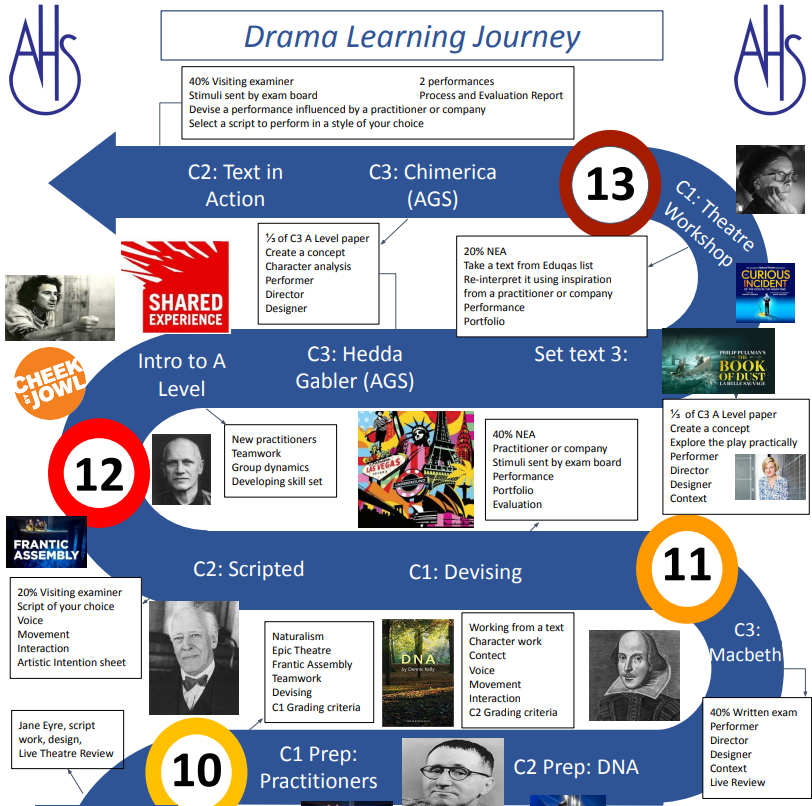
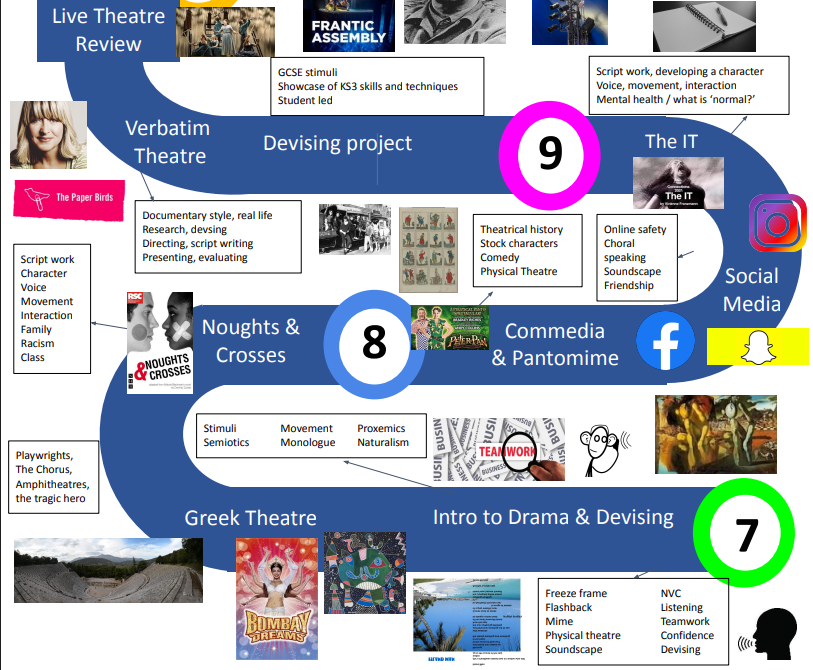
At Key Stage 3, we split the required skills for Drama into 3 categories:
- Making
- Performing
- Evaluating
We use 'I can' statements for the 3 attainment levels, WT/WA/WB.
Year 7 attainment descriptors
Working Towards
| Making | Performing | Evaluating |
|---|---|---|
|
|
|
Working At
| Making | Performing | Evaluating |
|---|---|---|
|
|
|
Working Beyond
| Making | Performing | Evaluating |
|---|---|---|
|
|
|
Year 8 attainment descriptors
Working Towards
| Making | Performing | Evaluating |
|---|---|---|
|
|
|
Working At
| Making | Performing | Evaluating |
|---|---|---|
|
|
|
Working Beyond
| Making | Performing | Evaluating |
|---|---|---|
|
|
|
Year 9 attainment descriptors
Working Towards
| Making | Performing | Evaluating |
|---|---|---|
|
|
|
Working At
| Making | Performing | Evaluating |
|---|---|---|
|
|
|
Working Beyond
| Making | Performing | Evaluating |
|---|---|---|
|
|
|
Key Stage 4 (Years 10-11) course implementation, learning journey & assessment info.
Course content
| Year 10 | Year 11 |
|---|---|
|
Introduction to GCSE Drama
Preparing for Component 1
Preparing for Component 2
Component 3 Interpreting Theatre In lessons we will practically explore the set text ’Macbeth’ and answer questions on it as either a director, designer or performer. You will watch a range of live theatre productions and develop review and analysis skills in order to prepare for Part B of the C3 exam paper. This will be examined at the end of Year 11. |
Component 1 Devising Theatre Students will participate in the creation, development and performance of a piece of devised theatre using the techniques of an influential practitioner in response to a stimulus chosen by Eduqas. You must produce:
Component 2 Performing from a text In this unit, you will perform 2 extracts from the same script for a visiting examiner. This is a script that you will select and study, covering the social, historical and cultural context as well as choosing appropriate lighting, sound and costume where necessary. |
Learning journey
This link takes you to the Eduqas specification for GCSE Drama, which contains all the necessary course information. Assessments take place throughout the 2 years of the course, in addition to Year 10 exams and mocks in the spring term of Year 11.
How will I be assessed?
| Component 1 - 40% | Component 2 20% | Component 3 40% |
|---|---|---|
|
NEA Internally assessed, externally moderated. Learners will be assessed on either acting or design. Learners participate in the creation, development and performance of a piece of devised theatre using either the techniques of an influential theatre practitioner or a genre, in response to a stimulus set by WJEC. Learners must produce: • a realisation of their piece of devised theatre • a portfolio of supporting evidence • an evaluation of the final performance or design |
NEA Externally assessed Learners will be assessed on either acting or design. Learners study two extracts from the same performance text chosen by the centre. Learners participate in one performance using sections of text from both extracts. |
Wriiten exam – 1 hr 30 mins Section A: A series of questions on one set text from a choice of seven: 1. Macbeth William Shakespeare 2. An Inspector Calls J.B. Priestley 3. Find Me Olwen Wymark 4. Noughts & Crosses Malorie Blackman, adapted by Sabrina Mahfouz 5. Refugee Boy Benjamin Zephaniah 6. I Love You Mum – I Promise I Won’t Die Mark Wheeller 7. The IT Vivienne Franzmann. Section B: Live Theatre Review One question, from a choice of two, requiring analysis and evaluation of a given aspect of a live theatre production seen during the course. |
Key Stage 5 (Years 12-13) course implementation, learning journey & assessment info.
In Key Stage 5 we currently offer both Grammar and High School students the Eduqas Drama and Theatre syllabus. The final stages of the AHS Drama Curriculum consolidate and celebrate the student’s journey, progress and achievements. Components require students to devise from a stimuli perform extracts from a script, and work with both ‘threads’ in a reinterpretation.
Course content
| Component 1 | Component 2 | Component 3 |
|---|---|---|
|
NEA: internally assessed, externally moderated Learners participate in the creation, development and performance of a piece of theatre based on a reinterpretation of an extract from a text chosen from a list. The piece must be developed using the techniques and working methods of either an influential theatre practitioner or a recognised theatre company.
|
Visiting examiner Learners participate in the creation, development and performance of two pieces of theatre based on a stimulus supplied by Eduqas
|
Written exam Study of 2 complete performance scripts and an extract from ‘The Book of Dust’. The majority of this component is taught at AGS with the exception of ‘Curious Incident’ / ‘The Book of Dust’. Just as in Key Stage 4 learners study all 3 scripts practically from the point of view of a designer, director and performer. In addition, the Component covers teaching of the social, political and historical context of each text, which learners might also be examined on. |
Learning journey
This link takes you to the Eduqas specification for A Level Drama, which contains all the necessary course information. Assessments take place throughout the 2 years of the course, in addition to Year 12 exams and mocks in the spring term of Year 13.
How will I be assessed?
| Component 1 - Theatre workshop 20% | Component 2 – Text in action 40% | Component 3 – Text in performance 40% |
|---|---|---|
|
NEA Internally assessed, externally moderated Learners will be assessed on either acting or design. Learners participate in the creation, development and performance of a piece of theatre based on a reinterpretation of an extract from a text chosen from a list supplied by WJEC. The piece must be developed using the techniques and working methods of either an influential theatre practitioner or a recognised theatre company. Learners must produce: • a realisation of the performance or design • a creative log. |
NEA Externally assessed Learners will be assessed on either acting or design. Learners participate in the creation, development and performance of two pieces of theatre based on a stimulus supplied by WJEC: 1. a devised piece using the techniques and working methods of either an influential theatre practitioner or a recognised theatre company (a different practitioner or company to that chosen for Component 1) 2. an extract from a text in a different style chosen by the learner. Learners must realise their performance live for the visiting examiner. Learners choosing design must also give a 5-10 minute presentation of their design to the examiner. Learners produce a process and evaluation report within one week of completion of the practical work. |
Written exam – 2hrs 30 mins Set Texts for assessment up to and including 2026 Two questions, based on two different texts, one written pre1956 and one written post-1956. Section A – Post - 1956 Saved, Edward Bond Accidental Death of an Anarchist, Dario Fo Racing Demon, David Hare Love and Information, Caryl Churchill Chimerica, Lucy Kirkwood The extracts will be printed in the examination paper. Candidates are not required to take in a clean copy of the set text. Section B – Pre - 1956 The Trojan Women, Euripides As You Like It, William Shakespeare, Hedda Gabler, Henrik Ibsen Machinal, Sophie Treadwell Cat on a Hot Tin Roof, Tennessee Williams Candidates are required to take a clean copy of the set text into the examination. Section C A question based on a specified extract from The Curious Incident of the Dog in the Night-Time, Mark Haddon, adapted by Simon Stephens. Details of the 10-15 minute extract will be released during the first week of March, in the year in which the examination is to be taken. A section of the extract will be printed in the examination paper. Candidates are not required to take in a clean copy of the set text. |
Subject impact
Key Stage 3
-
Year 7 SOW (Scheme of work) consolidated a smooth transition to AHS and developed key transferable skills such as confidence, teamwork and active listening as well as friendship, positive body language and non-verbal communication. Learner strengths and gaps were identified, and group work was adjusted accordingly.
-
Each Year group map included issue-based SOW, often real-life stories, which included links to L4L and highlighted British Values.
-
SOW across the Key Stage introduced learners to basic devising skills and techniques that will form the backbone of their AHS Drama journey as one of the key ‘threads’ and form part of the GCSE specification. Skills include freeze-frame and flashback, poetry, movement and choral speaking.
-
All Key Stage 3 learners worked with scripts, developing character, plot, context and design, the second ‘thread’ in the Drama curriculum.
-
In Year 9 the focus was on reviewing and analysing a performance, rather than performing it, developing skills for GCSE C3
-
Each Year group explored a key period and style in the development of theatre, Greek Drama, Commedia and Verbatim.
-
Every SOW in Key Stage 3 includes either a Career video ‘What’s the point?’ linking the particular skill with a career outside of Drama or a short interview with a professional in the PA industry.
Key Stage 4
-
The start of Key Stage 4 focussed on successful and smooth transition, with group devising tasks and small projects to refocus on effective teamwork, listening and confidence. Design skills, including lighting, sound, costume hair and make-up, set and props were briefly introduced to prepare for C3: Interpreting Theatre.
-
Students were introduced to key practitioners, Stanislavski, Brecht and Frantic Assembly and explored the relevant historical, cultural and social context. The corresponding styles of Naturalism, Epic Theatre and Physical Theatre were explored practically and students took part in a practitioner-led workshop.
-
Script work introduced in Key Stage 3 was developed with the study of a whole play, ‘DNA’ and a mini mock performance was performed in preparation for the C2 exam: Performing from a text. This revised the key terms of voice, movement and interaction, introduced in Key Stage 3. ‘DNA’ encouraged students to discuss British Values and the role of identity and belonging.
-
A second full script was explored practically in preparation for C3: Interpreting Theatre. Students were introduced to the roles of designer, director and performer, building on early work in Year 10. In addition to preparing design ideas for an imagined performance, learners also planned as a director and performer, focussing on voice, movement and interaction, skills covered in the ’DNA’ SOW.
-
All SOW have Career videos from the PA industry where speakers outline their individual journey from education into the business, the peaks and the pitfalls.
Key Stage 5
-
Final stages of the AHS Drama journey continuously celebrate and develop skills covered in Key Stage 4 and introduced in Key Stage 3. This is evident in the increasing quality of work over the two years, with students finishing Year 13 with advanced skills in devising, script work and theatrical analysis.
-
They are equipped to further pursue the subject at degree level should they choose it.
-
All students have benefited from developing the transferable skills that Drama offers.
-
We are particularly proud of the range of practitioners and theatre companies students have been encouraged to work with, including contemporary British women and female-led companies
-
All SOW have Career videos from the PA industry where speakers outline their individual journey, the peaks and the pitfalls. Learners are regularly sent information about auditions and preparing for Drama school and students have commented on the high quality of the Drama Careers provision.
Feedback in Drama lessons
This chart explains the types of feedback that students can expect to receive for work done in geography lessons/at home.
| Type of feedback | Details |
|---|---|
|
Assessments – Performances |
There will be a numerical grade on your ASSESSMENT TRACKER. You can also find a link there to see what that number means in Drama. Assessments are usually towards the end of the unit of work, but not always |
| Whole class feedback | This will be after an assessment and can be found on the GROUP FEEDBACK sheet. You should copy the targets as a whole into your ASSESSMENT TRACKER and highlight ONE that you will work on |
| COMMENT sheet | There will be teacher feedback here once in every unit of work. You will also use it to track the other types of feedback you receive |
| Self reflection | This will be in most lessons and you will record it on your COMMENT sheet |
| Peer reflections | This might be on your COMMENT sheet or in assessment on the GROUP FEEDBACK sheet as you perform in assessments |
| Oral contributions in class | This could be every lesson |
| Teacher comment | This might be something said in response to you answering a question or to a mini performance |
School values in Drama
| Boundless Aspiration | Curious Engagement | Resilient Bravery | Selfless Generosity |
|---|---|---|---|
|
|
|
|
