
Aylesbury High School
Physical Education
The importance of physical activity and sport within our community is recognised as an essential part of a student’s development.
From Year 7 onwards, we focus on introducing students to a wide range of sports and activities, ensuring everyone has the opportunity to develop fundamental physical skills and build confidence. We embrace the development of soft skills throughout learning, as this allows students to grow as well-rounded individuals through teamwork, communication, resilience, and problem-solving. Assessments are carried out at the end of each unit to measure progress in both practical performance and social-thinking skills, which contribute to overall success within core Physical Education.
Across Years 9–13, the curriculum is based on lifelong learning, encouraging students to explore activities and sports that can create new opportunities and inspire a lasting passion for physical activity. Students who wish to pursue the subject further can continue into Key Stage 4 through GCSE and BTEC pathways, where they develop their practical skills and theoretical knowledge through a combination of examinations and written assessments.
Student resources
The Google Drive, Google Site, and Clickview are only available for students and teachers of Aylesbury High School. The Google Drive contains all Google-based resources used in lessons. The GCSE PE Google Site contains extra resources and links to further learning and understanding.
The other quick links are to websites we subscribe to with extra resources. Students have their own login details given to them by the school.
| AHS only resources | Web based quick links |
Web based quick links |
|---|---|---|
|
|
|
|




Extension work & wider reading at Key Stage 4 (Years 10-11)
If you finish all the work set on Google Classroom very quickly and/or if you’re looking for PE things to do to stop you getting bored, try out some of these suggestions. Don’t forget lots of links and reminders of logins etc on the GCSEPE@AHSsite.
Watch or read recommendations
-
'Game On' - Netflix documentary about the unstoppable rise of women's sport (trailer)
-
Beastly Fury: The Strange Birth Of British Football. Richard Sanders
-
Sport And The British: A Modern History. Richard Holt
-
Sport in Capitalist Society: A Short History. Tony Collins
-
It's Not Cricket: Skullduggery, Sharp Practice and Downright Cheating in the Noble Game. Simon Rae
-
Bounce: The Myth of Talent and the Power of Practice. Matthew Syed
-
The Secret Race: Inside the Hidden World of the Tour de France: Doping, Cover-ups, and Winning at All Costs. Daniel Coyle
-
Power Games: A Political History of the Olympics. Jules Boykoff
-
The Games: A Global History of the Olympics. David Goldblatt
-
The English Game, Emergence and Evolution of Sport – Sport in 1850s Post-Industrial Britain. (trailer)
-
Race, Global Sporting Events – Political Exploitation Berlin 1936 Third Reich Ideology. (trailer)
-
Munich, Global sporting Events – Political Exploitation Munich 1972 Palestinian terrorism. (trailer)
-
Icarus, Ethics and Deviance – Drugs and Doping in sport. (trailer)
-
Gamechangers, Diet and Nutrition – Exercise Physiology. (trailer)
-
Remember The Titans, Stages of Group Formation – Sports Psychology. (trailer)
-
Andy Murray: Resurfacing – Sports Psychology and Exercise Physiology. (trailer)
-
The Last Dance: The untold story of Michael Jordan and the Bulls – Sports Psychology, Exercise Physiology and Socio-Cultural. (trailer)
Subject intent
All Physical Education schemes of work will empower students and enable them to develop physically, emotionally and socially in these three distinctly separate areas:
Physical Competence: skills, abilities and techniques developed and applied to performance to tackle increasingly demanding physical activities and achieve personal bests.
Health & Wellbeing: thriving due to good physical health, emotional and social wellbeing and confidence, self-belief and motivation to be healthy for life
Character & Employability: the positive traits, attitudes, behaviours and skills of considerate, responsible and imaginative citizens, ready to access the world of work as resourceful, responsible, reliable and collaborative employees.
Core PE Transition:
Physical Outcomes:
Through PE, students will continue to develop and learn how to apply, combine and refine fundamental movement skills and sports skills. Students will learn through a range of increasingly challenging recognised activities and adapted sports activities.
Personal Outcomes:
Through PE, students will become confident working on their own and with others. They will develop enthusiasm and resilience for learning, allocating my time and developing personal organisation.
Key Stage 3 Core PE
Physical Outcomes:
Through PE, students will develop their confidence and competence in applying techniques to a breadth of sports and physical activities. Students will understand what makes an effective performance and will learn through physically and intellectually challenging activities.
Personal Outcomes:
Through PE, students will develop resilience and interpersonal behaviours to make informed choices. Students will continue to develop a growth mindset through seizing new opportunities to learn and having a desire to succeed. Students will support others in their learning and contribute and provide ideas.
Year 7 My PB
Physical ME – Fundamental movement skills Thinking ME – knowledge and understanding; Social ME – communication, active listening. This is ME – believe in me – resilience
Year 8 My PB:
Physical ME – Technique & fluency of movement Thinking ME – Innovation
Social ME - Collaboration This is ME – Integrity
Year 9 My PB:
Physical ME – tactics, strategy & fluency of movement. Thinking ME – decision-making
Social ME – empathy – This is ME – responsibility
Key Stage 4: GCSE
Core PE: Leadership and Wellbeing
The physical and personal skills covered in Key Stage 3 form the basis of learning in Year 10 and Year 11 and are developed further as the focus shifts to providing situations where learners can challenge and develop their personal skills/ life skills and understand the importance of developing good healthy lifestyle behaviours.
Year 10 My PB:
Physical ME – Physical Health & Fitness
Thinking ME – Evaluation, goal-setting & improvement skills. Social ME – communication – speaking
This is ME – self-management
Year 11 My PB:
Physical ME – flair, originality & improvisation. Thinking ME – Application across a range of activities: Social ME – Motivating & influencing others
This is ME – Self Motivation
Key Stage 4
The GCSE in Physical Education equips students with the knowledge, understanding and skills to develop their own performance in sport. They develop their understanding of socio-cultural influences on participation in sport, and the benefits of physical activity to health, fitness and well-being.
Studying GCSE (9–1) Physical Education will open students' eyes to the amazing world of sports performance. Not only will they have the chance to perform in three different sports through the non-exam assessment component, they will also develop wide-ranging knowledge of the how and why of physical activity and sport. The combination of physical performance and academic challenge provides an exciting opportunity for students. They can perform, and then, through academic study, learn how to improve performance through application of the theory.
Physical Education is learnt through a range of different contexts and the impact it has on both our and others' everyday lives. You will learn the reasons why we do things, why some people outperform others, mentally and physically. You will also delve into the ethical considerations behind the use of drugs and also gain an understanding of the consequences of inactivity and poor diet.
GCSE (9–1) Physical Education is not just an excellent basis for the OCR A Level in Physical Education, it can take students much further. For those fascinated by the human mind, why not carry on to Psychology? For people into the idea of why the human race exists and has developed, this carries you through to Sociology. This is also an excellent additional qualification for those undertaking the sciences with the intention of moving through into medicine or physiotherapy routes.
Key Stage 3 (Years 7-9) course implementation, learning journey & attainment.
Course content
| Year 7 | Year 8 | Year 9 |
|---|---|---|
|
In Year 7 and 8, students are taught in their form groups for PE. All Year 7’s begin the year with an introduction to a number of physical challenges from around the world. Students will work individually, in pairs, groups and teams to recognise their strengths and areas for development. After this introduction, the girls will cover the following activities: Dance, swimming, netball, orienteering, cricket, hockey, badminton, basketball, and athletics.
|
In Year 8, the girls get the opportunity to consider whether they can apply their knowledge, skills and understanding in different contexts. During Year 8, girls will cover the following activities: Handball, badminton, rugby, hockey, athletics, tennis, dance, Rookie Lifeguard, Boxercise/Kin-ball/Pop Lacrosse.
|
In Year 9, students are taught in point groups, the girls take on extra leadership roles in lessons. During Year 9, girls will cover the following activities: Netball, Your Leaders, badminton, Gym Fit, Game of Your Own (football), athletics, rounders, dance, swimming (Aqua fit, water polo & synchro) and the Handball Leaders Award. Achieving WA at the end of Key Stage 3 is recognition that your daughter has met the national expectations for the National Curriculum 2014.
|
Learning Journey
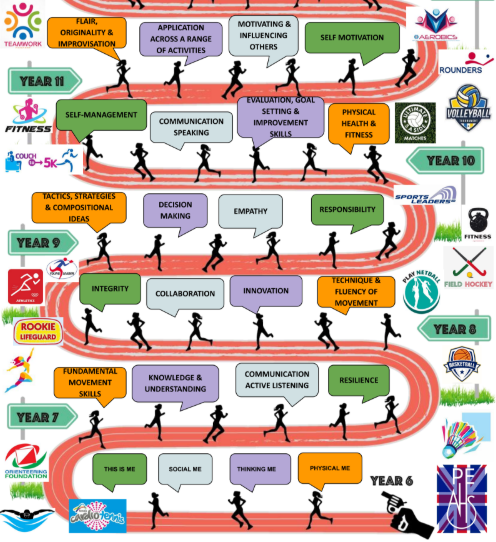
The girls are assessed using a My PB in line with the whole school Working towards/at/beyond in the following areas: Physical ME/Think Me/Social ME/This is ME.
Year 7 attainment descriptors
| Physical me | Thinking me | Social me | This is me |
|---|---|---|---|
|
Application of physical skills and tactics in a range of activities |
Cognitive, creative and problem-solving skills |
Understand and work well with others using interpersonal skills & leadership |
Believe in me: Demonstrate personal & affective skills, values, behaviours and character traits |
|
Fundamental movement skills |
Knowledge and understanding |
Communication and active listening |
Resilience |
Working Towards
| Physical me | Thinking me | Social me | This is me |
|---|---|---|---|
|
I can apply basic fundamental movement skills in the context of the activities in non-competitive practice situations or pair work. |
I know and understand some of the basic rules, skills, techniques and compositional ideas. I need a lot of encouragement to share my understanding and thoughts with others. I worry that I might not be correct. |
I do listen to others and think about my body language when I am naturally interested or when I am reminded to do it. Often I find myself thinking about my response or interrupting too much rather than really listening. |
I am getting slightly better at sticking to tasks in PE. I try not to give up at the first hurdle. I still need lots of support from the teacher and my friends. |
Working At
| Listening | Reading | Speaking | Writing |
|---|---|---|---|
|
I can apply basic fundamental movement skills in the context of activities with consistency in practice and small-sided competitive situations/group work. |
I am willing to share my knowledge and understanding in PE, usually when I know others will be receptive. I find it difficult to challenge other people’s understanding if they seem stronger. I prefer to feel fairly sure that my knowledge and understanding is correct. |
I work hard at being attentive to show others that I am actively listening and do try to focus on their ideas, thoughts and feelings. I tend to forget to check if my interpretation is accurate, so sometimes I haven’t fully understood or shown them that I have. |
I have more self-belief in PE and generally keep going, no matter what. I still need support and encouragement from others, but I often try out my own ideas when my first attempts don’t work. |
Working Beyond
| Listening | Reading | Speaking | Writing |
|---|---|---|---|
|
I can effectively apply fundamental movement skills in the context of activities with consistency, fluency and control in practice and competitive situations/group work. |
I am knowledgeable in PE and have a good understanding of a wide range of activities. Even if others are doubtful, I am able to explain the rules, skill, technique or compositional requirements to others. |
I give others my full attention – and show I am being attentive – in all aspects of PE, even when I am keen to get active or contribute. This includes watching demonstrations as well as listening to others speak. I make sure I check my understanding before moving on. |
I am determined to succeed even when a task is difficult. I learn from my mistakes, building on feedback from others, and always try alternatives before seeking help. I seek out new or harder challenges and push myself further in familiar tasks. |
Year 8 attainment descriptors
| Physical me | Thinking me | Social me | This is me |
|---|---|---|---|
|
Application of physical skills and tactics in a range of activities |
Cognitive, creative and problem-solving skills |
Understand and work well with others using interpersonal skills & leadership |
Believe in me: Demonstrate personal & affective skills, values, behaviours and character traits |
|
Fundamental movement skills |
Knowledge and understanding |
Communication and active listening |
Resilience |
Working Towards
| Listening | Reading | Speaking | Writing |
|---|---|---|---|
|
I can perform some techniques specific to the activity. I occasionally show some quality and control. I am able to demonstrate skills in practice. |
I do have ideas or can see that other people’s methods aren’t necessarily the only or best way, but need a lot of encouragement to give mine a go. I worry that my ideas seem daft or won’t work. |
I can cooperate with others, usually in small groups I choose to work with. I contribute to straightforward tasks which don’t test my tolerance or upset my opinions. |
I find it hard to stand up for myself as I am easily swayed by others. I tend to worry about what others will think or say about me, so I need more self-belief and encouragement to do what feels right. |
Working At
| Listening | Reading | Speaking | Writing |
|---|---|---|---|
|
I consistently demonstrate control in practice situations. I can coordinate various body parts at the same time. I can apply simple tactics and capitalise on some of my opponents' mistakes. |
I am willing to share my ideas or try new methods in some situations in PE, usually when I know others will be receptive. I find it difficult to challenge other people’s ideas if they seem stronger. I prefer to feel fairly sure that my ideas and adaptations will work. |
I can cooperate with a fairly wide range of people and I am willing to discuss and trial more complex ideas. I am usually happy for us to have different responsibilities. I struggle with my motivation or patience when people are disagreeing or there’s confusion in the group. |
Mostly I try to say or do things that I believe in. Usually I avoid saying or doing things with which I disagree. Sometimes, though, I find it hard to differ and occasionally follow the crowd because I am not sure or confident enough to challenge or oppose others. |
Working Beyond
| Listening | Reading | Speaking | Writing |
|---|---|---|---|
|
I show fluency, control and quality of movement both in competitive and practice situations. I can select appropriate tactics to bring about a change in performance. I am able to respond to opponents' actions successfully. |
I am creative in PE. Even if others are doubtful, I invent new ways to try things, link ideas to come up with a different approach or imagine what the end result will look like. When something doesn’t work, I readily adapt my idea or try an alternative method. |
I always try my best to build good relationships in PE situations, and I am a much more effective collaborator. I am keen to contribute and also negotiate to agree the best for the group. I can reflect on and agree roles according to people’s skills. I try to deal positively with conflict and find solutions. |
I am honest and stand up for what I believe is right, no matter the task or whom I work with in PE. I am willing and able to challenge others – constructively and appropriately – if I think something is wrong. Consequently, I respect myself and others respect me too. |
Year 9 attainment descriptors
| Physical me | Thinking me | Social me | This is me |
|---|---|---|---|
|
Application of physical skills and tactics in a range of activities |
Cognitive, creative and problem-solvingh skills |
Understand and work well with others using interpersonal skills & leadership |
Believe in me: Demonstrate personal & affective skills, values, behaviours and character traits |
|
Fundamental movement skills |
Knowledge and understanding |
Communication and active listening |
Resilience |
Working Towards
| Listening | Reading | Speaking | Writing |
|---|---|---|---|
|
I can perform using some tactics, strategies or compositional ideas specific to the activity. I tend to follow others and am more confident in practice. |
I can think of decisions or can see that other people’s methods aren’t necessarily the only or best way, but need a lot of encouragement to express mine. I worry that others will not agree with my decisions. |
I am aware that just because people are different from me doesn’t make them unequal or unacceptable. I do find it difficult to ‘put myself in their shoes’ but group work in PE helps me see things from other points of view. |
My behaviour in PE is usually what is expected. I am generally aware of the consequences of my actions on others and on the results of my/our work. I am still too impulsive at times and need to take more time to reflect and consider others before I act. |
Working At
| Listening | Reading | Speaking | Writing |
|---|---|---|---|
|
I can implement tactics, strategies or compositional ideas in practice situations. I tend to follow others' suggestions but can apply simple tactics, strategies and compositional ideas to improve the performance of my pair, group or team. |
I am willing to make decisions in some situations in PE, usually when I know others will be receptive. I find it difficult to challenge other people’s decisions if they seem stronger. I prefer to feel fairly sure that my decisions will be accepted by others. |
I do try to respect other people’s perspectives and consider why they speak or act in a certain way. I know that I still sometimes make assumptions or judge people too quickly, especially when their views or the way they behave are very different from mine. |
I show good self-control in PE, no matter the task or who I am working with. As a result, I have a positive relationship with the teachers and my peers. I feel my actions make a positive contribution to the enjoyment and working atmosphere of the lessons. |
Working Beyond
| Listening | Reading | Speaking | Writing |
|---|---|---|---|
|
I can implement tactics, strategies or compositional ideas, both in competitive and practice situations. I can select appropriate ideas to bring about change in performance. I am able to respond to opponents' actions and feedback successfully. |
I am decisive in PE. Even if others are doubtful. When something doesn’t work, I readily change my decision or try an alternative method. |
I am aware of others in PE. I take time to find out and understand their motives and needs. I always try to respond in a way that supports and includes them, without necessarily condoning what they do or say. My feedback is always constructive. |
Through PE, I have learnt to control my emotions in other areas of school and life. I know my attitudes and behaviours affect what happens, and determine how others view and respond to me, so I adapt them to try and shape the outcomes I would like. |
Key Stage 4 (Years 10-11) course implementation, learning journey & assessment info.
Course content – Core PE
| Year 10 | Year 11 |
|---|---|
|
In Year 10 and 11, students are taught in G-group classes. Through a range of physical activities and leadership experiences, students can acquire skills and learn behaviours which not only develop them as individuals but as drivers of change for others. At present, we are implementing My Personal Best into KS4 core PE. The aim is to develop life skills, leadership and employability skills for our students. My Personal Best - Character Education life skills are grouped into three areas:
|
Everyone does 2 hours of PE per week in Y10 and they cover the following: Sports Leaders Level 1 Rounders Volleyball Your Leaders -5 a side Football Pickleball Active Lives Handball
|
Course content – GCSE PE
| Year 10 | Year 11 |
|---|---|
|
Students follow the teaching of Component 1: Physical factors affecting performance, introduces and explores some of the physical factors which underpin participation and performance in physical activities and sports. Learners will start to explore the ways in which parts of the human body work and function during physical activity and the physiological adaptations that can occur due to diet and training. Learners will also develop their knowledge and understanding of the principles of training, why we train in different ways and how training plans can be made to optimise results. The study of these topics will aid learners in the development of both their own practical performance and that of others. In many areas of this specification, it is expected that practical examples from physical activities and sports will be used to show how theoretical concepts can be applied and to reinforce understanding. Component 1 – Applied Anatomy and Physiology, Physical Training 1 hour written exam 30% of total GCSE |
Students follow the teaching of Component 2: For sociocultural issues and sports psychology, learners will develop their knowledge of socio-cultural influences that impact on participation and performance in physical activities and sports. Learners will also develop their knowledge and understanding of how sport impacts on society. Engagement patterns of different social groups will be understood by learners, along with strategies to promote participation with practical examples. The commercialisation of physical activities and sports will be understood, including the influences of sponsorship and the media. Learners will also develop their knowledge and understanding of ethical and socio-cultural issues in physical activities and sports. Learners will develop their knowledge and understanding of sports psychology theories related to acquiring movement skills and optimising performance. Learners will be able to reflect on their own learning and performance of physical activities and sports skills to recognise the key psychological concepts affecting performance. Learners will develop their knowledge and understanding of the benefits of participating in physical activities and sports to their health, fitness and well-being. The physical, emotional and social aspects will be understood as well as the consequences of a sedentary lifestyle. Learners will also develop their knowledge and understanding of energy use along with diet, nutrition and hydration. Component 2 – Socio-cultural influences, sports psychology, health, fitness and well-being 1 hour written exam 30% of total GCSE |
Learning journey
This link takes you to the OCR specification for GCSE PE, which contains all the necessary course information.
How will I be taught?
Students have one practical and one theory lesson a week in Year 10 and one further theory lesson. Although in Year 11 the practical becomes the written NEA lesson. Homework will be set throughout lessons, which will either extend learning or help students with their knowledge and understanding of multiple areas.
The OCR GCSE Physical Education course covers applied anatomy and physiology, physical training, socio-cultural influences, sports psychology, and health, fitness, and well-being.
Learning outcomes require students to:
-
Develop theoretical knowledge and understanding of the factors that underpin physical activity and sport and use this knowledge to improve performance
-
Understand how the physiological and psychological state affects performance
-
Perform effectively in different physical activities by developing skills and techniques and selecting and using tactics, strategies and/or compositional ideas
-
Develop their ability to analyse and evaluate to improve performance
-
Understand the contribution which physical activity makes to health, fitness & well-being
-
Understand key socio-cultural influences which affect people’s involvement in sport.
NEA Guidelines
Students are assessed for their performance in three practical activities and a written performance analysis task.
Learners can only be assessed in activities from the approved list, one from the ‘individual’ list, one from the ‘team’ list, one other from either list.
How will I be assessed?
| Physical factors affecting performance 30% | Socio-cultural issues and sports psychology 30% | Practical Performances 30% | Analysis and Evaluation of Performance 10% |
|---|---|---|---|
|
60 mins • 1.1 Applied anatomy and physiology • 1.2 Physical training This paper consists of a mixture of objective response and multiple-choice questions, short answers and extended response items.
|
60 mins • 2.1 Socio-cultural influences • 2.2 Sports psychology • 2.3 Health, fitness and well-being. This paper consists of a mixture of objective response and multiple-choice questions, short answers and extended response items. |
Core and advanced skills in three activities taken from the approved lists:
This NEA will consist of three activities, including at least one ‘team’ and at least one ‘individual’ sport from the approved activity lists, all performed in competitive situations. |
This component draws upon the knowledge, understanding and skills a student has learnt and enables them to analyse and evaluate their own or a peer’s performance in one activity. This NEA will consist of a written task that must be produced under controlled conditions. |
Subject impact
Key Stage 3 (Years 7–9)
Year 7 My PB
Physical ME – Fundamental movement skills—you can apply basic fundamental movement skills in the context of activities with consistency in practise and small-sided competitive situations/group work.
Thinking ME – knowledge and understanding – you are willing to share my knowledge and understanding in PE, usually when you know others will be receptive.
Social ME - communication active listening – you work hard at being attentive to show others that you are actively listening and do try to focus on their ideas, thoughts and feelings.
This is ME – believe in me – resilience – you are willing to have a go, persevere when things are difficult, trial different methods, adapt to different circumstances, bounce back from setbacks.
When you have resilience you…
In PE ...try different techniques to see what works for you
In school...keep trying even when a task is difficult. You don’t give up or get frustrated.
In life…. You can cope when things are tough, you believe in yourself.
Year 8 My PB:
Physical ME – Technique & fluency of movement—you can consistently demonstrate control in practice situations. You can coordinate various body parts at the same time. You can apply simple tactics and capitalise on some of my opponents' mistakes.
Thinking ME – Innovation – You are creative in PE. Even if others are doubtful, you invent new ways to try things, link ideas to come up with a different approach or imagine what the end result will look like. When something doesn’t work, you readily adapt your idea or try an alternative method.
Social ME - Collaboration – You always try my best to build good relationships in PE situations, and I am a much more effective collaborator. You are keen to contribute and also negotiate to agree the best for the group. You can reflect on and agree roles according to people’s skills.
This is ME – Integrity – Students will set themselves high standards, keep their word, behave consistently, make choices based on values rather than personal gain, put their principles into action.
When they have integrity you…
In PE … are honest about the score and the rules, acknowledging when you have committed a foul.
In school... you can see both sides of an argument.
In life….are fair and honest with your friends; they trust you.
Year 9 My PB:
Physical ME – tactics, strategy & fluency of movement – You can implement tactics, strategies or compositional ideas, both in competitive and practice situations. I can select appropriate ideas to bring about change in performance. I am able to respond to opponents' actions and feedback successfully.
Thinking ME - decision-making – You are decisive in PE. Even if others are doubtful. When something doesn’t work, you readily change my decision or try an alternative method.
Social ME – empathy – You are aware of others in PE. You take time to find out and understand their motives and needs. You always try to respond in a way that supports and includes them, without necessarily condoning what they do or say. Your feedback is always constructive.
This is ME - responsibility...plan ahead, organise myself and my belongings, complete tasks to the best of my ability, don’t let others down, volunteer to help—not just for the prestigious roles.
When you have responsibility you…
In PE ...offer advice and encouragement to teammates and partners.
In school...positively contribute to the enjoyment and working atmosphere of the lesson.
In life….play an active role in a global community.
Key Stage 4
Core PE –
Physical Outcomes:
Through PE, students will learn to embed physical activity habits and make lifestyle choices that prepare the students for further learning.
Personal Outcomes:
Through PE, students will be self-motivated, articulate and passionate. Students will learn to build their mental health and manage pressure, training or work environments where work readiness, wellbeing and pressure are daily factors.
By undertaking a qualification in Sports Leadership, you will learn and demonstrate important life skills such as effective communication and organisation whilst learning to lead basic physical activities to younger people and their peers. The award will equip you with valuable and essential employability skills. The Skills Framework identifies five key skills areas: Communication, Self-Belief, Teamwork, Self-Management and Problem-Solving. This ensures that all young people have the ability to realise their potential whatever their career pathway.
GCSE PE
A good GCSE PE grade shows that you possess a mixture of practical and academic skills. GCSE PE leads specifically to further study of Physical Education at AS and A2 and beyond to degrees in areas such as Physical Education; Sports Sciences; Sport and Exercise Sciences; Sports Psychology and many, many more.
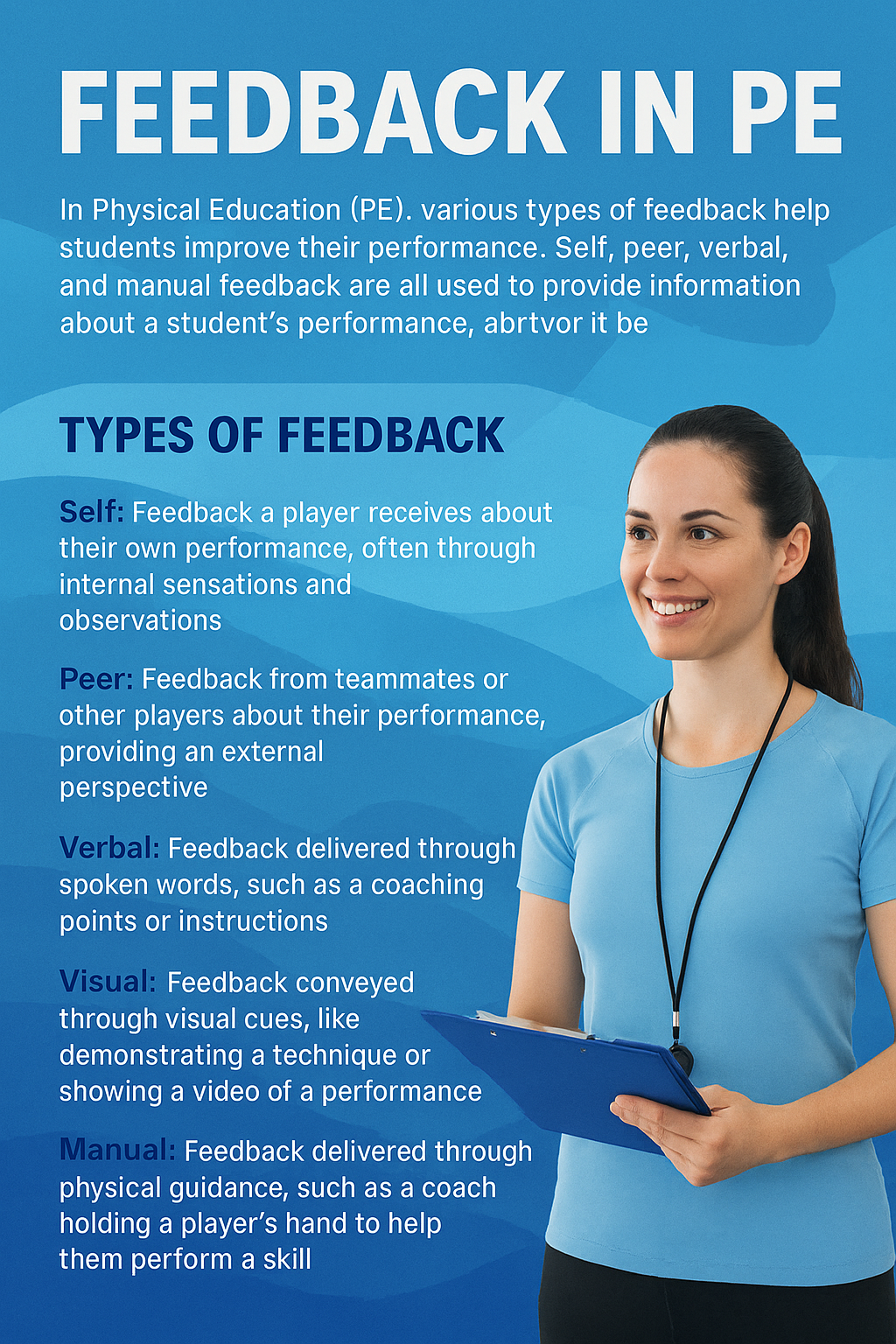
Feedback in PE lessons
School values in PE
| Boundless Aspiration | Curious Engagement | Resilient Bravery | Selfless Generosity |
|---|---|---|---|
|
|
|
|