
Aylesbury High School
Religious Studies
We want to develop students who are curious but respectful of others' beliefs and values. We want them to enjoy thinking deeply about challenging concepts and important questions about life and the world around us.
They will have opportunities to explore questions of meaning, identity and purpose. Students learn how to respond with developed explanations which draw on firm knowledge of religious and non-religious views but also challenge and extend their own perspectives.
At all Key Stages, we formally assess student understanding in a variety of ways, including, speeches, essays, exams, quick knowledge tests and presentations and more informally through engagement in class discussions, work in books and retrieval activities.
Key Stage 3
Students are introduced to world religions and non-religious world views, including beliefs and practices. Throughout KS3, three broad areas of religion, philosophy and ethics are the lenses through which lessons are examined. We have considered the demographic of the school and developed a curriculum that reflects and supports this.
They will have opportunities to explore questions of meaning, identity and purpose. Students learn how to respond with developed explanations which draw on firm knowledge of religious and non-religious views but also challenge and extend their own perspectives.
In Year 7, students are introduced to philosophical questions, an overview of key themes in the Bible and a study of Christianity, the main religious tradition in Great Britain. In Year 8 students develop their philosophical skills while also studying two religions in more depth. Year 9 students consider ethical approaches to decision-making and continue to develop their knowledge of world religions and philosophical ideas.
From the beginning of Key Stage 3, we want to develop the skills and knowledge that will allow students to progress to both GCSE and A Level so we encourage students to write formally, developing strong, well-reasoned arguments and to express ideas clearly both orally and in writing.
Key Stage 4
Students studying the GCSE course will develop knowledge and understanding of 2 specific religions: Islam and Christianity. They cover religious beliefs, teachings, and sources of wisdom and authority, including a study of key religious texts. The cohort is also given some choice in the ethical and philosophical themes which they must also study. These themes reflect current, relevant issues that society faces and allow students to reflect on their own views as well as those of different faiths and none.
Key Stage 5
Students undertake an in-depth study of two core areas: philosophy of religion and ethics; and a study of religion (Christianity). We encourage students to develop the skills necessary to move on to further study at university; encouraging and honing critical thinking , evaluation and analysis skills.
Student resources
The Google Drive and Clickview are only available for students and teachers of Aylesbury High School. The Google Drive contains all Google-based resources used in lessons.
The other quick links are to websites we subscribe to with extra resources. Students have their own login details given to them by the school.
| AHS only resources | Web based quick links |
Web based quick links |
|---|---|---|
|
|
|
|





| You Tube links |
|---|
| Crash Course Philosophy |
| Crash Course Religions |
Extension work & wider reading at Key Stage 3 (Years 7-9)
If you have finished all the work set on Google Classroom/in lessons very quickly and/or if you’re looking for RS things to do to stop you getting bored, try out some of these suggestions.
Non-Fiction
World Religions: Judaism, Christianity and Islam (KS3 Knowing Religion) by Andy Lewis and
Robert Orme
World Religions: Hinduism, Buddhism and Sikhism (KS3 Knowing Religion) by Tristan Elby
Lewis and Neil McKain.
World Religions: The Great Faiths Explored & Explained by John Bowker
Fiction
The Little Prince by Antoine de Saint-Exupéry
Alice’s Adventures in Wonderland by Lewis Carroll.
Theo’s Odyssey by Catherine Clement
The Chronicles of Narnia by Lewis Caroll
Are you there God, it’s me Margaret by Judy Blume
I dared to call him father by Bilquis Seikh
My Sister Lives on the Mantlepiece – Annabel Pitcher
Flawed by Cecilia Ahern
The boy with the Topknot by Sathnam Sangera
Media
Evan Almighty (PG rating)
Bruce Almighty (12 rating)
The Chronicles of Narnia (PG rating)
Three Lions (U rating)
Bend it like Beckham (PG rating)
Prince of Egypt (PG rating)
Muhammad – The Last Prophet (U rating)
Extension work & wider reading at Key Stage 4 (Years 10-11)
If you finish all the work set on Google Classroom very quickly and/or if you’re looking for RS things to do to stop you getting bored, try out some of these suggestions.
Non-Fiction
Christianity: A Very Short Introduction by Linda Woodhead
Islam: A Very Short Introduction by Malise Ruthven
Creation magazine
Other minds: The Octopus and the Evolution of Intelligent Life by Peter Godfrey-Smith
The Book of Awesome Women: Boundary Breakers, Freedom Fighters, Sheroes and Female
Firsts by Becca Anderson
Fiction
Life of Pi by Yann Martel
Handle with Care – Jodie Picoult
Change of Heart by Jodie Picoult
The Divorce Girl by Caryn Mirriam-Goldberg
The Hiding Place by Corrie Ten Boom
The Storyteller by Jodie Picoult
A Spark of Light by Jodi Picoult
Media
The Good life – Netflix series
The Matrix (15 rating)
The Passion of the Christ (15 rating)
Slumdog Millionaire (15 rating)
My Sister’s Keeper (12 rating)
The Shawshank Redemption (15 rating)
Inception (15 rating)
Extension work & wider reading at Key Stage 5 (Years 12-13)
If you finish all the work set on Google Classroom very quickly and/or if you’re looking for RS things to do to stop you getting bored, try out some of these suggestions.
Subject intent
Key Stage 3
We want to develop students who are curious but respectful of others' beliefs and values. We want them to enjoy thinking deeply about challenging concepts and important questions about life and the world around us.
Students are introduced to world religions and non-religious world views, including beliefs and practices. Throughout KS3, three broad areas of religion, philosophy and ethics are the lenses through which lessons are examined. We have considered the demographic of the school and developed a curriculum that reflects and supports this.
They will have opportunities to explore questions of meaning, identity and purpose. Students learn how to respond with developed explanations which draw on firm knowledge of religious and non-religious views but also challenge and extend their own perspectives.
In Year 7, students are introduced to philosophical questions, an overview of key themes in the Bible and a study of Christianity, the main religious tradition in Great Britain. In Year 8, students develop their philosophical skills while also studying two religions in more depth. Year 9 students consider ethical approaches to decision-making and continue to develop their knowledge of world religions and philosophical ideas.
Key Stage 4
Students studying the GCSE course will develop knowledge and understanding of 2 specific religions: Islam and Christianity. They cover religious beliefs, teachings, and sources of wisdom and authority, including a study of key religious texts. Students also develop the ability to construct well-argued, well-informed, balanced and structured written arguments, demonstrating their depth and breadth of understanding of the subject.
Key Stage 5
Students will undertake an in-depth study of two core areas: philosophy of religion and ethics; and a study of religion (Christianity). Students will develop knowledge and understanding of the meaning and significance of religious and non-religious beliefs. They will consider the influence of these beliefs and teachings on individuals, communities and societies, the cause and significance of similarities and differences in beliefs and teachings and examine the approach of philosophy to the study of religion and belief. Students will be able to analyse and evaluate issues arising from the topics, the views and arguments of scholars such as Aquinas, Aristotle, Hume and Paley. They will also be able to use specialist language and terminology appropriately.
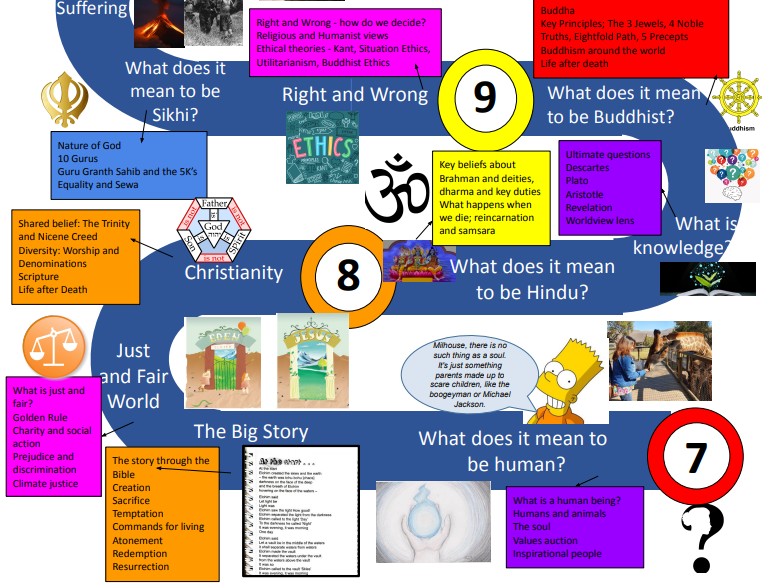
Key Stage 3 (Years 7-9) course implementation, learning journey & attainment.
Course content
| Year 7 | Year 8 | Year 9 |
|---|---|---|
|
|
|
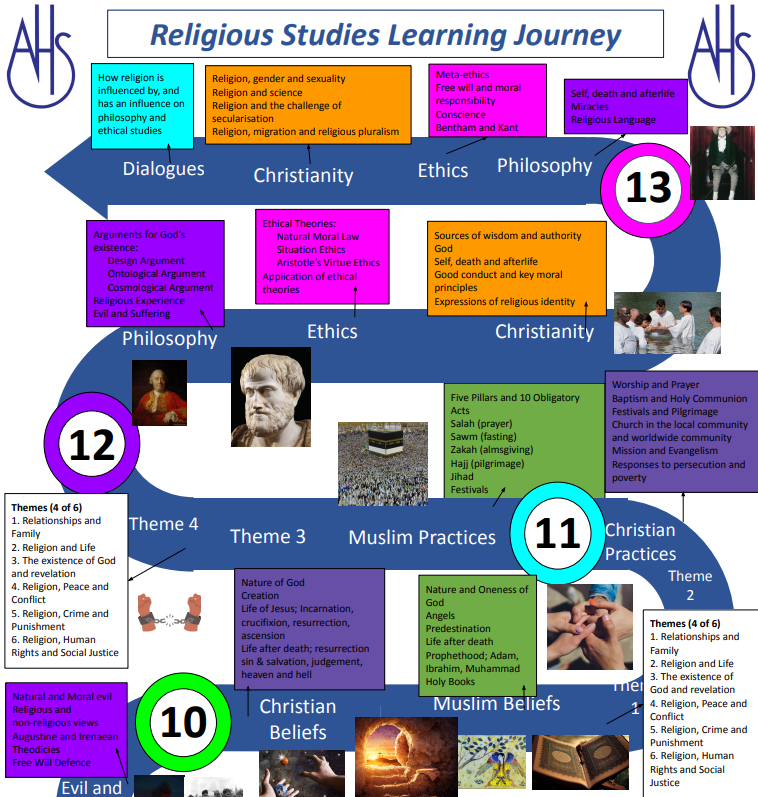
Learning Journey
Year 7 attainment descriptors
In Key Stage 3, we use 'I can' statements across 2 criteria to determine our attainment in Religion, Ethics and Philosophy. The two criteria are:
- Knowledge and understanding
- Evaluation and analysis
Working Towards
| Knowledge and Understanding | Evaluation and analysis |
|---|---|
|
|
Working At
| Knowledge and Understanding | Evaluation and analysis |
|---|---|
|
|
Working Beyo
| Knowledge and Understanding | Evaluation and analysis |
|---|---|
|
|
Year 8 attainment descriptors
In Key Stage 3, we use 'I can' statements across 2 criteria to determine our attainment in Religion, Ethics and Philosophy. The two criteria are:
- Knowledge and understanding
- Evaluation and analysis
Working Towards
| Knowledge and Understanding | Evaluation and analysis |
|---|---|
|
|
Working At
| Knowledge and Understanding | Evaluation and analysis |
|---|---|
|
|
Working Beyond
| Knowledge and Understanding | Evaluation and analysis |
|---|---|
|
|
Year 9 attainment descriptors
In Key Stage 3, we use 'I can' statements across 2 criteria to determine our attainment in Religion, Ethics and Philosophy. The two criteria are:
- Knowledge and understanding
- Evaluation and analysis
Working Towards
| Knowledge and Understanding | Evaluation and analysis |
|---|---|
|
|
Working At
| Knowledge and Understanding | Evaluation and analysis |
|---|---|
|
|
Working Beyond
| Knowledge and Understanding | Evaluation and analysis |
|---|---|
|
|
Key Stage 4 (Years 10-11) course implementation, learning journey & assessment info.
Course content
| Year 10 | Year 11 |
|---|---|
|
Muslim beliefs and teachings:
Muslim Practices:
Christian beliefs and teachings:
Christian practices:
|
Students need to study 4 themes. Classes are given a choice from the 6 below. Themes: Religion, human rights and social justice:
Themes: Religion and life:
Themes: Religion, crime and punishment:
Themes: Religion, relationships and families:
Themes: The existence of God and revelation:
Themes: Religion, peace and conflict:
|
Learning journey
This link takes you to the AQA specification for GCSE Religious Studies, which contains all the necessary course information. Assessments take place throughout the 2 years of the course, in addition to Year 10 exams and mocks in the spring term of Year 11.
How will I be assessed?
| Component 1: The study of religions: beliefs, teachings and practices – 50% | Component 2: Thematic studies - 50% |
|---|---|
|
Written exam – 1 hr 45 mins Each religion has a common structure of two five-part questions of 1, 1, 4, 6 and 12 marks. |
Written exam – 1 hr 45 mins Each religion has a common structure of two five-part questions of 1, 1, 4, 6 and 12 marks. |
Key Stage 5 (Years 12-13) course implementation, learning journey & assessment info.
Course content
| Year 12 | Year 13 |
|---|---|
|
Philosophy:
Ethics:
Christianity:
|
Philosophy:
Ethics:
Christianity:
Dialogues This looks at how religion is influenced by, and has an influence on Philosophy of Religion and Ethical studies in relation to the issues studied across the rest of the course. |
Learning journey
This link takes you to the AQA specification for Religious Studies, which contains all the necessary course information. Assessments take place throughout the 2 years of the course, in addition to Year 12 exams and mocks in the spring term of Year 13.
How will I be assessed?
| Component 1: Philosophy of religion and ethics - 50% | Component 2: Study of religion and dialogues - 50% |
|---|---|
|
Written exam – 3 hrs Section A: Philosophy of religion – two compulsory two-part questions, each worth 10 marks and 15 marks. Section B: Ethics and religion – two compulsory two-part questions, each worth 10 marks and 15 marks. In both sections, questions may span more than one topic. In each two-part question, the first part tests AO1 and the second part tests AO2. |
Written exam – 3 hrs Section A: Study of religion – two compulsory two-part questions, each worth 10 marks and 15 marks relating to the religion chosen. Questions may be set that span more than one topic. In each two-part question, the first part tests AO1 and the second part tests AO2. Section B: The dialogue between philosophy of religion and religion – one unstructured synoptic question from a choice of two (25 marks). Section C: The dialogue between ethical studies and religion – one unstructured synoptic question from a choice of two (25 marks). |
Subject impact
Key Stage 3
We have designed our curriculum to ensure that every student has the opportunity to make outstanding progress in Religious Studies. We strive for every pupil who studies Religious Studies to have developed skills of analysis and evaluation, as well come to gain a greater understanding of the world around them. Our discussions on religion, philosophy and ethics provide holistic development and encourages our students to better understand and interact with the world around them, as well as give them the academic confidence to succeed.
Students will be able to use religious and philosophical language and concepts to explain religions, beliefs, practices and values, including differences within religions and similarities shared across religions and non-religious world-views.
They will be able to explain and interpret different forms of religious and spiritual expression.
Our students will be able to explain different interpretations of religious and non-religious beliefs and research different perspectives on issues and ideas.
They will consider different responses to and insights about questions of identity, meaning, purpose and value found in Christianity and other faith and non-religious world-views, arguing their own views in the light of this.
They will be able to explain some challenges of living in a multi-faith and belief society and the impact of commitment on the lives of individuals and communities.
By the end of Key Stage 3, pupils will be familiar with the origins and history of Christianity as well as some of the other major world religions. Pupils will be able to describe a range of religious concepts including the practices of prayer and worship. Pupils will understand the significance of religious rules such as The Ten Commandments and their lasting importance in contemporary society. Pupils will develop confidence in becoming courageous advocates, challenging injustice and suffering in the world and, through personal experience, foster empathy and tolerance within a diverse world.
Key Stage 4
By the end of Key Stage 4, GCSE students will demonstrate a deeper understanding of Christian and Islamic beliefs, teachings and practices and how these can differ depending on denomination. Students will be able to identify places of religious significance around the world and the importance of those historically and as places of pilgrimage. They will confidently articulate justified opinions on ethical issues, giving religious, non-religious and personal views. Students will be able to explain in detail how religious teachings in both Christianity and Islam can be applied to contemporary moral issues such as euthanasia, abortion, abuse of the world and the use of capital punishment. They will know how religious organisations challenge the global problems of injustice and poverty and link religious teachings to these issues. Students will be able to confidently articulate justified opinions on issues giving personal, religious and non-religious views.
All Key Stage 4 students will use a wide range of language, ideas, approaches and methods to analyse and demonstrate a broad understanding of religions and beliefs and their significance in modern society.
Students will be able to pull together evidence and insights from religion and other disciplines to explore what it means to be human.
They will explain how different interpretations of religious and non-religious views may be brought together to share insights about meaning, purpose and values.
Students will relate a wide range of perspectives, from religious and non-religious world views to contemporary social and moral issues, demonstrating an understanding of the diversity of views within and between them.
They will be able to arrive at independent conclusions based on research into & evidence about religion and belief and their impact, positive & negative, on communities & society.
Key Stage 5
Our A Level students will be confident, analytical, philosophical thinkers. They will demonstrate an excellent understanding of the arguments for God’s existence and other key philosophical arguments while also being able to articulate the challenges and criticisms.
Students will have a strong grasp of the most significant ethical theories and confidently apply them to a number of contemporary moral and social issues.
Their understanding of Christianity will be developed further still as they consider how Christianity responds to potentially contentious and controversial issues.
The final part of the A Level course allows students to consider the dialogues that have taken place between religion, philosophy and ethics and to understand that these disciplines are interwoven with and influenced by each other.
Students develop greater skills in analysis and evaluation, with an excellent ability to construct and maintain an argument in written work. Their knowledge and critical understanding will be accurate, relevant and fully developed in breadth and depth with good use of relevant evidence and examples. They will demonstrate good knowledge and understanding of the diversity of views and scholarly opinion in a clear and coherent presentation of ideas with precise use of the appropriate subject vocabulary.
Feedback in RS lessons
This chart explains the types of feedback that students can expect to receive for work done in geography lessons/at home.
| Activity | Types of feedback |
|---|---|
|
Exercise books |
Organisation and completion of work checked when circulating or as part of homework marking. Verbal or written comments |
|
Small group oral work/mini whiteboard activities/classwork |
Verbal feedback |
|
Contributions to class discussion |
Verbal feedback |
|
Homework (Key Stage 3) |
Traffic light marking –
Numbered comment for whole class feedback |
|
Homework (Key Stage 4/5) |
Written comments Exam marking if appropriate |
|
Assessments (Key Stage 3) |
Teacher marked → whole class feedback Feedback sheet with highlighted statements and www (what went well) and ebi (even better if) comments |
|
Assessments (Key Stage 4/5) |
Teacher marked according to exam mark schemes. Www and ebi comments Some peer marking |
School values in RS
| Boundless Aspiration | Curious Engagement | Resilient Bravery | Selfless Generosity |
|---|---|---|---|
|
|
|
|