Sociology
The study of A Level Sociology focusses on an understanding of contemporary society. Studying Sociology fosters the development of critical and reflective thinking with a respect for social diversity. It also provides an awareness of the importance of social structure and social action in explaining social issues. Students are encouraged to develop their own sociological awareness through active engagement with the contemporary social world. At Aylesbury High School we study the Eduqas A Level Sociology course. The Sociology A Level course consists of three papers taken at the end of the two-year course. All assessment is by written exam and there is no coursework component. The topics we cover include: Culture and Socialisation, Families, Education, Inequality, Crime and Research Methods.
Student resources
The Google Drive, Google Site and Clickview are only available for students and teachers of Aylesbury High School. The Google Drive contains all Google-based resources used in lessons.
The other quick links are to websites we subscribe to with extra resources. Students have their own login details given to them by the school.
| AHS only resources | Web based quick links |
Web based quick links |
|---|---|---|
|
|
|
|








Extension work & wider reading at Key Stage 5 (Years 12-13)
It is an expectation that you will undertake an hour of consolidation work for each taught hour at school in addition to any homework you may have. Here are some suggestions as to how you can spend the time:
-
Finish any work that you didn’t manage to complete in class. This can include notes from the textbook, responses to questions, grids and mindmaps – you should never have incomplete tasks.
-
Read ahead, even if not explicitly told to do so, in preparation for future lessons.
-
Consolidate your learning by writing summaries of key ideas, content, terminology, and concepts that have arisen from the lesson. There will be links to further reading attached to most lessons. Use these to expand on your notes.
-
Work on knowing the terminology associated with sociology. Use your glossaries to highlight and interpret keywords, create quizzes or flashcards to support this process.
-
Make full use of Jstor (see below for login) by reading more academic essays on both areas you are interested in and those studied in class.
-
Read around the subject by using the sociology review. Make notes on what you find interesting and look to identify ways in which these concepts can inform the areas studied in class.
-
Complete tasks on Seneca.
-
Listen to a Podcast, e.g. Thinking Allowed. Summarise the episode in a paragraph.
-
Create A3 unit “at a glance” revision guides for each unit studied. Ensure that key concepts, ideas, and terminology form the foundation of the A3 guide.
-
Answer tasks in the A Level textbook to develop your understanding of each unit.
-
Regularly watch the news and keep well-informed of current events. Write your views on the stories, discuss with other people and explain how this links to sociology.
-
Make use of past papers and have a go at writing practice responses. We will be happy to mark anything that you attempt. (See below for the link to the past papers).
Useful websites & Jstor
https://www.tutor2u.net/sociology
https://www.thesociologyteacher.com/knowledge-a-level-sociology
https://www.eduqas.co.uk/qualifications/sociology-as-a-level/#tab_pastpapers
Jstor can be accessed on the school computers by going to www.jstor.org. If you want to use it at home, you can set up a log in when at school.
Username: AylesburyHS
Password: LibEPQ
Clinic: Monday lunchtime in H13
Subject intent
The study of A Level Sociology focusses on an understanding of contemporary society. Studying Sociology fosters the development of critical and reflective thinking with a respect for social diversity. It also provides an awareness of the importance of social structure and social action in explaining social issues. Students are encouraged to develop their own sociological awareness through active engagement with the contemporary social world. The Eduqas A Level in Sociology encourages students to:
-
acquire knowledge and a critical understanding of contemporary social processes and social changes
-
appreciate the significance of theoretical and conceptual issues in sociological debate
-
understand and evaluate sociological methodology and a range of research methods through active involvement in the research process
-
develop skills that enable individuals to focus on their personal identity, roles and responsibilities within society
-
develop a lifelong interest in social issues.
Studying sociology at A Level will give you an awareness of the social, political and economic issues that shape society. It will help you develop greater empathy towards communities that differ from your own and open your mind to a diverse range of ideas and beliefs.
Key Stage 5 (Years 12-13) course implementation, learning journey & assessment info.
Course content
| Year 12 | Year 13 |
|---|---|
|
Paper 1 – Socialisation and Culture
Paper 2 – Methods of Sociological Enquiry
|
Paper 3 – Power and Stratification
|
Learning journey
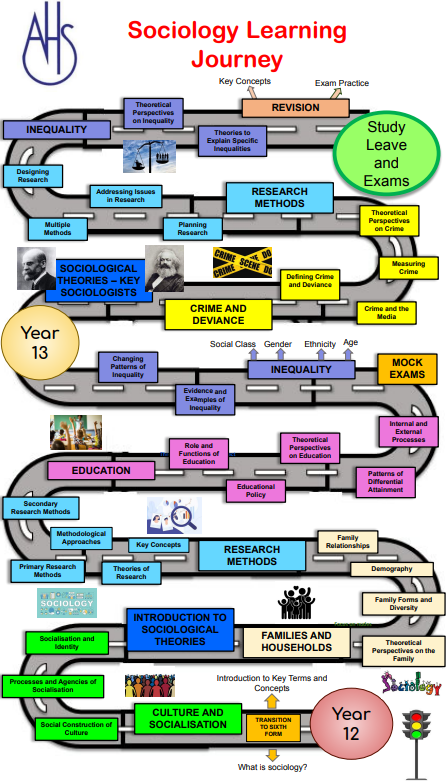
This link takes you to the Eduqas specification for Sociology A Level, which contains all the necessary course information. Assessments take place throughout the 2 years of the course, in addition to Year 12 exams and mocks in the spring term of Year 13.
How will I be assessed?
| Component 1 40% | Component 2 20% | Component 3 40% |
|---|---|---|
|
Written exam: 2 hours 30 mins Section A - 20 marks one structured question on the key concepts and processes of cultural transmission, socialisation and the acquisition of identity. Section B - 50 marks This section offers a choice between two options: families and households youth cultures. Each option includes a compulsory question and a choice between two essay questions. Section C - 50 marks This section offers a choice between three options:
Each option includes a compulsory question and a choice between two essay questions. |
Written exam: 1 hour 45 mins 60 marks Two compulsory questions. One question will be based on stimulus material, which will be a synopsis of a piece of sociological research. The questions will include extended writing and one question will require learners to design, justify and evaluate a piece of sociological research. |
Written exam: 2 hours 30 mins Section A - 60 marks one question on the theme of social differentiation and stratification. This will include a compulsory question and a choice between two essay questions. Section B - 60 marks The questions in this section are on the theme of power. There is a choice between four options: crime and deviance health and disability politics world sociology. Each option includes a compulsory question and a choice between two essay questions.
|
Subject impact
Studying A level sociology will allow students to develop a deeper understanding of social structures and issues. By the end of the course, students will be able to understand, recall and evaluate a range of sociological perspectives and concepts. The course will teach students how to think critically and reflectively. It will strengthen students’ skills in communication, evaluation and analysis.
Regular completion of exam-style questions, both in the lesson and set for homework, are used to help students to practise exam skills and to assess students’ progress. End of topic knowledge checks and regular retrieval activities provide the opportunity to address misconceptions and facilitate appropriate teacher interventions.
The study of sociology develops academic and interpersonal skills necessary for a range of different roles and future careers. Sociology enhances students’ writing ability. It develops students’ cultural competence and self-awareness and helps them to understand other people’s cultural context and diverse beliefs.
Feedback in Sociology lessons
| Type of feedback | Information |
|---|---|
|
Written feedback on timed and homework essays
|
Marked by the teacher and based on exam board mark schemes and assessment objectives. AO1 Demonstrate knowledge and understanding of: sociological theories, concepts and evidence sociological research methods AO2 Apply sociological theories, concepts, evidence and research methods to a range of issues AO3 Analyse and evaluate sociological theories, concepts, evidence and research methods in order to: present arguments make judgements draw conclusions |
| Retrieval tests | End of topic knowledge tests – Google forms or written |
| Verbal | Regular verbal feedback during retrieval activities and group discussions. This could be individual or to a small group. |
School values in Sociology
| Boundless Aspiration | Curious Engagement | Resilient Bravery | Selfless Generosity |
|---|---|---|---|
|
|
|
|
