
Aylesbury High School
Psychology
Student resources
Student resources are organised through their Google Classrooms and will be allocated as appropriate. Clickview is only available for students and teachers of Aylesbury High School.
The other quick links are to websites we subscribe to with extra resources. Students have their own login details given to them by the school.
| AHS only resources | Web based quick links |
Web based quick links |
|---|---|---|
|
|
|
|





Extension work & wider reading at Key Stage 5 (Years 12-13)
Routine Consolidation
In the Sixth Form, students are expected to complete one hour of independent study for every lesson studied. Below are some suggestions as to how you can spend your study periods should your homework not hit that level:
-
Finish any work you didn’t manage to complete in class. Catch up within a realistic timeframe if you have been absent, prioritising the most recent work missed so that you can follow the next lesson.
-
Read ahead, even if not explicitly told to do so, in preparation for future lessons.
Ask yourself questions about your reading:
Connect: How are these ideas connected to what I already know?
Extend: What new concepts/specialist terms have I learnt?
Question: What questions do I have? Is there anything I need clarifying?
-
Create your own notes/mindmaps/flashcards/slides. Use different colours/drawings to help remember your notes. Distinguish between AO1 and AO3 content. Create essay plans as mind maps. If you find it difficult to remember evaluation points, then prioritise these.
-
Use quizzes to learn specialist terminology and key ideas: e.g.GHL/Tutor2u/Quizlet. Or create your own using tools such as Notion. Review your notes routinely.
-
Talk to people about what you have learnt, even if they know nothing about the topic. Get them to ask you questions to see if you can explain the content in simple terms.
Making Progress
-
Teacher feedback from past tests will show you how to make progress. Make notes on your test paper when your teacher is giving whole-class feedback. Add to your progress tracker after each test and review this before your next test. Ask your teacher if you have questions.
-
Research Methods is around 1⁄3 of all assessed content, so review this routinely.
-
Specialist terminology must be used accurately and frequently for a top grade. Highlight key terms in bold/different colours on your class notes. Practice defining key terms in revision.
-
Detailed evaluation in your essays is essential for a top grade. Remember, in a standard essay, there are more marks for evaluation than for knowledge and understanding.
Top tips for evaluation:
-
Always use the PEEL structure for detailed evaluation points.
-
Learn one evaluative study (e.g. supporting/conflicting evidence) for each topic.
-
You do not need to know the names/dates, but you do need to be able to identify some details relating to the procedure/findings and say why this matters.
-
Explain rather than just state your point, e.g. ‘This shows that . . .’
-
Sum up each point with a link sentence, e.g. ‘This matters because . . .’ ‘The implications of this are . . .’ ‘Therefore, the validity of this position is weakened.’
-
Bring in counter-arguments and use linking sentences such as, ‘However’, ‘Furthermore’, ‘Nevertheless’ . . .
-
Refer to issues and debates, where appropriate, e.g. : ‘This amounts to biological determinism . . .which matters because . . .’
Revision Activities
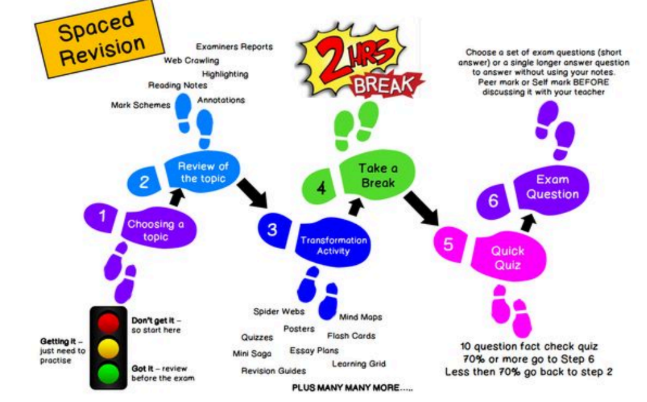
Routine consolidation of your work gives you a head start on revision. A ‘spaced approach’ to revision, outlined in the steps given below, has been shown to be effective:
1. Choose a topic
-
RAG rate different topics using the checklists provided: Red (I find this difficult), Amber (Not totally confident), Green (I get it!). Prioritise revising those topics you find most difficult.
2. Review the material
-
Reading – If you haven't understood something or want a refresher, re-visit lesson slides, re-read the GHL or see Tutor2u or Physics and Maths Tutor for useful summaries.
-
Videos – Consolidate your learning with Psychboost videos or Tutor2u online lessons. Also, see videos from SMCartledge and Bear it in Mind. Especially useful if you miss a lesson.
3. ‘Transformation activity’: Engage with the material
-
Blurt: Blurt topic content on a whiteboard/A3 paper. Use a textbook to spot the gaps.
-
Create mindmaps/flashcards/slides. Use different colours/drawings to help remember your notes. If you find it difficult to remember evaluation points, then prioritise these.
-
Talk to a friend/family member about your work – explaining ideas to a novice is a great way to see how much you have understood.
-
Write essay plans – Plan 8 and 16 mark essay responses.
-
Seneca Learning – A quick and interactive way to review key content. Access for free here.
4. Take a break: you need time to forget what you have learnt before actively retrieving it . . .
5. Quick Quiz
-
Use GHL/Tutor2u multiple choice quizzes or your own flashcards/decks to check your understanding of a topic and your confidence with specialist terminology.
6. Exam Questions:
-
Practise exam questions: You can download past exam papers and mark schemes via the AQA website assessment pages. Use the mark schemes to help further your understanding. Also, find exam questions organised by topic on the Physics and Maths Tutor website.
Extension activities
-
A Levels will keep you busy, and it will probably feel like there is always work to be done. However, if you have some free time, particularly during the school holidays, then engage in wider-reading. This is especially important if you are hoping to study Psychology at university – plus it will spark your enthusiasm for the subject!
-
Psychology Society runs weekly and is a great opportunity to find out about psychology beyond the A Level specification. Some of these sessions will be career-related with visiting speakers. If you would like to run a session, just ask!
-
Psychology Today Magazine is written especially for A Level students and often has specification-relevant articles. There is a reference copy in the school library.
-
BPS Digest: Broaden your knowledge of psychology and embed research methods by reading British Psychological Society Research Digest articles summarising recent research.
-
Listen to a Podcast: E.g. The BBC’s All in the Mind programme shares the latest psychological research on a range of topics in an accessible format. See here for other podcasts.
-
Make use of Jstor by reading academic essays on topics you are interested in. Especially useful in preparation for UCAS applications and university. Find out how to access this here.
-
Find details of more resources here: A Level Psychology Resources - GC version
-
Sign up to a MOOC on a Psychology topic that interests you, to widen your appreciation of the subject. FutureLearn is a good place to start. Again, useful prep for UCAS and university.
-
Apply Psychology to everyday life. When you see or hear claims about human behaviour made by friends/in the news/on social media, ask yourself:
Claim: What is the claim that is being made here?
Support: What evidence is being presented? How valid/reliable/generalisable is it?
Question: What questions do I have? How could I research this?
Subject intent
Many students choose to study Psychology at A Level because they are interested in learning about human behaviour through the scientific study of compelling topics such as mental health, gender, memory, attachment, social psychology and forensic psychology. The course also provides the opportunity for students to consider key issues and debates in psychological research, such as cultural bias and free will vs. determinism.
The intent of this course is to develop students’ knowledge, application and evaluation of key psychological theories and studies, as well as develop their mathematical, practical, and analytical skills in research methods. It prepares students to meet the assessment objectives of the A Level course and provides a solid foundation in the knowledge and skills required for related further study and work.
We aim to bring Psychology to life using class discussions, mini-experiments, presentations and creative activities. Exam technique is refined through the routine practice of examination-style questions, including essays, and student progress is routinely monitored using half-termly mid-and end-of-topic tests, plus annual mock examinations.
Encompassing a broad range of topics and skills, the subject attracts students taking a wide range of other A Level choices; for some students, this is their only subject with an extended written essay component; for other students, this is their only A Level in a scientific discipline. The diverse range of skills and perspectives of our students makes for an interesting background to class discussion.
A Level Psychology has the added attraction of counting as a science for many university courses. Around a quarter to a third of our students typically go on to study Psychology, or related subjects, such as Criminology, at university. Many of these students have successfully applied to Russell Group universities, and we have supported students with successful Oxbridge applications. Other students have gone on to study courses as diverse as Dentistry, Drama, English, Medicine and Sports Sciences, benefiting from the transferable skills in research and analytical thinking that the A Level course has given them.
Key Stage 5 (Years 12-13) course implementation, learning journey & assessment info.
Course content
Years 12 & 13
| Paper 1 | Paper 2 | Paper 3 |
|---|---|---|
|
Introductory topics in Psychology
|
Psychology in context
|
Issues and options in Psychology
|
Learning journey
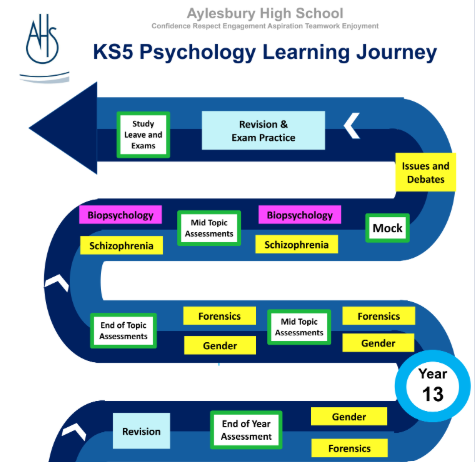
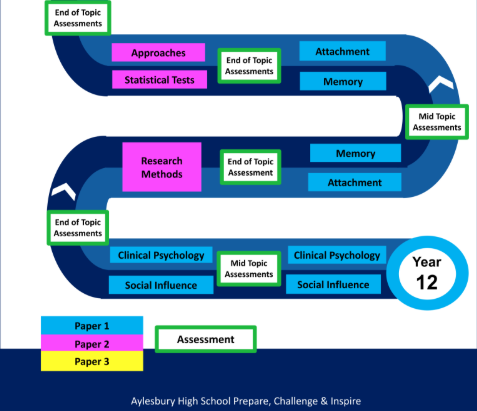
This link takes you to the AQA specification for Psychology A Level, which contains all the necessary course information. Assessments take place throughout the 2 years of the course, in addition to Year 12 exams and mocks in the spring term of Year 13.
How will I be assessed?
| Paper 1 33 1/3 % | Paper 2 33 1/3 % | Paper 3 33 1/3 % |
|---|---|---|
|
Written exam – 2 hours Questions Section A: multiple choice, short answer and extended writing, 24 marks Section B: multiple choice, short answer and extended writing, 24 marks Section C: multiple choice, short answer and extended writing, 24 marks Section D: multiple choice, short answer and extended writing, 24 marks |
Written exam – 2 hours Questions Section A: multiple choice, short answer and extended writing, 24 marks Section B: multiple choice, short answer and extended writing, 24 marks Section C: multiple choice, short answer and extended writing, 48 marks |
Written exam – 2 hours Questions Section A: multiple choice, short answer and extended writing, 24 marks Section B: one topic from option 1, 9–11 above, multiple choice, short answer and extended writing, 24 marks Section C: one topic from option 2, 12–14 above, multiple choice, short answer and extended writing, 24 marks Section D: one topic from option 3, 15–17 above, multiple choice, short answer and extended writing, 24 marks |
Psychology Assessment and Essay guidance
Subject impact
Evidence of impact can be seen in students’ ability to understand and recall information, but more importantly to select and apply this knowledge to new contexts and scenarios. Routine mid-topic and end-of-topic assessments provide the opportunity to address misconceptions and facilitate appropriate teacher interventions.
Impact can be measured in terms of progression throughout the course. When learning a new topic, students are able to draw upon prior learning and see the connections between different areas of knowledge. For example, students can effectively recall and apply core content from Year 12 topics such as Research Methods and Approaches when learning new topics in Year 13.
Key measures are the final examination results and student progress in relation to their target grade. Our examination results for A-Level Psychology are consistently well above the national average, with the majority of students attaining at or above their target grade.
Impact is also evidenced by how prepared students feel for further study and the world of work. The variety of teaching and learning strategies employed throughout the two-year course gives students confidence and a base of transferable skills in areas such as revision and exam technique, discussion and debate, working as a team, delivering presentations and conducting research. Furthermore, students who go on to study Psychology or related subjects at university will have secured a solid grounding in psychological theory and research methods.
Finally, students express their enjoyment of Psychology, the quality of teaching they receive and their appreciation of the knowledge and skills they gain from studying this A Level. This can be observed in the engagement of students during lessons and is routinely recorded in student voice feedback.
Feedback in Psychology lessons
Feedback in Psychology helps you see what you're doing well and where you can improve, making your learning more effective. We use a variety of methods, including verbal, written, or online feedback. Self-reflection is always a vital step in this process and is routinely encouraged in class.
|
Type of Feedback |
Function of this Feedback |
Example of when this is used |
|
Verbal |
Teachers can provide instant feedback during lessons, either individually or to the whole class. | During discussions/debates/presentations in lessons. |
|
Written |
Teachers can provide comments on student work, identifying what went well (WWW) and highlighting areas for improvement (EBI). Marking codes and assessment grids are used to summarise teacher feedback. |
Mid/End of topic tests and some handwritten homework assignments. |
|
Online |
Teachers can also provide feedback on digital assignments via Google Classroom. Rubrics or AI can be used to immediately assess multiple choice/short answer responses and suggest improvements. |
Some Google Classroom assignments. Google Form quizzes. Seneca Learning activities. |
|
Self-assessment |
Students can reflect on their own work, identifying their strengths and weaknesses, using guidance/mark schemes shared by the teacher in class. Students are always asked to complete post-test reflections on their ‘Progress Tracker’, to help them to make progress. |
Some class/homework assignments and selected questions in mid/end of topic tests.
|
|
Peer assessment |
Students can provide feedback to each other, learning from one another's work. | Some class/homework assignments and selected questions in mid/end of topic tests. |
School values in Psychology
| Boundless Aspiration | Curious Engagement | Resilient Bravery | Selfless Generosity |
|---|---|---|---|
|
|
|
|