Science
Welcome to Key Stage 3 Science at AHS. Our curriculum is designed to ignite curiosity, challenge critical thinking, and build a powerful foundation for understanding the natural world. By introducing students to the core principles of Biology, Chemistry, and Physics, we encourage them to ask big questions, solve complex problems, and develop a lifelong passion for discovery.
From their very first term, students are immersed in hands-on laboratory experiences. We place practical work at the centre of our curriculum, teaching students to think and act like true scientists. Through the Working Scientifically framework, they master vital experimental skills—ranging from the safe handling of chemicals and the use of microscopes to utilising digital data loggers. We don't just teach facts; we teach students how to analyse data, evaluate evidence, and build the resilience required to navigate the scientific process.
In Years 7 and 8, our integrated approach builds seamlessly on primary school foundations. Students explore two major topics per year within each of the three core disciplines. They engage deeply with the "big ideas" of science, such as the relationship between structure and function in living organisms, the particulate model of matter, and the mechanisms of energy transfer.
At AHS, science extends far beyond textbooks. We integrate contemporary, topical issues like sustainability and environmental ethics directly into our modules, empowering students to consider the wider impact of scientific progress.
By the conclusion of Key Stage 3, our students emerge as scientifically literate, mathematically confident, and deeply curious individuals—fully prepared for the academic rigours of their GCSEs and equipped to understand the fast-moving world around them.
Student resources
The Google Drive, Google Site and Clickview are only available for students and teachers of Aylesbury High School. The Google Drive and Google Site contain all Google-based resources used in lessons.
The other quick links are to websites we subscribe to with extra resources. Students have their own login details given to them by the school.
| AHS only resources | Web based quick links |
Web based quick links |
|---|---|---|
|
|
|
|






Extension work & wider reading at Key Stage 3 (Years 7-9)
If you have finished all the work set on Google Classroom/in lessons very quickly and/or if you’re looking for Science things to do to stop you getting bored, try out some of these suggestions.
Some interesting websites
https://www.natgeokids.com/uk/category/discover/science/
https://www.science-sparks.com/science-experiments-for-teens/
https://www.sciencejournalforkids.org/
https://spark.iop.org/collections/marvin-and-milo
https://student-tutor.com/blog/top-science-experiments-for-kids-and-teens/
https://www.mkewithkids.com/post/here-are-two-weeks-worth-of-fun-and-easy-science-experiments/
Some interesting videos/TV shows and Podcasts
https://www.bbc.co.uk/iplayer/episodes/m0026y0p/horrible-science
https://www.bbc.co.uk/sounds/brand/m000fwyj
https://www.youtube.com/watch?v=lTxvhITF0p0
https://www.bbc.co.uk/iplayer/episodes/m001f1tg/the-secret-genius-of-modern-life
https://www.bbc.co.uk/programmes/m001f1tg
Subject intent
Key Stage 3
Key Stage 3 Science introduces students to the exciting worlds of Biology, Chemistry and Physics. They also get the chance to develop their experimental skills. Their curiosity and interest is stimulated through a wide range of practical work, problem-solving, and ICT-based activities. By the end of Key Stage 3 students have a strong foundation of knowledge which they will build upon at GCSE level.
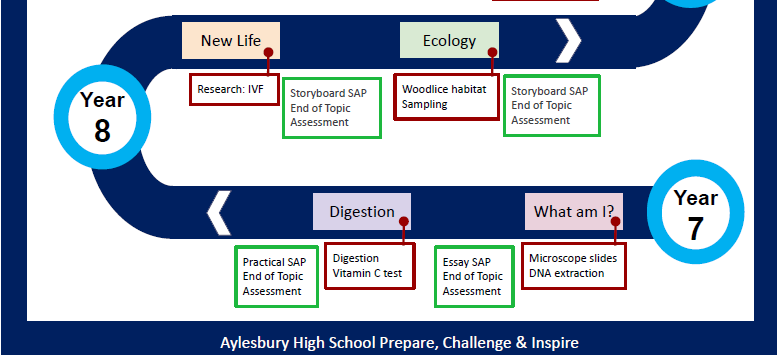
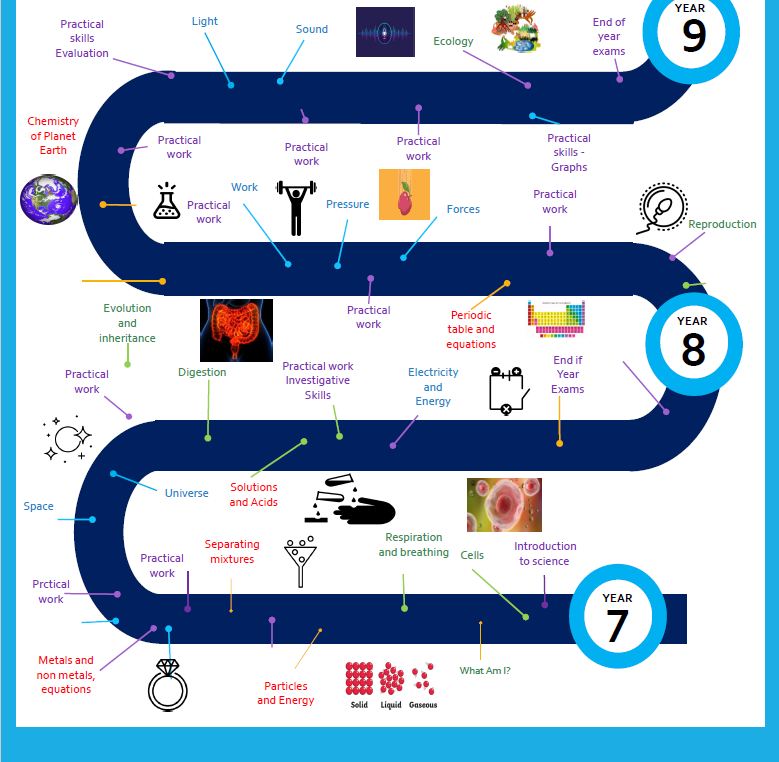
Year 7 starts with ‘Introduction To Science’, which starts to develop the skills that students will need to progress in Science. We develop these skills further in Year 7 and Year 8, building upon what students will have studied at Key Stage 2. Students study 2 topics from each of the three disciplines.
Year 8 builds upon and further develops the concepts that students meet in Year 7. We also introduce key ideas and skills that students will meet again in more depth during the GCSE years.
Key Stage 3 (Years 7-9) course implementation, learning journey & attainment.
Course content
| Year 7 | Year 8 |
|---|---|
|
|
Learning Journey
Biology
Chemistry
Physics
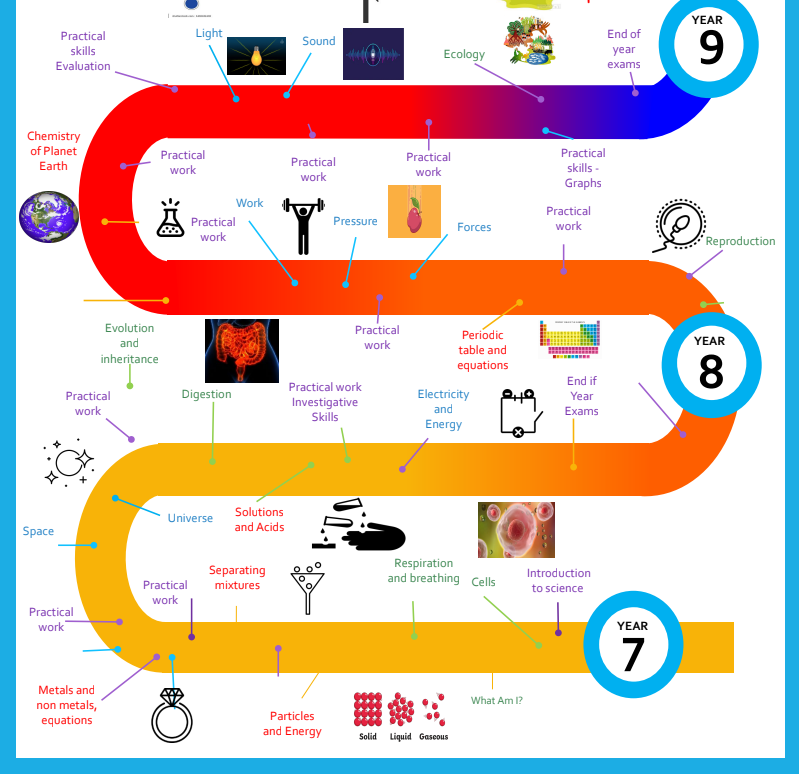
Year 7 attainment descriptors
At Key Stage 3, we focus on skills and literacy across the sciences, in addition to having more specific focusses on the 3 individual sciences.
Working Towards
| Skills | Literacy | Biology | Chemistry | Physics |
|---|---|---|---|---|
|
|
|
|
|
Working At
| Skills | Literacy | Biology | Chemistry | Physics |
|---|---|---|---|---|
|
|
|
|
|
Working Beyond
| Skills | Literacy | Biology | Chemistry | Physics |
|---|---|---|---|---|
|
|
|
|
|
Year 8 attainment descriptors
At Key Stage 3, we focus on skills and literacy across the sciences, in addition to having more specific focusses on the 3 individual sciences. These statements are on top of what students learn to do in Year 7.
Working Towards
| Skills | Literacy | Biology | Chemistry | Physics |
|---|---|---|---|---|
|
|
|
|
|
Working At
| Skills | Literacy | Biology | Chemistry | Physics |
|---|---|---|---|---|
|
|
|
|
|
Working Beyond
| Skills | Literacy | Biology | Chemistry | Physics |
|---|---|---|---|---|
|
|
|
|
|
Subject impact
Key Stage 3
Scientific knowledge and conceptual understanding
Developed through the disciplines of biology, chemistry and physics. Our schemes of work give students an understanding of the big ideas in science, e.g. the links between structure and function in living organisms, the particulate model as the key to understanding the properties of matter, and the transfer of energy.
Nature, processes and methods of science
Different types of investigative techniques help students to answer scientific questions about the world around them. Students are taught about working scientifically through a range of practical investigations.
Uses and implications
Evaluation and critical analysis of information is encouraged. In recent years, we have incorporated topical issues into our teaching, such as sustainability and the environment.
Our booklets help EAL students and templates are also provided. Glossaries are used to encourage the learning of scientific vocabulary.
By the end of year 8, students have:
-
Gained confidence and competence in manipulating equations, drawing graphs, and using mathematics to solve problems, including units in their answers.
-
Gained an understanding of the concepts, often abstract, covered in Science.
-
Be competent in using a range of apparatus, including data loggers to investigate relationships and gather data.
-
Gained knowledge of how Science is useful in the outside world, including an awareness of careers where a knowledge of Science is useful.
-
Gain skills in answering exam-style questions, including: carefully reading questions, extracting key information, carrying out calculations, or giving an explanation in sufficient detail.
Feedback in Science lessons
This chart explains the types of feedback that students can expect to receive for work done in geography lessons/at home.
| Activity | Types of feedback |
|---|---|
|
Assessments |
Written feedback or done via Google Classroom |
|
Written tasks |
Written feedback or done via Google Classroom |
|
Lesson & homework activities |
Self-assessment, peer-assessment, automatically marked online. |
|
Oral work in class |
Verbal feedback |
School values in Science
| Boundless Aspiration | Curious Engagement | Resilient Bravery | Selfless Generosity |
|---|---|---|---|
|
|
|
|
