
Aylesbury High School
Physics
Welcome to Physics at AHS, where we hope to inspire and empower the next generation of female scientists, thinkers, and innovators. To ensure a smooth academic journey, our curriculum seamlessly bridges the gap between Key Stage 3 Science and Key Stage 4, easing your daughter's transition by introducing fundamental GCSE concepts during Year 9. From Year 9, students follow the AQA GCSE Physics specification, which we deliver via a spiral curriculum to continually improve knowledge retrieval and reinforce the vital links between core concepts. For those students who choose to progress to Key Stage 5, we offer the OCR A Level Physics course, challenging them to delve deeper into advanced fields like astrophysics, medical imaging, and quantum mechanics, having mastered the core concepts of energy, forces, electricity and waves.
We believe that exceptional physics education extends far beyond the classroom. To spark real-world ambition, our Year 13 students embark on an unforgettable trip to CERN in Geneva to witness cutting-edge particle physics firsthand, while our Year 12 students have enjoyed enriching 'Physics in Action' lecture days, virtual tours or Particle Physics workshops. Within our school community, students will be fully supported by dedicated help clinics and our vibrant, student-led STEM Society, run passionately by our Year 12 physics ambassadors. Together, we foster a supportive, high-achieving environment where your daughter can develop the analytical mind and confidence needed to shape the future of STEM.
Student resources
The Google Site and Clickview are only available for students and teachers of Aylesbury High School. The Google Site provides access to all Google-based resources used in lessons.
The other quick links are to websites we subscribe to with extra resources. Students have their own login details given to them by the school.
| AHS only resources | Web based quick links GCSE | Web based quick links GCSE & A Level |
Web based quick links A Level |
|---|---|---|---|
|
|
|
|
|










All extension and revision work for Physics is organised through the Google Site.
Subject intent
Key Stage 4
We aim to build on the solid foundation of knowledge and skills developed at Key Stage 3, while the complexity of practical skills, mathematical techniques and concepts increase.
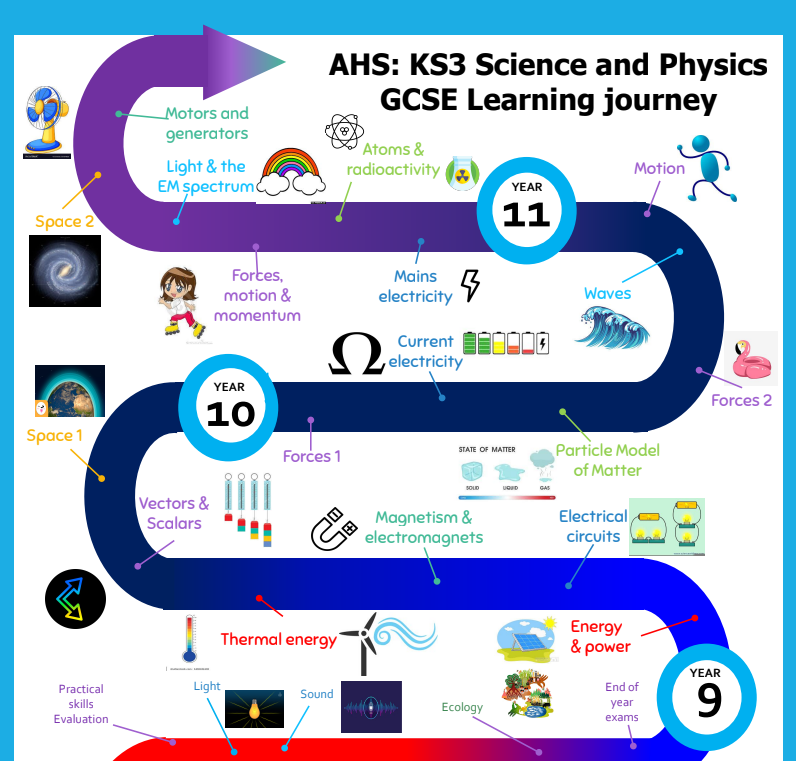
GCSE Physics now starts at the beginning of Year 9 & we begin with the fundamental concepts of Energy & Power, before moving onto Electrical Circuits, Thermal energy transfers, Magnetism and Forces, and finishing with Space, which tends to fascinate a range of students and so builds their interest and enthusiasm.
During year 10, we begin with another module of Forces. The ideas within Forces and Energy are revisited throughout the course and also give an excellent opportunity to introduce the mathematical nature of Physics. The Current Electricity topic comes next, building on Circuits from year 9 and covers some of the more abstract concepts, such as potential difference and static. We continue with some more Energy calculations, and then Particles and their behaviour and Waves, before revisiting each topic area at least once more in order to introduce and develop the more complex and demanding ideas. This trend of raising complexity continues, with Nuclear Physics, more Space and Electromagnetism near the end of the course.
Key Stage 5
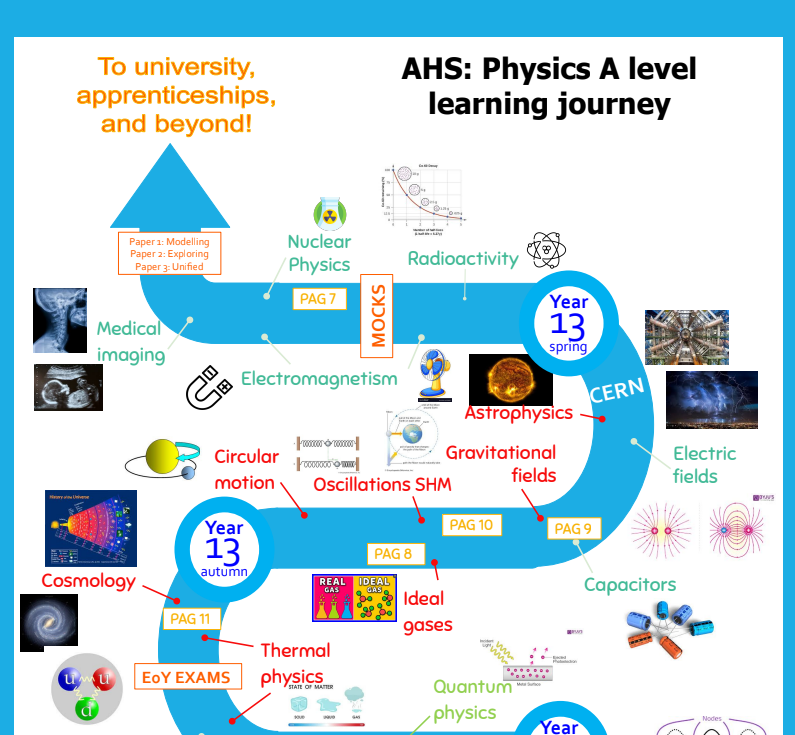
The A level journey starts with Foundations of Physics, as we have found students make better progress when actually taught this as a standalone topic, whilst continuing to develop the skills throughout the course. Running in parallel, students study Electricity, as these ideas continue seamlessly from GCSE and it is one of the less mathematically challenging topics. Waves and Forces and Motion follow, with the abstract Quantum Physics being taught towards the end of Year 12. Particle Physics and Thermal Physics then start the Year 13 section of the course.
Year 13 continues with Ideal Gases, Gravitational and Electric fields, Fields, Capacitors, Radioactivity and Electromagnetism taught at the end of the course. PAGs provide the opportunity to show progression of practical skills, introduced in the Foundations module and consolidated during lessons. Experimental and analytical skills are assessed within the final exams.
Key Stage 3 (Years 7-9) course implementation, learning journey & attainment.
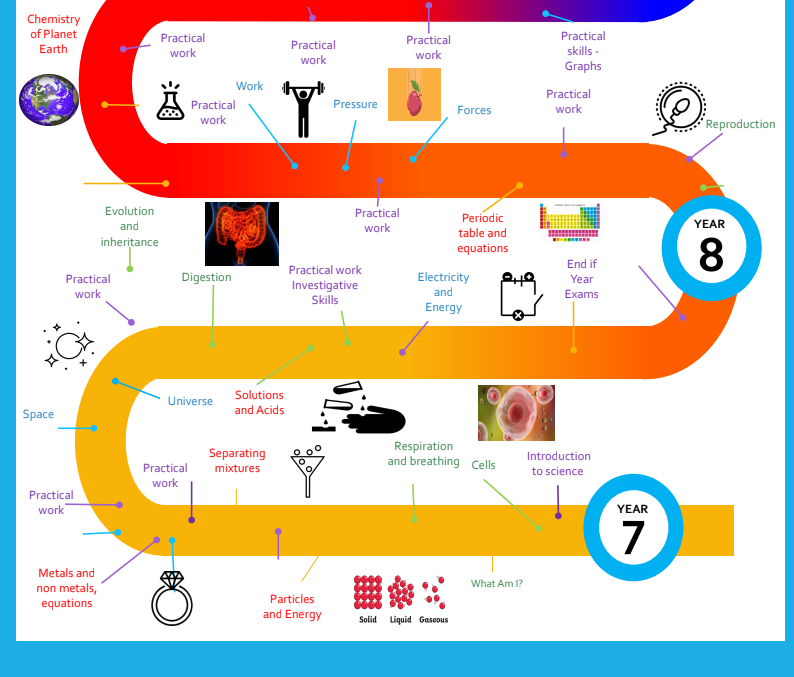
In Years 7 and 8, students do science, but at the start of Year 9 they start their individual science courses for GCSE. Therefore, in Year 9, students begin studying GCSE Physics.
Course content
| Year 9 |
|---|
|
Learning Journey
Year 9 attainment descriptors
In Year 9, even though students start their GCSE Physics course, we still give them WT/WA/WB attainment grades in order to fit in with the rest of the curriculum. Students are assessed on their ability in 4 key areas:
- Knowledge and understanding
- Application and analysis
- Problem-solving
- Practical skills and evaluation
Please see the GCSE assessment requirements to further your understanding of how GCSE Physics is assessed.
Key Stage 4 (Years 10-11) course implementation, learning journey & assessment info.
Course content
| Year 10 | Year 11 |
|---|---|
|
|
Learning journey
At GCSE level, students are assessed on their ability in 4 key areas.
- Knowledge and understanding
- Application and analysis
- Problem-solving
- Practical skills and evaluation
This link takes you to the AQA specification, which contains all the necessary course information. Assessments take place throughout the 2 years of the course, in addition to Year 10 exams and mocks in the spring term of Year 11.
How will I be assessed?
The following summary is based upon students doing the Higher papers.
| Paper 1 50% | Paper 2 50% |
|---|---|
|
Topics 1–4:
Written exam – 1 hr 45 mins • Multiple choice, structured, closed short answer and open response |
Topics 5-8:
Written exam 1h4 45 mins • Multiple choice, structured, closed short answer and open response. |
Key Stage 5 (Years 12-13) course implementation, learning journey & assessment info.
Course content
| Year 12 | Year 13 |
|---|---|
|
|
Learning journey
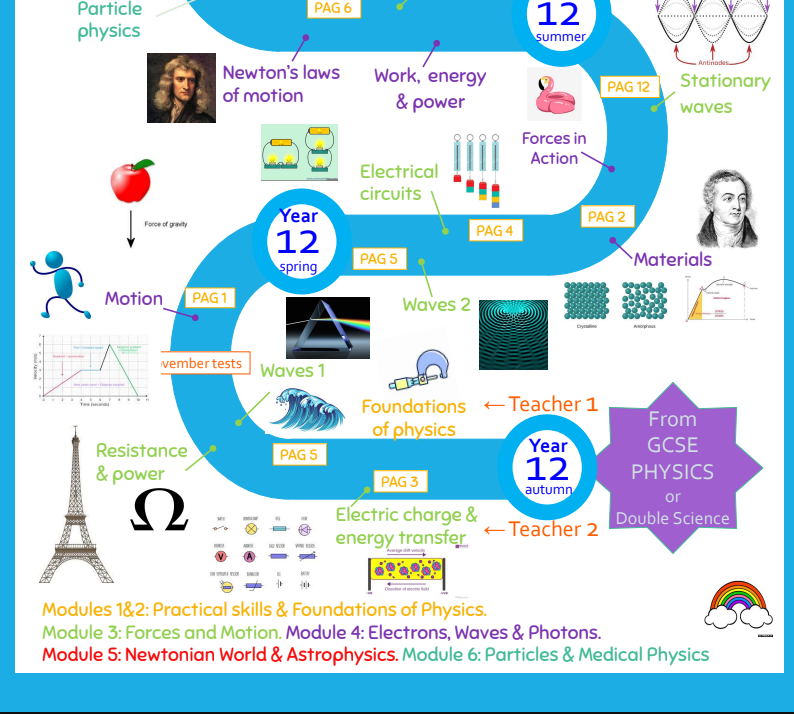
At A level, students are assessed on their ability in 3 key areas:
- Knowledge and understanding of scientific ideas, processes, techniques and procedures.
- Application of knowledge and understanding of scientific ideas, processes, techniques and procedures:
- Analyse, interpret and evaluate scientific information, ideas and evidence, including in relation to issues
This link takes you to the OCR specification, which contains all the necessary course information. Assessments take place throughout the 2 years of the course, in addition to Year 12 exams and mocks in the spring term of Year 13.
How will I be assessed?
We do monthly progress tests as our ongoing method, along with experimental work (PAGs)
| Paper 1 – Modelling Physics 37% | Paper 2 – Exploring Physics 37% | Paper 3 - Unified Physics 26% | Practical endorsement in Physics |
|---|---|---|---|
|
Written exam – 2hrs 15 mins |
Written exam – 2hrs 15 mins |
Written exam – 1 hr 30 mins |
NEA |
Subject impact
Key Stage 4
By the end of year 11, students have:
-
Studied all the topics included in the specification
-
Gained confidence and competence in manipulating equations, converting to SI units, including units in their answer
-
Gained an understanding of the concepts, often abstract, covered in Physics
-
Be competent in using a range of apparatus, including data loggers, to investigate relationships and gather data
-
Gained knowledge of how Physics is useful in the outside world, including an awareness of careers where a knowledge of Physics is useful.
-
Gain skills for answering exam-style questions, to include carefully reading the question, extracting the important parts, carrying out a calculation and considering the answer is reasonable, or giving an explanation in sufficient detail for the marks available.
-
Have sufficient knowledge to make an informed decision about continuing the subject to A Level
We will monitor the progress of all students, in particular, to ensure PP and SEND students meet expectations and have additional support as necessary. All lessons will include a selection of several from the following:
-
Experiment
-
Group work
-
Discussion
-
Screen presentation shared electronically
-
Work in the booklets, with the booklets shared electronically
-
Demonstration
This is to make understanding the concepts accessible to all students, whatever their preferred learning style.
Key Stage 5
-
Studied all the topics included in the specification
-
Gained confidence and competence in manipulating the more complex equations in A Level
-
Gained a deep understanding of the concepts, often abstract, covered in Physics
-
Be competent in using a wide range of apparatus, including data loggers to investigate relationships and gather data. Also, using IT to process and present the data
-
Gain skills for answering exam-style questions, to include carefully reading the question, extracting the important parts, carrying out a calculation and considering the answer is reasonable, or giving an explanation in sufficient detail for the marks available.
-
Gain the skills to work and study independently and as part of a team
We will monitor the progress of all students, in particular, to ensure PP and SEND students meet expectations and have additional support as necessary. All lessons will include a selection of several from the following:
-
Experiment
-
Group work
-
Discussion
-
Screen presentation shared electronically
-
Work in the booklets, with the booklets shared electronically
-
Demonstration
This is to make understanding the concepts accessible to all students, whatever their preferred learning style.
Feedback in Physics lessons
This chart explains the types of feedback that students can expect to receive for work done in physics lessons/at home.
| Activity | Types of feedback |
|---|---|
|
Assessments/tests |
Marked by teacher → Time to go through answers and whole class feedback, opportunity for DIRT* |
| Written tasks e.g. long explanations |
In class, verbal one-to-one/sometimes written or self-assessed against mark schemes. We are going to do more of this! |
| Written and mathematical problems | Whole class or one to one while circulating |
| Oral contributions in class | Verbal – hopefully encouraging! |
| Mini whiteboard activities | Whole class, verbal or think pair, share discussion – this is great both ways. |
| Classwork | Verbal with suggestions on technique or approaches – when circulating |
| Exercise books/booklets | In class or taken in if homework is set, sometimes self or peer marked |
| Google quiz | Mix of auto marking and teacher assessed |
| Homework | Usually in class, whole class is self-assessed and corrected, but it does depend on the task. |
| Kerboodle. Seneca and eRevision | Auto-marked – you can look back over your answers for next time. |
| Carousel | Self-marked with opportunity – great opportunity for retrieval practice (watch out for those arriving over the coming months) |
School values in Physics
| Boundless Aspiration | Curious Engagement | Resilient Bravery | Selfless Generosity |
|---|---|---|---|
|
|
|
|