
Aylesbury High School
Art
The Art and Design curriculum develops creative and critical thinking, equipping students with proficiency in handling different media, processes and techniques as well as developing recording skills through drawing and making. Students develop their intellectual curiosity in contextual and historical sources through practical and written investigations. The curriculum prepares them for their next steps and helps to develop skills that are useful in any career.
Student resources
The Google Site is only available to students and teachers of Aylesbury High School. The Google Arts Site contains extra resources and links to further learning and understanding.
The other quick links are to websites with extra resources.
Extension work & wider reading at Key Stage 3 (Years 7-9)
Art & Design Reading List for Key Stage 3 (Years 7-9)
Book - specific about art
- We Are Artists by Kari Herbert
- A History of Pictures for Children by David Hockney
- Art of Protest: What a Revolution Looks Like by De Nichols
- Black Artists Shaping the World by Sharna Jackson
- The Bigger Picture – Women who changed the world by Sophia Bennett
- How to Look at Art. By Susie Hodge
- Steal like an Artist. By Austin Kleon
- Creative Photoshop: Digital Illustration and Art Techniques - Derek Lea
- Splat! The Most Exciting Artists of All Time - Mary Richards
- The Best Ever Jobs in Art - Rob Colson
- How Art Works - Sarah Hull
- Vincent’s Starry Night and Other Stories by Michael Bird
- The Artist’s Manual by Angela Gair
Fiction with art stories
- Bitter by Akwaeke Emezi
- The Goldfinch by Donna Tartt
- Girl With a Pearl Earring by Tracy Chevalier
- Draw the Line by Laurent Linn
- Starfish by Akemi Dawn Bowman
- Behind the canvas by Alexander Vance
- Anneli the Art Hater Anne Fine
- The Van Gogh Deception (The Lost Art Mysteries) by Deron R Hicks
- The Rembrandt Conspiracy (The Lost Art Mysteries)
Stories about the artist
- Grayson Perry: Portrait Of The Artist As A Young Girl by Grayson Perry (Author), Wendy Jones (Author)
- Who Was Frida Kahlo? by Sarah Fabiny
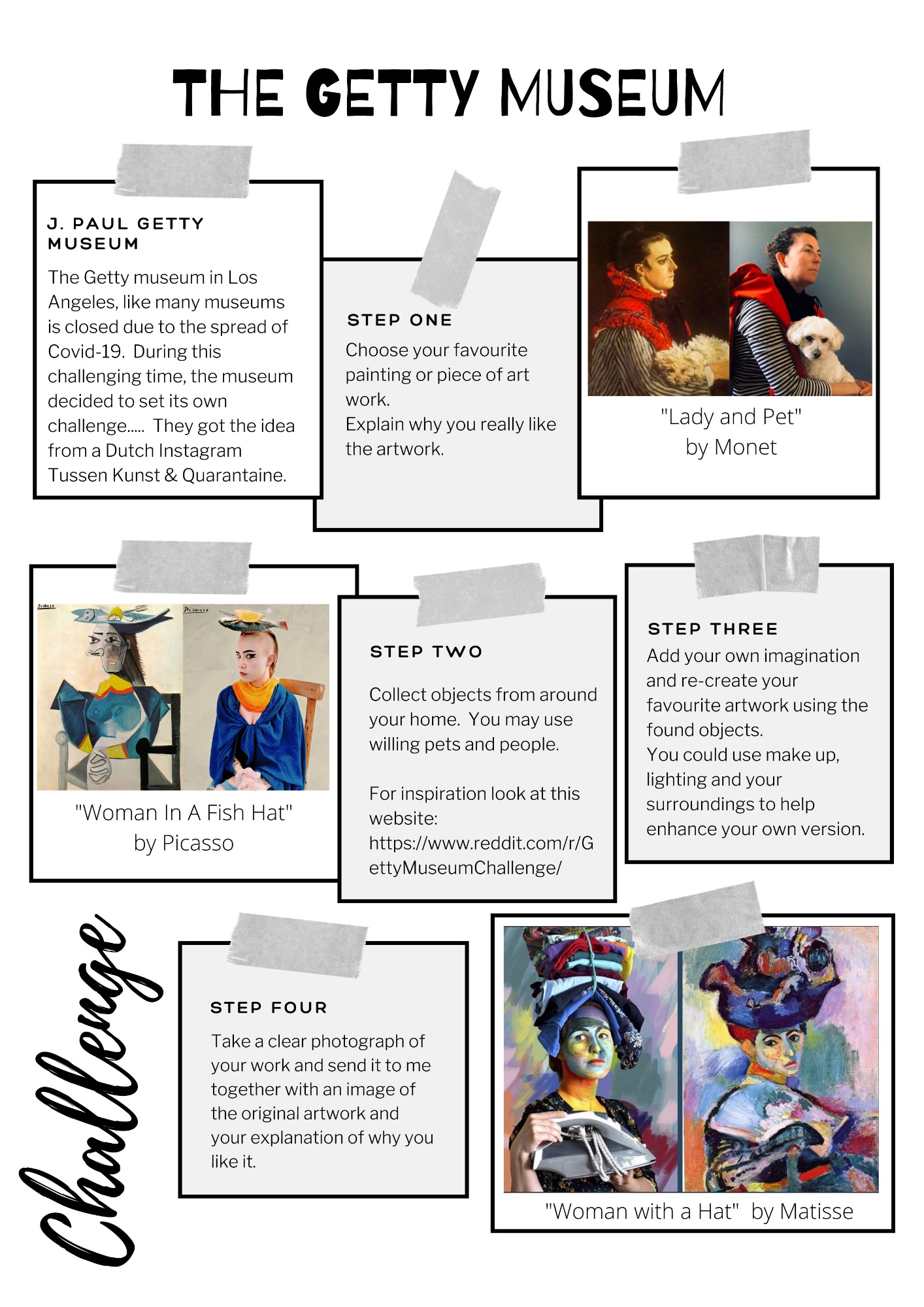
Home Learning Drawing Challenge Years 7-13
How to make your own sketchbook
Mock turtle unit
Tim Burton unit
Photography challenge
Extension work & wider reading at Key Stage 4 (Years 10-11)
Art & Design Reading List for Key Stage 4 (Years 10-11)
Book - specific about art
- We Are Artists by Kari Herbert
- A History of Pictures for Children by David Hockney
- Art of Protest: What a Revolution Looks Like by De Nichols
- Black Artists Shaping the World by Sharna Jackson
- The Bigger Picture – Women who changed the world by Sophia Bennett
- How to Look at Art. By Susie Hodge
- Steal like an Artist. By Austin Kleon
- Creative Photoshop: Digital Illustration and Art Techniques - Derek Lea
- Splat! The Most Exciting Artists of All Time - Mary Richards
- The Best Ever Jobs in Art - Rob Colson
- How Art Works - Sarah Hull
- Vincent’s Starry Night and Other Stories by Michael Bird
- The Artist’s Manual by Angela Gair
Fiction with Art stories
- Bitter by Akwaeke Emezi
- The Goldfinch by Donna Tartt
- Girl With a Pearl Earring by Tracy Chevalier
- Draw the Line by Laurent Linn
- Starfish by Akemi Dawn Bowman
- Behind the canvas by Alexander Vance
- Anneli the Art Hater Anne Fine
- The Van Gogh Deception (The Lost Art Mysteries) by Deron R Hicks
- The Rembrandt Conspiracy (The Lost Art Mysteries)
Stories about the Artist
- Grayson Perry: Portrait Of The Artist As A Young Girl by Grayson Perry (Author), Wendy Jones (Author)
- Who Was Frida Kahlo? by Sarah Fabiny
Home Learning Drawing Challenge Year 7-13
How to make a sketchbook
Mock turtle unit
Tim Burton unit
Photography challenge
GCSE & A Level Home Learning
Extension work & wider reading at Key Stage 5 (Years 12-13)
Art & Design A Level Reading list:
- This Is Modern Art - Matthew Collings
- A world History of Art - Honour and Flemming
- Ways of Seeing - John Berger
- The Story of Art- E.H Gombrich
- Your Sketchbook Your Self- Felicity Allen
- Art Now
- Isms….Understanding Modern Art - Sam Phillips
- Why Your Five Year Old Could Not Have Done That by Susie Hodge
- Thinking About Art: A Thematic Guide to Art History
- Ways of Looking: How to Experience Contemporary Art - Ossian Ward
- How to Write About Contemporary Art - Gilda Williams
- Steal Like an Artist by Austin Kleon
- Broad Strokes: 15 Women Who Made Art and Made History (in That Order) by Bridget Quinn
- The Art Forger by Barbara A. Shapiro
- Shock of the New by Robert Hughes
- Drawing on the Right Side of the Brain by Betty Edwards
- Seven Days in The Art World by Sarah Thornton
- 150 Photographic Projects for Art Students by John Easterby
- Why Does it not have to be in focus - Jackie Higgins
- 100 ideas that changed photography by Mary Marien
- A Big Important Art Book. By Danielle Krysa
Home Learning Drawing Challenge Year 7-13
How to make a sketchbook
Mock turtle unit
Tim Burton unit
Photography Challenge
GCSE & A Level Home Learning
Subject intent
We aim to encourage open-minded, creative, critical and reflective thinkers who have the courage and confidence to be independent as they reflect the world in a visual form.
We aim to provide a vibrant and dynamic curriculum that will give students the freedom to explore their creativity, inspire design ideas, whilst equipping them with the skills to continue the subject with confidence at A-Level and beyond.
Co-curricular opportunities foster a love for the subject and offer opportunities to develop imagination and leadership skills and encourage students to take on roles of responsibility.
Careers are linked to SOW and are relevant in line with the Gatsby Benchmarks.
Key Stage 3 (Years 7-9) course implementation, learning journey & attainment
The Art curriculum aims for students to learn about the work of a range of artists, designers and craftspeople and work within a range of contexts and disciplines. Students will explore and investigate contemporary and historical art as well as study a variety of cultural traditions from around the world. This ensures that students have a deeper understanding of artistic techniques and styles.
Students will develop appropriate research skills through guidance towards self-directed research tasks.
Students will learn how to constructively value and judge their own work and the work of others. Students will use visual language and literacy skills to express themselves effectively and communicate ideas, which will enable them to produce creative outcomes.
Students will be encouraged to problem-solve through manipulating materials, processes, responding, experimenting and adapting their thinking to arrive at creative outcomes. Co-curricular opportunities are important at Key Stage 3 and take the form of lunchtime clubs, House Art, regular competitions and Creative Arts Activity Day.
Course content
| Year 7 | Year 8 | Year 9 |
|---|---|---|
|
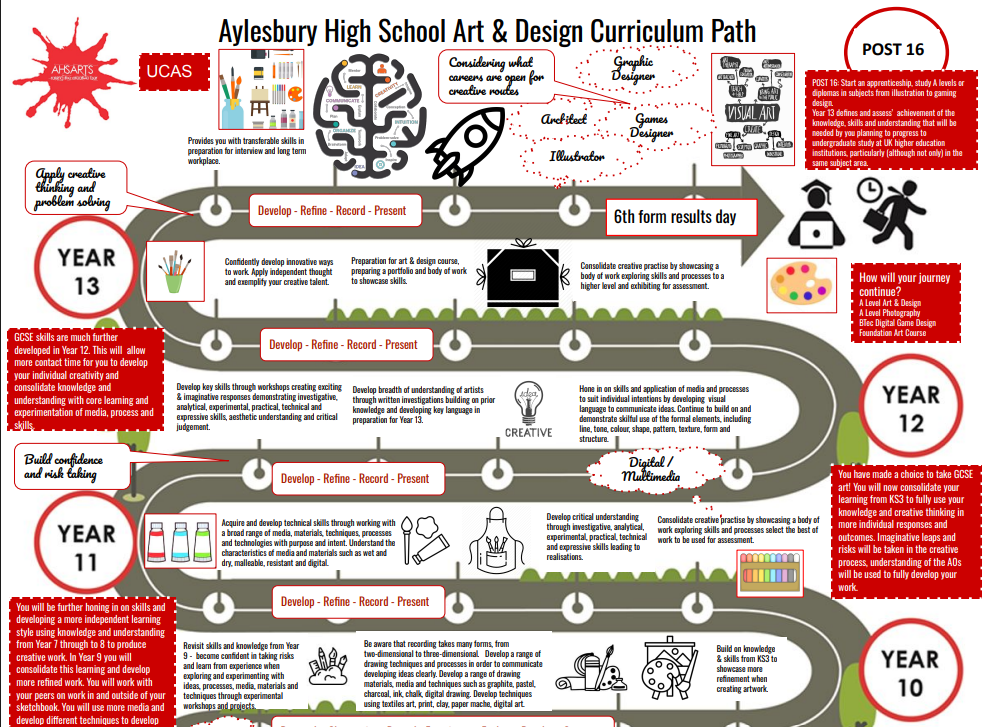
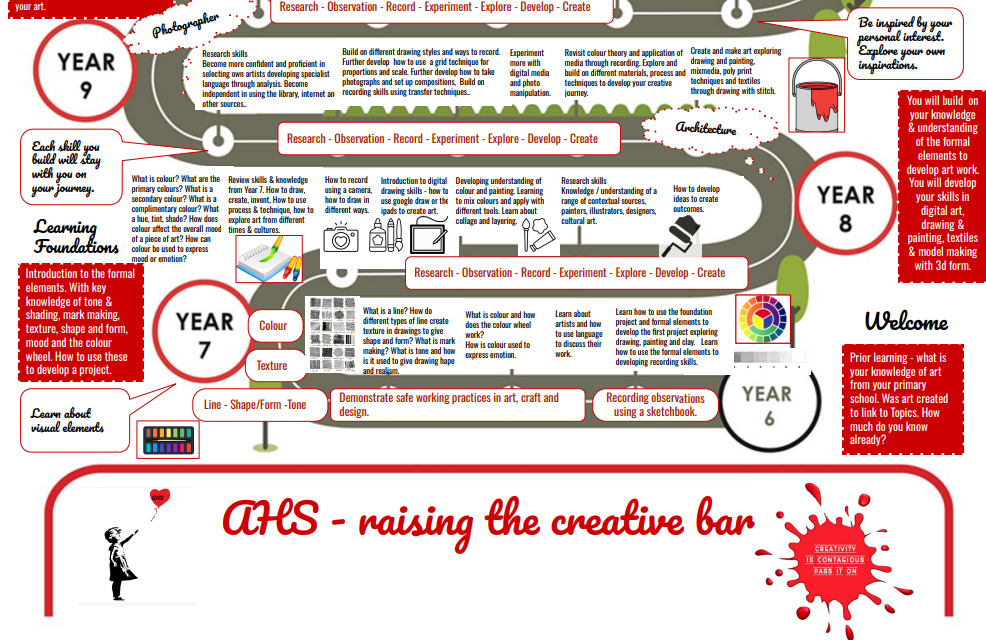
Students will explore two to three different topics: Introduction to Art and Design: In the first half of the term, students will learn about what art is and develop different skills relating to the formal elements before completing a test to conclude the induction period. Under the sea: Students will develop their recording skills through design by looking at the natural world for inspiration. They will build on their prior knowledge of the formal elements to develop their understanding through a range of recording tasks. They will primarily record ideas looking at fish and packaging before experimenting with clay. They will look at artists for inspiration, developing their ideas in creating a clay vessel piece of art.
|
Students will create work on two different projects: Facial Features: Students will further develop their recording skills using a variety of different styles of drawing related to facial features. They will use grid drawing techniques to help look at proportion and scale as well as free drawing. They will learn about new processes and techniques using a variety of different art disciplines to develop their skills and build on existing knowledge from Year 7. Some of these are painting, digital art and installation art using found materials. They will look at a variety of art forms as they develop their practical and written investigations building on their reading, literacy and oracy skills. Architecture ~ Our Town: Students will begin to use more complex uses of the formal elements. They will advance their drawing using different forms and record with a variety of media, exploring processes and techniques ranging from drawing, collage, digital art print and sculpture. They will deepen their understanding of artists and designers' work from various time periods and styles. They will extend their written and visual communication, looking to develop annotations and evaluate their ideas. Students will develop their understanding of design and make links with careers. |
Students will create work inspired by two different projects: Students will continue a broad curriculum in Art and Design. Projects will provide a more in depth, thorough and comprehensive understanding of skills and knowledge developed throughout the key stages. Students will consolidate their learning from Year 7, 8 and 9 by completing the Key Stage 3 curriculum. Students opting for GCSE in this subject will have the building blocks to further develop their creative practice as they begin more independently-led work. Diversity: Students will learn about diversity and what this means to them and what it means as an artist. Students will develop individual outcomes and work as a team, creating a collaborative piece. Students will use a wide range of diverse artists looking specifically at Identity and use this to inform their own ideas. They will explore drawing, collage, pattern, print, photography and digital art. Taking a Leap: Summer Project: |
Learning Journey
Grade & Attainment descriptors
These attainment descriptors clarify the skills/knowledge needed for the different levels of attainment in Years 7-9.
We split the grade descriptors into 4 categories:
| Artists - develop | Materials - refine | Drawing - record | Final piece - present |
|---|---|---|---|
| To look at the work of a range of artists who use recording in various ways. To respond visually & contextually to processes & techniques. To use this to develop & create a personal response and final outcome. | To explore the qualities & limitations of media & materials. To refine sketching & tonal awareness as well as experiment with media & processes. To refine & modify development. | To record observations & show visual knowledge through sketching & other forms. To use written annotations & notes to help support & explain visual work. |
To create a visual outcome using the knowledge & investigations from your sketchbook. Outcomes should be inspired by artists. To understand how to make a piece of art that is personal & shows links with sketchbook work. |
For each of these categories there is then a description of what students need to do to achieve: Working Towards (WT), Working At (WA) and Working Beyond (WB).
Year 7 attainment descriptors
Working Towards
| Artists - develop | Materials - refine | Drawing - record | Final piece - present |
|---|---|---|---|
|
|
|
|
Working At
| Artists - develop | Materials - refine | Drawing - record | Final piece - present |
|---|---|---|---|
|
|
|
|
Working Beyond
| Artists - develop | Materials - refine | Drawing - record | Final piece - present |
|---|---|---|---|
|
|
|
|
Year 8 attainment descriptors
Working Towards
| Artists - develop | Materials - refine | Drawing - record | Final piece - present |
|---|---|---|---|
|
|
|
|
Working At
| Artists - develop | Materials - refine | Drawing - record | Final piece - present |
|---|---|---|---|
|
|
|
|
Working Beyond
| Artists - develop | Materials - refine | Drawing - record | Final piece - present |
|---|---|---|---|
|
|
|
|
Year 9 attainment descriptors
Working Towards
| Artists - develop | Materials - refine | Drawing - record | Final piece - present |
|---|---|---|---|
|
|
|
|
Working At
| Artists - develop | Materials - refine | Drawing - record | Final piece - present |
|---|---|---|---|
|
|
|
|
Working Beyond
| Artists - develop | Materials - refine | Drawing - record | Final piece - present |
|---|---|---|---|
|
|
|
|
Key Stage 4 (Years 10-11) course implementation, learning journey & attainment
Students continue to build on prior learning at Key Stage 3 having already developed foundation skills relating to the assessment criteria. Students will take an independent approach to their GCSE project and devise a topic to investigate that is usually personal to them.
Their ability to record, explore, experiment, analyse and make art is developed further through more risk and rigour. They apply a creative approach to problem-solving, and they are able to consider and develop original ideas from initiation to realisation. Students take ownership of their learning and can communicate this with Art staff through tutorials to make informed decisions and next steps for their work. They can express individual thoughts and choices confidently, they can take risks, experiment and learn from mistakes.
Students are encouraged to work outside their sketchbooks on large scales and to explore a range of ideas before producing realisations. The development process at GCSE is fundamental to the success of a project.
Co-curricular opportunities are vital at Key Stage 4 and the Art rooms are regularly used to further enhance their creative practice, House Art, regular competitions and trips to art galleries develop creative thinking.
Course content
| Year 10 | Year 11 |
|---|---|
|
At GCSE, students produce controlled assessment projects which form 60% of their final grade and complete an externally set assignment forming 40% of the GCSE. Throughout this course, students will record observations, develop ideas, experiment and refine techniques and designs, producing carefully developed outcomes. In Year 10, the first term allows for students to use a wide range of techniques that can be referenced during the independent project. Students produce theme-based projects as part of one of their controlled assessment units. Starting points have been ’Distort & Alter’, ‘Growth & Decay’, ‘Flora & Fauna’, and this year ‘Up Close’. They develop drawing skills, experiment with media and techniques, analyse and respond to the work of artists and craftspeople before developing their own ideas, leading to an outcome in their own choice of media. This can range from 2d to 3d. Students begin to master their skill set and develop a deeper understanding of art, craft and design. |
Students select their own independent line of enquiry following the GCSE assessment objectives, develop, refine, record and present. This could be inspired by an earlier theme or self-directed. They will develop their art by making independent choices, questioning materials, process and techniques. They will need to show imaginative risk-taking and thorough development of their work, showing skill and refinement. Students will conclude their line of enquiry through the development of an original and meaningful outcome response. An external set assignment will be released in January with directed themes in which students respond in a similar structure in preparation for their 10-hour final exam. |
Learning journey
At GCSE level, students are assessed on their ability in 4 different areas across 2 different assessments. This link takes you to the Edexcel specification, which contains all the necessary course information.
How will I be assessed?
| Component 1 - Personal Portfolio 60% | Component 2 - Externally Set Assignment 40% |
|---|---|
|
Development of a portfolio which contains evidence of the knowledge, skills and understanding from the specification. This component allows students opportunities to:
Work is internally set, moderated and standardised. A sample of centre work is externally moderated. |
10 hours This component draws together the knowledge, skills and understanding from component 1. Students must present personal response(s) to an externally set broad-based thematic starting point, set by Pearson in the ESA paper. The ESA is set for students on January 2nd each year. Work is internally set, moderated and standardised. A sample of centre work is externally moderated. |
| AO1 25% | AO2 25% | AO3 25% | AO4 25% |
|---|---|---|---|
| Develop ideas through investigations, demonstrating critical understanding of sources | Refine work by exploring ideas, selecting and experimenting with appropriate media, materials, techniques and processes | Record ideas, observations and insights relevant to intentions as work progresses | Present a personal and meaningful response that realises intentions and demonstrates understanding of visual language |
Key Stage 5 (Years 12-13) course implementation, learning journey & attainment
Students are now at the stage to fully implement their learning which has been developing throughout their Art education.
In Year 12 students have the opportunity to explore, expand and consolidate their technical skills and grasp of the assessment objectives by using the whole of the first year as an exploratory and investigative year, learning and honing skills, and gradually developing a sense of their own strengths in the subject.
Year 13 students are able to use the time to fully consolidate their expertise and hone in on selected skills and disciplines, taking risks and developing their work in their area of focus for the Contextual Study and producing work relating to that theme.
The A Level course enables students to work both independently and collaboratively, important skills that will transfer into society in any role. Engagement with the arts helps our students develop a sense of their own identity and value. The course facilitates degrees in the creative industries as well as prepares students for a future in whatever career they choose. Employers value people who can think creatively and innovatively alongside qualifications. Studying art facilitates these things as well as time management, which is a fundamental skill set valued by employees. Studying the arts teaches determination and resilience – qualities useful to any career.
Visual art education opens possibilities and opportunities for our students to discover themselves, their creativity, values, ethics, societies and cultures. Sixth Form students are given the opportunity to continue to develop their creative practice through study periods and be involved in House Art and take on an Art Ambassador role. Visiting artists, life drawing opportunities as well as trips to London and the summer residential to Amsterdam/ Paris enable students to develop the abilities to think critically and imaginatively; it fosters intercultural understanding, and an empathic approach to cultural diversity through their learning.
Course content
| Year 12 & 13 |
|---|
|
Students' conceptual understanding of art is pushed further, and they have the opportunity to explore media and its possibilities. Students taking A Level Art and Design will choose from a selection of starting points from one specific theme. They will learn how to address the assessment objectives with a foundation-style approach to learning. This will enable all students to explore, experiment and develop their understanding of materials and processes before branching off and becoming more independent, taking risks and developing skilful and imaginative work. Students will develop a more personal project in the second year of the A Level centred around a self-directed starting point. This will be an independent line of enquiry following the A Level assessment objectives, develop, refine, record and present. An Externally Set Assignment will form the culmination of the A Level with 40% of the marks awarded, on a theme set by the exam board. |
Learning journey
At A level, students are assessed on their ability in 4 different areas across 2 different assessments. This link takes you to the Eduqas specification, which contains all of the necessary course information.
How will I be assessed?
| Component 1 - Personal Portfolio 60% | Component 2 - Externally Set Assignment 40% |
|---|---|
|
The Personal Investigation consists of two integrated constituent parts: 1. a major in-depth critical, practical and theoretical investigative project/portfolio and outcome/s based on themes and subject matter that have personal significance; 2. an extended written element of 1000 words minimum, which may contain images and texts and must clearly relate to practical and theoretical work using an appropriate working vocabulary and specialist terminology. Both the practical/theoretical work and the written element will be assessed together using the assessment objectives. Learners will be required to select, evaluate and present their work for assessment. The Personal Investigation will be determined by the learner and teacher, assessed by the teacher and externally moderated. No time limit: duration to be determined by the centre. |
The Externally Set Assignment consists of two parts: Part 1: Preparatory study period
|
| AO1 25% | AO2 25% | AO3 25% | AO4 25% |
|---|---|---|---|
| Develop ideas through sustained and focused investigations informed by contextual and other sources, demonstrating analytical and critical understanding. | Explore and select appropriate resources, media, materials, techniques and processes, reviewing and refining ideas as work develops. | Record ideas, observations and insights relevant to intentions, reflecting critically on work and progress. | Present a personal and meaningful response that realises intentions and, where appropriate, makes connections between visual and other elements. |
Subject impact
To ensure that all students achieve mastery in specified knowledge, students are formatively assessed regularly at KS3 through assessment stickers, which can be teacher, self and peer-led and teaching is adapted accordingly. Students at KS3 will be assessed on the National Curriculum and at GCSE and GCE exam board assessment objectives A01 - 4 and 9-1. A* - U marking scheme. Assessment data is used to judge the success of the curriculum and progress towards mastery. Teaching time is allocated to the reteaching of specific knowledge and skills and refining work; any written or verbal feedback focusses on any key areas needed for improvement. The impact of the curriculum upon students becoming artists, designers or craftspeople who can make critical and analytical judgements is assessed through students’ engagement in unit activities, the amount of time spent on independent learning outside the classroom and whether students go to any galleries or museums, read publications or if students are interested in studying Art, Design or Applied Arts at A Level and university. The impact of the curriculum builds on skills throughout the key stages and prepares students for industry-led jobs.
Key Stage 3
Assessment:
Students at KS3 are assessed regularly throughout their projects. Our department's marking stickers enable our students to show what they have learnt and how they will make progress, as well as areas to target for the next lesson. Students are given the opportunity to revisit work when appropriate and use additional time to address targets. Students can use lesson time to self and peer assess. This may be written or done as a whole class gallery discussion. Students are assessed in line with the school's marking policy 9– 1 grading. Assessment is about recognising that we all make mistakes, identifying them and learning from the process. This approach develops resilience, as well as improves knowledge and the skills needed for Key Stage 4.
Cultural Capital:
The curriculum provides opportunities for students to broaden their school experiences through a range of enrichment opportunities. At Key Stage 3 students get the opportunity to speak with visiting artists, develop their cultural awareness and sense of belief through specific projects. For example, looking at diversity in art, looking at British Values celebrating different faiths and beliefs (Eid decorations) and encouraging respect for other people (war memorial art). Students are given career talks and these are embedded into projects at key points.
Community Links:
Students at Key Stage 3 are encouraged to develop their creativity, independence, judgement and self-reflection through their art. Classroom displays reflect a sense of pride in their artwork and this is also demonstrated by creative outcomes across the wider curriculum. Students’ art is celebrated through the art blog, newsletters, Twitter account, website and around the school. Students are able to use the art rooms at lunch to further explore their art or learn new skills unrelated to their classroom art in a club run by Art Ambassadors. All students have the opportunity to enter House Art and external competitions.
Knowledge & Skills:
The knowledge embedded into students at Key Stage 3 is to learn to use a range of techniques to record their observations in sketchbooks, journals and other media as a basis for exploring their ideas. They will learn to use a range of techniques and media, including painting, to increase their proficiency in the handling of different materials. They will learn to analyse and evaluate their own work, and that of others, in order to strengthen the visual impact or applications of their work on the history of art, craft, design and architecture, including periods, styles and major movements from ancient times up to the present day. The knowledge embedded into the curriculum prepares students for Key Stage 4.
The Art curriculum has been designed to engage with and stretch our students. To be able to allow for critical thinking, evaluate learning through discussion, building on confidence and resilience.
Key Stage 4
Assessment:
Students at GCSE are assessed regularly throughout their projects. Sketchbooks are checked and targets given. Students have one-to-one tutorials to enable them to confidently communicate their ideas. Students build on their learning from lesson to lesson, addressing targets and making progress. Students are assessed in line with the GCSE specification and the school's marking policy 9 -1 grading.
Students build on resilience by self and peer assessment, students recognise the marking scheme and exemplar materials provided and become more confident in assessing their own work. They begin to appreciate assessment as a useful tool to review their work and identify gaps in their learning.
Cultural Capital:
The curriculum provides a vast amount of opportunities for students to broaden their school experiences through a range of enrichment opportunities. Students get the opportunity to see live artwork in galleries or through visiting artists and make reactions about it and be able to question it. Students are able to explore the visual world we live in, to communicate this through creating and making, to experiment with different media, processes and techniques, to develop a cultural appreciation through visual and analytical language to promote British values.
Community Links:
Students continue to develop their creativity, independence, judgement and self-reflection through their art. Student work is celebrated with a final summer exhibition showcasing their achievements. Students are given opportunities to work as a team entering House Art competitions.
Knowledge & Skills:
Throughout the GCSE, students will know and understand how sources inspire the development of ideas, drawing on: the work and approaches of artists, craftspeople or designers from contemporary and/or historical contexts, periods, societies and cultures, contemporary and/or historical environments, situations or issues, and other relevant sources researched by the student in their chosen area.
They will know about the ways in which meanings, ideas and intentions can be communicated through visual and tactile language, using formal elements, including: colour, line, form, tone and texture. They will know the characteristics, properties and effects of using different media, materials, techniques and processes, and the ways in which they can be used in relation to their own creative intentions and chosen area. They will know the different purposes, intentions and functions of art, craft and design in a variety of contexts appropriate to their work.
Engagement with the arts helps our students develop a sense of their own identity and value. This in turn develops personal responsibility within our school and the wider community. The knowledge embedded into the curriculum prepares students for Key Stage 5.
Key Stage 5
Assessment:
Students at GCE are assessed in a similar way to GCSE with regular discussions about progress and targets. Students' one-to-one tutorials enable them to make independent choices about their learning. Interim creative assessment days facilitate the learning journey, allowing time for students to fully engage with their set themes, producing quality responses.
Cultural Capital:
Students are immersed in opportunities to broaden their understanding of the visual world and know how to create and make art. This learning can lead to many careers in the creative industries. Students have the opportunity to become Art Ambassadors, run clubs for lower schools, enter prestigious competitions like The Royal Academy Summer Show and have visiting speakers and artists, i.e. Adebanji Alade. Residential trips allow for a broader learning experience and give our students the opportunities to discover themselves, their creativity, values, ethics, societies and cultures, and so students not only develop their creative learning but develop skills that are transferable to other areas of the school.
Community Links:
Students work with local and national organisations such as the National Trust / Waddesdon House to create installation pieces. Students have the opportunity to become House Art Captains, organising and promoting the arts in the wider community. Student art is showcased in the summer exhibition.
Knowledge & Skills:
Students at A Level will develop their knowledge of intellectual, imaginative, creative and intuitive capabilities. They will have investigative, analytical, experimental, practical, technical and expressive skills, aesthetic understanding and critical judgement. They will show independence of mind in developing, refining and communicating their own ideas, their own intentions and their own personal outcomes. They will show an interest in, enthusiasm for, and enjoyment of art, craft and design. They will have knowledge of working with a broad range of media. They will have knowledge of an understanding of the interrelationship between art, craft and design processes and an awareness of the contexts in which they operate. They will have knowledge and experience of real world contexts and, where appropriate, links to the creative industries. They will have knowledge and understanding of art, craft, design and media and technologies in contemporary and past societies and cultures. They will have an awareness of different roles, functions, audiences and consumers of art, craft and design. The knowledge embedded into the curriculum prepares students for opportunities for all learners to go into higher education. Studying arts subjects increases social mobility and provides and contributes to the creative industries.
Feedback in Art lessons
The marking criteria for Art, especially at Key Stage 3 (Years 7-9), change frequently according to the task. These charts show how the feedback might look.
Artists - develop
|
www (What went well) |
ebi (Even better if) |
|---|---|
|
You need to:
|
Materials - refine
|
www |
ebi |
|---|---|
|
You have considered:
|
You need to:
|
Drawing - record
|
www |
ebi |
|---|---|
|
You have considered:
|
You need to:
|
Final piece - presentation
|
www |
ebi |
|---|---|
|
You have considered:
|
You need to:
|
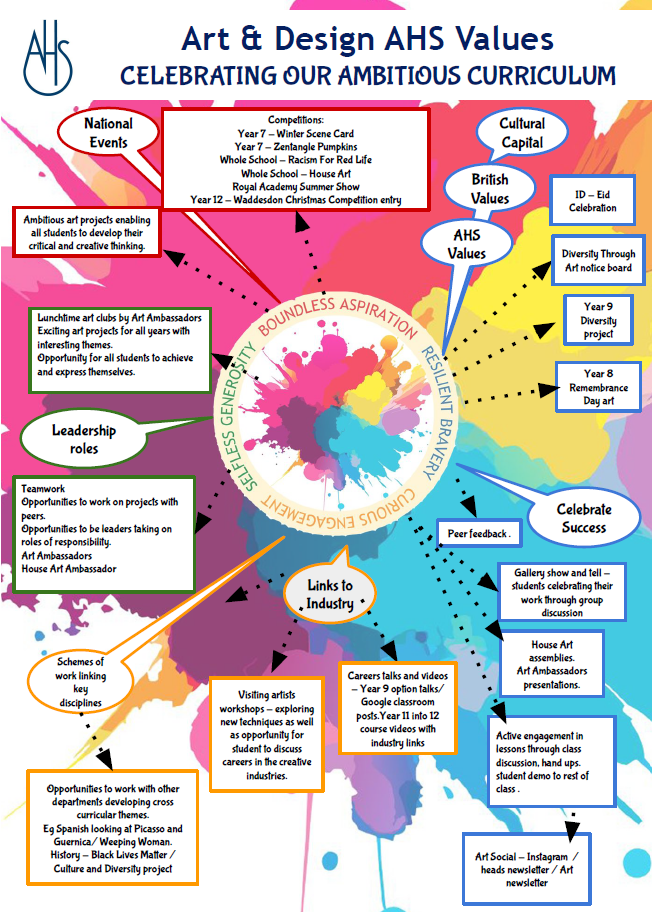
School values in Art
| Boundless Aspiration | Curious Engagement | Resilient Bravery | Selfless Generosity |
|---|---|---|---|
|
|
|
|
Why take Art?