
Aylesbury High School
French
At the start of Year 7, all students, regardless of the language they have in the first term, do 5–6 lessons on language learning in general. We look to tap into the knowledge they have from primary school, from home languages and from other subject areas which can be used to help them learn a language. Students choose the two languages they would like to continue with for Years 8 and 9. This is a completely free choice.
We teach British values in the area of global citizenship. A message of tolerance and understanding in the context of learning more about the world is paramount in our approach. Our subject gives students valuable learning skills and strategies which they can apply to their other subjects, not least rote learning, a skill not much used in many subjects. We are a department which embraces technology and leads the school in our use of it, which increases student motivation, interest, IT skills, and relevance in the modern world.
Assessments are carried out at the end of units. They test the 4 key skills: Listening, Reading, Speaking & Writing. The curriculum we have designed helps to prepare all students to study the languages at GCSE and beyond. We offer a trip in Year 9 to the Loire Valley.
Our Key Stage 3 curriculum has been put together to reflect what we feel is important for them to learn in terms of vocabulary, structures and grammar on the one hand, married to appropriate cultural input on the other. We change aspects of the subject content from time to time to reflect shifts in each country and the changing interests of our students too. It also feeds into the GCSE curriculum, so that it is a constant journey.
Languages are very much facilitating subjects; they exist alongside and interact with other subjects constantly and all students have the opportunity to see their place in the world as it relates to them.
At both Key Stages 4 and 5, our curricula are dictated by the exam specifications. All four skills are assessed equally at Key Stage 4 (Years 10-11), so Listening, Reading, Speaking & Writing all carry a 25% weighting. We offer an exchange to Bourg-en-Bresse in Year 10. Our aim in Key Stage 4 is to prepare students for A Level and not just pass the GCSE. We consolidate the grammar and skills covered at Key Stage 3, but also build on and extend this knowledge by applying an increasing number of complex topics and structures.
We use a variety of authentic resources, such as songs, articles, alongside the course textbook to maintain interest, enjoyment and challenge. French lessons are very varied in approach and students are used to tackling topics in a wide variety of ways. At Key Stage 5 (Years 12-13) students are assessed once again in listening, reading, speaking & writing, but they also have the opportunity to study a book and a film. They conduct an Independent Research project as part of their oral exam which can encompass any area of interest they have in any of the countries where French is spoken. Year 12s are able to go on the exchange, and Year 13s have a trip to Paris. FLTs are available for students to practise in small groups to improve their oral confidence and fluency. This also gives them an opportunity to learn about the target language culture and nuanced idiomatic expressions.
Student resources
The Google Drive, Google Site and Clickview are only available for students and teachers of Aylesbury High School. The Google Drive contains all Google-based resources used in lessons. The MFL Google Site contains extra resources and links to further learning and understanding.
The other quick links are to websites we subscribe to with extra resources. Students have their own login details given to them by the school.
| AHS only resources | Web based quick links |
Web based quick links |
|---|---|---|
|
|
|
|










Extension work & wider reading at Key Stage 3 (Years 7-9)
If you have finished all the work set on Google Classroom/in lessons very quickly and/or if you’re looking for French things to do to stop you getting bored, try out some of these suggestions. Don’t forget lots of links and reminders of logins etc on the MFL@AHS site
Vocabulary and grammar
-
Linguascope – use the beginner section for KS3 revision or try the intermediate section for GCSE-level challenge!
-
Zut.org: we no longer have a login for this, but it is free to use after 4pm
-
Languages Online: no login needed – revise your grammar before the GCSE course starts!
-
Languagenut: all students in Year 8 & 9 have a login for this
-
The Great Languages Challenge: from the British Council, this ties in with what we have done in Year 7 and Year 9, about spotting the links between languages
Reading and listening practice
-
BBC Bitesize - KS3 French: useful videos and revision resources
-
Duolingo Stories: if you don’t already have a Duolingo account, you can create one very easily using your school Google email
-
Gulli and TFO French channel TV. Not always subtitled though.
-
Don’t forget our Netflix/ Amazon Prime recommendations – or try some Peppa Pig episodes!
-
Listen to stories in French on Audible
-
Musée du Louvre: explications et visites virtuelles https://petitlouvre.louvre.fr/
-
Listen to some of our top French music recommendations – you could make a music video to accompany your favourite song!
-
or to learn different ballroom dances in French!
Speaking
-
app.golingo. co.uk
Recipes
Why not try some French cooking… send us photos of anything you make to go on the AHS French Twitter page (@AHSFrenchies)! Also, send your teacher any other recipes you have tried, and we can add them to the list.
-
Charlotte au chocolat ( works as well with a normal bowl)
Arts and Crafts
-
Lots of ideas of things to make connected to France
-
Make your own French berêt
-
Become a French artist by colouring in these Famous French paintings!
Extension work & wider reading at Key Stage 4 (Years 10-11)
If you finish all the work set on Google Classroom very quickly and/or if you’re looking for French things to do to stop you getting bored, try out some of these suggestions. Don’t forget lots of links and reminders of logins etc on the MFL@AHS site
Vocabulary and reading/listening practice
-
Linguascope the intermediate section, is great for GCSE vocabulary practice.
-
Languages Online: no login needed.
-
Languagenut: all students in Year 10 & 11 have a login for this.
-
BBC Bitesize - GCSE French: useful videos and revision resources.
-
TV5 Monde: lots of extra and interesting lessons!
-
TV5 Monde Plus: a 100% free, on demand and unlimited platform for French content (films, series, documentaries, cartoons) available anywhere, anytime.
-
Don’t forget our Netflix/ Amazon/ Audible recommendations!
-
Test your knowledge of French culture.
-
Read some French short stories / books/ comics on the culturethèque of L'Institut français. Just register for free.
-
Listen to and read some crazy stories on Duolingo Stories
-
Try some of these creative languages projects from Oxford University
-
Try listening to some of our French music recommendations – you could make a music video to accompany your favourite song!
-
Musée du Louvre: explications et visites virtuelles https://petitlouvre.louvre.fr/
-
Listen to some of our top French music recommendations or to learn different ballroom dances in French!
Recipes
Why not try some French cooking… send us photos of anything you make to go on the AHS French Twitter page (@AHSFrenchies)! Also send your teacher any other recipes you have tried and we can add them to the list.
-
Charlotte au chocolat (works as well with a normal bowl)
Arts and Crafts
-
Lots of ideas of things to make connected to France
-
Make your own French béret
-
Become a French artist by colouring in these Famous French paintings!
Extension work & wider reading at Key Stage 5 (Years 12–13)
If you finish all the work set on Google Classroom very quickly and/or if you’re looking for French things to do to stop you getting bored, try out some of these suggestions. Don’t forget about the A Level French extra resources site for articles, videos etc linked to all the A Level topics.
Year 12 and 13 French Read, Watch, Listen Recommendations
-
Kerboodle: all students have access to the online version of the textbook, so you can do extra reading/listening/grammar activities
-
Instagram (@ahs_frenchies): I post loads of links on here to stories and articles which would be great evidence for stimulus cards – you could go through and create a document of specific examples from the Spanish-speaking world
-
VerTaal: tons of authentic listening resources (no login needed and they are self-marking)
-
TV5 Monde Edul: very exhaustive site with news videos, grammar and vocabulary practice
-
Lawless French: a variety of levels and skills practice. The subjuntivisor is particularly useful!
-
Conjuguemos: to practise your grammar
-
Biblioteca Nacional de España: they have made their entire online catalogue available for free
-
France 24 is a good way to keep you up to date with French and world news. All in English.
-
Netflix/ Disney+/ HBO have French films. They change regularly, so keep looking. You can also change the language of any animation films to French!
-
Podcasts on spotify on various topics by Inner French
-
ITVX has series and films in French for free.
-
Try some TED talks en Français
-
Try the Duolingo Stories podcast or Coffee Break French
-
Find podcasts on our topics on BBC Sounds App
-
Choses à Savoir: Short, two-minute general knowledge episodes covering science, history, and the world.
-
Listen to stories in French on Audible
-
Find out more about key figures from French History: Marie Curie, Marie-Antoinette, Napoléon, Louis XIV, Louis Pasteur….
-
The REX in Berkhamsted regularly plays French films
-
Make your own Spotify playlist with your favourite French-speaking artists: Big Flo and Oli, Gims, Angèle…and other suggestions
Films and series
-
Le fabuleux destin d'Amélie Poulain (2001) - Bande annonce (Clickview Online)
-
Entre les murs (2008) - Bande annonce (Clickview Online)
-
Coco Avant Chanel (2009) - Bande annonce (Clickview Online)
-
Avant que de tout perdre (2012) - En streaming gratuit (TV5Monde+)
-
La Famille Bélier (2014) - Bande annonce (Amazon Prime)
-
Un peu, beaucoup, aveuglément (2015) - Bande annonce (Netflix)
-
Baron Noir (2016) - Bande annonce (Netflix)
-
Il a déjà tes yeux - Série en streaming gratuit et replay (2019) (TV5Monde+)
-
Les Misérables (2019) - Bande annonce (Netflix) [NOT THE MUSICAL]
-
Une affaire française (2021) - En streaming gratuit (Channel 4)
-
Lupin (2021) - Bande annonce (Netflix)
-
Obsédée (2022) - En streaming gratuit (Channel 4)
-
Je verrai toujours vos visages (2023) - Bande annonce (Netflix)
-
Et la fête continue ! (2023) - En streaming gratuit (TV5Monde+)
-
Pas de vagues (2023) - En streaming gratuit (TV5Monde+)
And also more recently: Un petit truc en plus, Untouchable, Juste une illusion,Comédie Française, L’amour ouf, La vie en rose, Entre les murs, Joyeux Noël, La famille Bélier, L’école buissonière, L’arnacoeur, De Gaulle, Aznavour, Bienvenue chez les ch’tis, Juste Ciel!
Audiobooks
-
La métamorphose by Franz Kafka - Texte intégral (Follow along each using the transcript available)
-
Le Portrait de Dorian Gray by Oscar Wilde - Texte intégral (Follow along each using the transcript available)
-
Harry Potter by J.K. Rowling [Livres complets en français]
Books
-
La grammaire est une chanson douce by Érik Orsenna
-
Le Petit Prince by Antoine de Saint-Exupéry
-
L’élégance du Hérisson by Muriel Barbery
-
No et Moi by Delphine le Vigan
-
Un sac de billes by Joseph Joffo
-
Kiffe kiffe demain by Faïza Guène
-
L’élégance du hérisson, Muriel Barbéry
-
Tout le bleu du ciel, Melissa Da Costa
-
Les nymphéas noirs, Michel Bussi
-
Et si c’était vrai, Marc Lévy
Radios
Fun Radio : écouter la radio en direct, musique, émissions et podcasts
NRJ : écouter la radio en direct, musique, clips, actus, webradios…
RTL2 Le Son Pop-Rock : écouter la radio en direct, musique, émissions et événements
Subject intent
- To give students transferable skills for language learning which can be used across all different topic areas and key stages.
- To enable students to be effective communicators in a global world.
- To facilitate the learning of key vocabulary, structures and grammar which allow for effective, accurate communication in the target language.
- To foster a cultural understanding of the target language countries and their place in the wider world. To develop an interest in, and understanding of, music, films, sport, history and other aspects of the culture.
- To allow students to be creative in their use of the target language, confident in their application of the language in a range of contexts.
- To enable students to be independent learners, using all the resources at their disposal to become more proficient language learners.
- To prepare students for their next steps in language education and, ultimately, its role in the workplace and the wider world.
- To inspire students to travel and use their language skills.
- To allow students to see and explore cross-curricular links using their language skills.
Key Stage 3 (Years 7-9) course implementation, learning journey & attainment.
Course content
| Year 7 | Year 8 | Year 9 |
|---|---|---|
|
|
|
Learning Journey
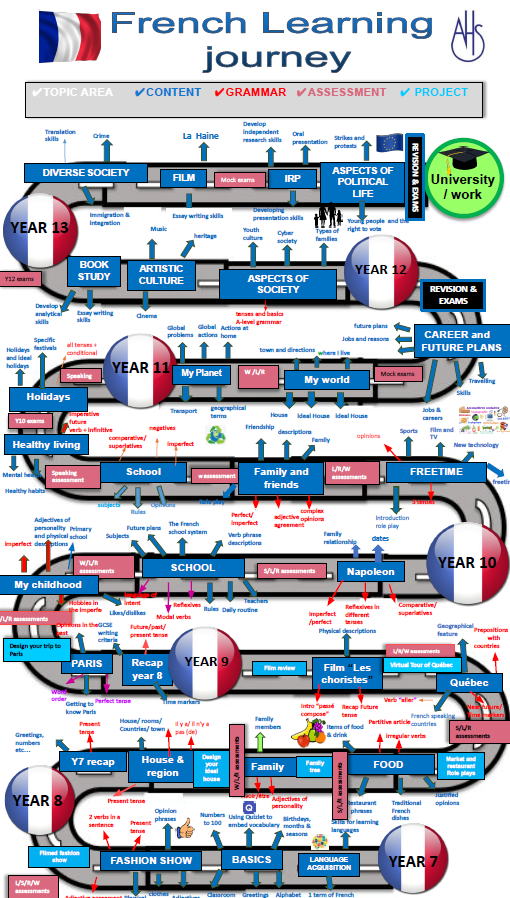
These attainment descriptors clarify the skills/knowledge needed for the different levels of attainment in Years 7–9. For Years 8 and 9 it is always the case that not all of these will have been covered before the summer term. Teachers therefore make a judgement based upon how the skills/knowledge that have been covered have been used by the students before each data collection. This is not the case in Year 7, where students only get one term of each language, so everything is covered by the time of each term's data collection.
Students can use these descriptors to focus on particular areas in order to make improvements. For writing and speaking in particular, there are very targeted areas to look at.
Year 7 attainment descriptors
At Key Stage 3, we use "I can" statements for our attainment descriptors. We use a process of 'best fit', whereby you don't necessarily have to meet every criterion to qualify, but you will meet the majority.
Working Towards
| Listening | Reading | Speaking | Writing |
|---|---|---|---|
|
|
|
|
Working At
| Listening | Reading | Speaking | Writing |
|---|---|---|---|
|
|
|
|
Working Beyond
| Listening | Reading | Speaking | Writing |
|---|---|---|---|
|
|
|
|
Year 8 attainment descriptors
At Key Stage 3, we use "I can" statements for our attainment descriptors. We use a process of 'best fit', whereby you don't necessarily have to meet every criterion to qualify, but you will meet the majority.
Working Towards
| Listening | Reading | Speaking | Writing |
|---|---|---|---|
|
|
|
|
Working At
| Listening | Reading | Speaking | Writing |
|---|---|---|---|
|
|
|
|
Working Beyond
| Listening | Reading | Speaking | Writing |
|---|---|---|---|
|
|
|
|
Year 9 attainment descriptors
At Key Stage 3, we use "I can" statements for our attainment descriptors. We use a process of 'best fit', whereby you don't necessarily have to meet every criterion to qualify, but you will meet the majority.
Working Towards
| Listening | Reading | Speaking | Writing |
|---|---|---|---|
|
|
|
|
Working At
| Listening | Reading | Speaking | Writing |
|---|---|---|---|
|
|
|
|
Working Beyond
| Listening | Reading | Speaking | Writing |
|---|---|---|---|
|
|
|
|
Key Stage 4 (Years 10-11) course implementation, learning journey & assessment info.
Course content
| Year 10 | Year 11 |
|---|---|
|
|
Learning journey
At GCSE level, students are assessed on their ability in 4 different skills. Listening, Speaking, Reading & Writing. This link takes you to the Edexcel specification, which contains all the necessary course information. Assessments take place throughout the 2 years of the course, in addition to Year 10 exams and mocks in the spring term of Year 11.
How will I be assessed?
The following summary is based upon students doing the Higher papers.
| Listening 25% | Reading 25% | Speaking 25% | Writing 25% |
|---|---|---|---|
|
60 mins All Questions & answers in English 9 comprehension question sections. The exam finishes with a dictation. Multiple choice and short answer options Listen to each item 3 times |
60 mins All Questions & answers in English 8 comprehension question sections. The exam finishes with a translation from French to English at the end. Multiple choice and short answer options |
14 mins prep Read aloud c.1 1/2 mins Role Play c.1 1/2 mins Photo task c.2 mins General conversation 5 mins |
1 hr 20 mins All Questions in English 3 sections 1. 80-90 word task, respond to 4 bullet points 2. 130–150 word task, respond to 4 bullet points 3. Translation into French |
Key Stage 5 (Years 12-13) course implementation, learning journey & assessment info.
Course content
| Year 12 | Year 13 |
|---|---|
|
|
Learning journey
At A level, students are assessed on their ability in 4 different skills. Listening, Speaking, Reading & Writing. This link takes you to the AQA specification, which contains all the necessary course information. Assessments take place throughout the 2 years of the course, in addition to Year 12 exams and mocks in the spring term of Year 13.
How will I be assessed?
| Paper 1 50% | Paper 2 20% | Paper 3 30% |
|---|---|---|
|
Listening, Reading & Translation 2h 30 mins 3 Listening comprehension sections 1 listening summary 4 reading comprehension sections 1 reading summary 1 translation: French – English 1 translation: English – French |
Writing 2h 1 essay on film 1 essay on play |
Speaking c.23 mins 1 stimulus card relating to one topic. 5 mins prep, 6 mins oral. Independent Research Project (IRP) 2 min presentation and 10 min discussion. Topic chosen and prepared by the student on any area of interest related to France. |
Subject impact
Key Stage 3 (Years 7–9)
- Learnt how to use 3 different timeframes, opinions & justifications to prepare for GCSE.
- Developed their language detective skills, giving them an increased awareness of the grammatical terms used in languages, and made links between different languages—metacognition developed from the first week of Year 7.
- Become more confident in trying, even if they may make mistakes.
- Used technology effectively to enhance their learning—we exclusively use digital exercise books in French at Key Stage 3.
- Made cross-curricular links with other subjects, such as History & Geography.
- Improved all four skills: speaking, listening, reading and writing.
- Become familiar with techniques and question styles required at GCSE.
- Had regular opportunities for co-curricular enrichment, through activities such as translation competitions and the Year 9 trip to the Loire Valley.
- Been inspired to carry on studying the language at GCSE.
Key Stage 4 (Years 10-11)
- Reinforced grammar learnt at Key Stage 3 and developed more confidence in its use.
- Become able to access a range of authentic texts and materials and deal with them appropriately.
- Become familiar and confident with the skills required at GCSE.
- Become more confident speakers, able to have short conversations in French, through regular practice with the FLT. Able to respond in a variety of different situations, role plays, different stimuli etc.
- Used exam-style questions in classwork, homework and assessments to prepare for exams.
- Used technology effectively to enhance learning.
- Learnt about diverse cultural aspects of French-speaking countries
- Had regular opportunities for co-curricular enrichment, through activities such as translation competitions and the Y0 Exchange to Bourg-en-Bresse.
- Been inspired to carry on studying the language at A Level.
Key Stage 5 (Years 12–13)
- Developed a life-long love of the French language and passion for French culture.
- Acquired confidence in speaking in French for an extended period of time on a variety of topical issues.
- Acquired the necessary grammatical knowledge to be able to express themselves as accurately and fluently as possible, both when speaking and when writing.
- Acquired the appropriate examination techniques, such as writing summaries & doing translations to enable them to access the top grades at A Level.
- Acquired a thorough knowledge of various current issues in French-speaking countries, such as the political system, immigration and the effects of reunification.
- Developed independent research skills, through the IRP.
- Had opportunities to practise their language skills in a real life situation through an exchange to Bourg-en-Bresse in Year 12 and a trip to Paris in Year 13.
- Been provided with the opportunities, skills and support to enable them to study French and other language-related courses at top universities, including Oxbridge.
- Learnt a life skill which can be married as a skill to any future job.
Feedback in French lessons
This chart explains the types of feedback that students can expect to receive for work done in language lessons/at home.
| Activity | Types of feedback |
|---|---|
|
Assessments (all skills) |
Teacher marked → whole class feedback → student self-assessed targets Feedback sheet with statements ticked and/or brief written comments |
|
Written tasks e.g. 90 or 150 word tasks |
‘Deep marking’ with targets (could be self-assessed targets) |
|
Productive Skills |
Language corrected with ‘suggestions’ → self-assessment targets Could also have a brief written comment |
|
Oral work in class |
Verbal feedback |
|
Oral homework |
Recorded verbal feedback (possibly a mark depending on the nature of the task) |
|
Small group oral work/mini whiteboard activities/classwork |
Verbal feedback |
|
L&R comprehension exercises |
Self or peer marked |
|
Exercise books |
Organisation and completion of work checked when circulating |
|
Digital books |
Marking rubric used in Google Classroom – 3 categories (understanding, organisation, completion) Some key exercises corrected with ‘suggestions’ |
|
Google Quiz |
Self-marking → self-assessed targets |
|
Homework |
Depends on the nature of the task – see above |
School values in French
| Boundless Aspiration | Curious Engagement | Resilient Bravery | Selfless Generosity |
|---|---|---|---|
|
|
|
|