
Aylesbury High School
German
At the start of Year 7, all students, regardless of the language they have in the first term, do 5–6 lessons on language learning in general. We look to tap into the knowledge they have from primary school, from home languages and from other subject areas which can be used to help them learn a language. Students choose the two languages they would like to continue with for Years 8 and 9. This is a completely free choice.
We teach British values in the area of global citizenship. A message of tolerance and understanding in the context of learning more about the world is paramount in our approach. Our subject gives students valuable learning skills and strategies which they can apply to their other subjects, not least rote learning, a skill not much used in many subjects. We are a department which embraces technology and leads the school in our use of it, which increases student motivation, interest, IT skills, and relevance in the modern world.
Assessments are carried out at the end of units. They test the 4 key skills: Listening, Reading, Speaking & Writing. The curriculum we have designed helps to prepare all students to study the languages at GCSE and beyond. We offer a trip in Year 9 to the Christmas markets of the Rhineland.
Our Key Stage 3 curriculum has been put together to reflect what we feel is important for them to learn in terms of vocabulary, structures and grammar on the one hand, married to appropriate cultural input on the other. We change aspects of the subject content from time to time to reflect shifts in each country and the changing interests of our students too. It also feeds into the GCSE curriculum, so that it is a constant journey.
Languages are very much facilitating subjects; they exist alongside and interact with other subjects constantly and all students have the opportunity to see their place in the world as it relates to them.
At both Key Stages 4 and 5, our curricula are dictated by the exam specifications. All four skills are assessed equally at Key Stage 4 (Years 10-11), so Listening, Reading, Speaking & Writing all carry a 25% weighting. We offer an exchange to Stuttgart in Year 10. Our aim in KS4 is to prepare students for A Level and not just pass the GCSE. We consolidate the grammar and skills covered at KS3, but also build on and extend this knowledge by applying an increasing number of complex topics and structures.
We use a variety of authentic resources, such as songs, articles, alongside the course textbook to maintain interest, enjoyment and challenge. German lessons are very varied in approach and students are used to tackling topics in a wide variety of ways. At Key Stage 5 (Years 12–13), students are assessed once again in listening, reading, speaking & writing, but they also have the opportunity to study a book and a film. They conduct an Independent Research project as part of their oral exam which can encompass any area of interest they have in any of the countries where German is spoken. Year 12s are able to go on the exchange, and Year 13s have a trip to Berlin. FLTs are available for students to practise in small groups to improve their oral confidence and fluency. This also gives them an opportunity to learn about the target language culture and nuanced idiomatic expressions.
Student resources
The Google Drive, Google Site and Clickview are only available for students and teachers of Aylesbury High School. The Google Drive contains all Google-based resources used in lessons. The MFL Google Site contains extra resources and links to further learning and understanding.
The other quick links are to websites we subscribe to with extra resources. Students have their own login details given to them by the school.
| AHS only resources | Web based quick links |
Web based quick links |
|---|---|---|
|
|
|
|









Extension work & wider reading at Key Stage 3 (Years 7-9)
If you have finished all the work set on Google Classroom/in lessons very quickly and/or if you’re looking for German things to do to stop you getting bored, try out some of these suggestions. Don’t forget lots of links and reminders of logins etc on the MFL@AHS site
Vocabulary
Duolingo: Lots of useful and also weird and wonderful vocabulary. Or how about trying out a related Germanic language like Dutch or Swedish?
Languagenut: You have a personal log-in for this (Year 8 onwards). You can select vocabulary for different topics. Choose ones you covered earlier in the year or ones you haven’t done yet but would like to get a head start on. For Year 8–9.
Linguascope: You can select vocabulary for different topics. Choose ones you covered earlier in the year or ones you haven’t done yet but would like to get a head start on.
Languagesonline: You can select vocabulary for different topics. Choose ones you covered earlier in the year or ones you haven’t done yet but would like to get a head start on.
Reading
Duolingo Stories: Practise reading and listening skills by working through the stories and earning points as you go.
Languagenut: You have a personal log-in for this. Exam skills – Key Stage 3. You can choose texts by topic and type of exercise.
Listening
Languagenut: You have a personal log-in for this. Exam skills – Key Stage 3. You can choose texts by topic and type of exercise.
Lyrics training: Set the language to German and discover lots of German songs. Train your ear by typing the next word in the lyrics that you hear.
Goethe Institut Step into German Music: They have a clip of the month with a different song each time, and you can also explore all their previous clips under the music video tab.
Clickview – Accessible through the student homepage – lots of German-related materials.
Make yourself a German playlist of your favourite artists and share with your friends.
Grammar
Languagenut: You have personal log-ins for this. Go to Grammar and Verbs to practise grammar points covered this year and Sentence Building to practise word order with different topics.
Languagesonline: Go to the grammar section to practise grammar points covered this year.
Film/TV recommendations
Das Boot (PG) On Clickview. Classic multi-Oscar-nominated drama following the fortunes and dangers of a German U-boat and its crew in the Atlantic during World War II.
Netflix Reactor. This platform supports language learning in general. They have a range of different age ratings. Lots of different options available.
Extra German – a really trashy sitcom from the 90s. You can get individual episodes with English subtitles.
Peppa Wutz – your favourite pig’s adventures in German.
Cooking
Brezl A favourite from the German exchange to Stuttgart.
Maultaschen Another favourite from the German exchange.
Späztle A cross between tiny, delicious dumplings and noodles. A favourite from Stuttgart and the Christmas markets trip.
Wiener Schnitzel Traditionally made with veal but could also be made with pork or chicken.
Sachertorte A delicious chocolate cake filled with apricot jam from Vienna. The original recipe is supposedly top-secret, known only to the famous Hotel Sacher, but this Mary Berry version is equally good.
Apfelstrudel Another Austrian classic. Real strudel pastry is incredibly tricky to make, so try this easier version with filo pastry.
Kaiserschmarrn Austrian pancakes but not as you might expect them.
Kalter Hund No, not eating your dog, but a no-bake German birthday cake!
Craft
Schultüte German children receive these cones filled with sweets and stationery on their first day at school. Find out more about this tradition here.
Design (and make) a carnival costume Look back at the carnival project from Year 8.
Ostereierbaum In German-speaking countries, at Easter people traditionally decorate trees near their home. Have a look for inspiration here and decorate a tree or two near you.
German Easter eggs – As well as chocolate eggs, people also traditionally make coloured eggs at Easter. Here’s a guide to how to do that.
Extension work & wider reading at Key Stage 4 (Years 10-11)
If you finish all the work set on Google Classroom very quickly and/or if you’re looking for German things to do to stop you getting bored, try out some of these suggestions. Don’t forget lots of links and reminders of logins etc on the MFL@AHS site
Vocabulary
-
Duolingo: lots of useful and also weird and wonderful vocabulary. Or how about trying out a related Germanic language like Dutch or Swedish?
-
Languagenut: You have a personal log-in for this. You can select vocabulary for different topics. Choose ones you covered earlier in the year or ones you haven’t done yet but would like to get a head start on.
-
Linguascope: Intermediate Section You can select vocabulary for different topics. Choose ones you covered earlier in the year or ones you haven’t done yet, but would like to get a head start on.
-
Languagesonline: You can select vocabulary for different topics. Choose ones you covered earlier in the year or ones you haven’t done yet but would like to get a head start on.
-
Knowt: go over vocabulary from topics covered earlier in the year or make a head start on new ones.
-
Lyricstraining: practise listening skills whilst listening to German pop music
Reading
-
Languagenut: You have a personal log-in for this. Exam skills – Key Stage 4. You can choose texts by topic and type of exercise.
-
Languagesonline: Topics – GCSE Reading Practice.
Listening
-
Languagenut: You have a personal log-in for this. Exam skills – Key Stage 4. You can choose texts by topic and type of exercise.
-
Lyrics training: set the language to German and discover lots of German songs. Train your ear by typing the next word in the lyrics that you hear.
-
Goethe Institut Step into German Music: They have a clip of the month with a different song each time, and you can also explore all their previous clips under the music video tab.
-
Audible: Currently offering free audiobooks, including some in German.
Grammar
-
Languagenut: You have personal log-ins for this. Go to Grammar and Verbs to practise grammar points covered this year and Sentence Building to practise word order with different topics.
-
Languagesonline: Go to the grammar section to practise grammar points covered this year.
Film/TV/Radio recommendations
-
Das Boot (PG) On Clickview. Classic multi-Oscar-nominated drama following the fortunes and dangers of a German U-boat and its crew in the Atlantic during World War II.
-
Die Welle (12A) On Clickview. Teacher Rainer Wenger leads his class in an experiment on fascism. Set in a modern secondary school, this film is based on a real-life experiment conducted in an American school. Hard hitting with disastrous results.
-
Goodbye Lenin (15) On Clickview. A son hides the Berlin Wall's fall from his mother when she wakes from a coma.
-
Deutschland 83, Deutschland 86 and Deutschland 89 (on Channel 4 OD): Cold War thriller set in 1980s Germany about life in the East and West.
-
Germany: Memories of a Nation Radio series about German history and identity
-
German films and TV on Netflix This is the catalogue of German films/series available through Netflix. They have a range of different age ratings. Lots of different options available. The language learning through Netflix site also allows you to have a dictionary to help understand how everything works.
-
Extra German - a really trashy sitcom from the 90s. You can get individual episodes with English subtitles
-
Tunnel 29 The extraordinary true story of a man who dug a tunnel right under the feet of Berlin Wall border guards to help friends, family and strangers escape.
-
Tatort Classic German police drama which has many series set in different German cities. Currently, on Channel 4OD: Inspector Borowski (set in Kiel), Helen Dorn (set in Düsseldorf), Inspector Falke (set in Hamburg)
-
Bad Banks (on Channel 4 OD) An explosive German thriller set in the world of global finance in which a young investment banker is trapped in a vortex of corruption, greed and blackmail during a deadly battle between two rival banks
-
Schaubünhne This German theatre company is streaming recordings of plays every day. A mix of German and non-German playwrights. Some German audio only and some with the option of English subtitles.
Cooking
-
Brezl A favourite from the German exchange to Stuttgart.
-
Maultaschen Another favourite from the German exchange.
-
Späztle A cross between tiny, delicious dumplings and noodles. A favourite from Stuttgart and the Christmas markets trip.
- Wiener Schnitzel Traditionally made with veal but could also be made with pork or chicken.
-
Sachertorte A delicious chocolate cake filled with apricot jam from Vienna. The original recipe is supposedly top-secret, known only to the famous Hotel Sacher, but this Mary Berry version is equally good.
-
Apfelstrudel Another Austrian classic. Real strudel pastry is incredibly tricky to make, so try this easier version with filo pastry.
-
Kaiserschmarrn Austrian pancakes but not as you might expect them.
-
Kalter Hund No, not eating your dog, but a no-bake German birthday cake!
Craft
-
Schultüte German children receive these cones filled with sweets and stationery on their first day at school. Find out more about this tradition here and have a go at making one to give to a friend on the first day back in school.
-
Design (and make) a carnival costume. Look back at the carnival project from Year 8 and design a carnival costume/float for 2021. Will it be coronavirus themed?
-
Ostereierbaum In German-speaking countries, at Easter, people traditionally decorate trees near their home. Have a look for inspiration here and decorate a tree or two near you.
German Easter eggs – As well as chocolate eggs, people also traditionally make coloured eggs at Easter. Here’s a guide to how to do that.
Extension work & wider reading at Key Stage 5 (Years 12-13)
If you finish all the work set on Google Classroom very quickly and/or if you’re looking for German things to do to stop you getting bored, try out some of these suggestions. Don’t forget about the A Level German extra resources site for articles, videos etc linked to all the A Level topics.
Year 12 and 13 German Read, Watch, Listen Recommendations
Films
-
Das Boot (PG) On Clickview. Classic multi-Oscar-nominated drama following the fortunes and dangers of a German U-boat and its crew in the Atlantic during World War II.
-
Die Welle (12A) On Clickview. Teacher Rainer Wenger leads his class in an experiment on fascism. Set in a modern secondary school, this film is based on a real-life experiment conducted in an American school. Hard hitting with disastrous results.
-
Goodbye Lenin (15) On Clickview. A son hides the Berlin Wall's fall from his mother when she wakes from a coma. Also on the A Level Spec.
-
Die fetten Jahre sind vorbei You watched/will watch a clip of this when doing the politics topic. Worth watching the whole film. Also on the A Level Spec.
-
Almanya – Willkommen in Deutschland German-Turkish identity. Also on the A Level Spec.
-
Sophie Scholl – Die letzten Tage You probably last watched this in Year 9. Definitely worth rewatching. Also on the A Level Spec.
-
Lola rennt Thriller film. The story follows a woman who needs to obtain 100,000 Deutsche Mark in twenty minutes to save her boyfriend's life. Also on the A Level Spec.
-
Das Wunder von Bern Set in post-WW2 West Germany about West Germany’s victory in the 1954 World Cup and a return West German prisoner of war. Also on the A Level Spec.
-
Der Untergang The last days in Hitler’s bunker. Also on the A Level Spec.
-
Nirgendwo in Afrika Also on the A Level Spec. Film version of a very readable novel about the author’s childhood as a German-Jewish refugee in Kenya.
TV
-
Deutschland 83, Deutschland 86 and Deutschland 89 (on Channel 4 OD): Cold War thriller set in 1980s Germany about life in the East and West.
-
German films and TV on Netflix This is the catalogue of German films/series available through Netflix. They have a range of different age ratings. Lots of different options available. The language learning through the Netflix site also allows you to have a dictionary to help understand how everything works.
-
Extra German – a really trashy sitcom from the 90s. You can get individual episodes with English subtitles
-
Tatort Classic German police drama which has many series set in different German cities. Currently, on Channel 4OD: Inspector Borowski (set in Kiel), Helen Dorn (set in Düsseldorf), Inspector Falke (set in Hamburg)
-
Bad Banks (on Channel 4 OD) An explosive German thriller set in the world of global finance in which a young investment banker is trapped in a vortex of corruption, greed and blackmail during a deadly battle between two rival banks
Radio/Music/Audibooks
-
Germany: Memories of a Nation Radio series about German history and identity
-
Tunnel 29 The extraordinary true story of a man who dug a tunnel right under the feet of Berlin Wall border guards to help friends, family and strangers escape.
-
Lyrics training: set the language to German and discover lots of German songs. Train your ear by typing the next word in the lyrics that you hear.
-
Goethe Institut Step into German Music: They have a clip of the month with a different song each time, and you can also explore all their previous clips under the music video tab.
-
Audible: Currently offering free audiobooks, including some in German.
Books/Plays
-
Schaubünhne This German theatre company is streaming recordings of plays every day. A mix of German and non-German playwrights. Some German audio only and some with the option of English subtitles.
Here are some of the other A Level spec options for you to explore.
-
Heinrich Böll Die verlorene Ehre der Katharina Blum
-
Bertolt Brecht Mutter Courage und ihre Kinder
Der kaukasische Kreidekreis
-
Max Frisch Andorra
-
Heinrich Heine Gedichte – Buch der Lieder
-
Jana Hensel Zonenkinder
-
Franz Kafka Die Verwandlung
-
Wladimir Kaminer Russendisko
-
Uwe Timm Die Entdeckung der Currywurst
-
Alfred Andersch Sansibar oder der letzte Grund
-
Judith Hermann Sommerhaus, später und andere Erzählungen
-
Bernhard Schlink Der Vorleser
Subject intent
- To give students transferable skills for language learning which can be used across all different topic areas and key stages.
- To enable students to be effective communicators in a global world.
- To facilitate the learning of key vocabulary, structures and grammar which allow for effective, accurate communication in the target language.
- To foster a cultural understanding of the target language countries and their place in the wider world. To develop an interest in, and understanding of, music, films, sport, history and other aspects of the culture.
- To allow students to be creative in their use of the target language, confident in their application of the language in a range of contexts.
- To enable students to be independent learners, using all the resources at their disposal to become more proficient language learners.
- To prepare students for their next steps in language education and, ultimately, its role in the workplace and the wider world.
- To inspire students to travel and use their language skills.
- To allow students to see and explore cross-curricular links using their language skills.
Key Stage 3 (Years 7-9) course implementation, learning journey & attainment.
Course content
| Year 7 | Year 8 | Year 9 |
|---|---|---|
|
|
|
Learning Journey
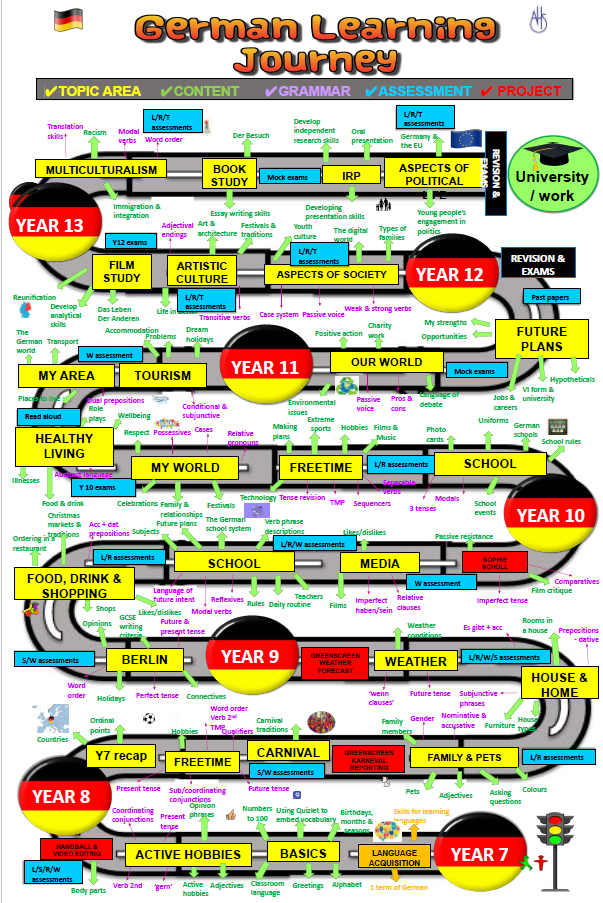
These attainment descriptors clarify the skills/knowledge needed for the different levels of attainment in Years 7–9. For Years 8 and 9 it is always the case that not all of these will have been covered before the summer term. Teachers therefore make a judgement based upon how the skills/knowledge that have been covered have been used by the students before each data collection. This is not the case in Year 7, where students only get 1 term of each language, so everything is covered by the time of each term's data collection.
Students can use these descriptors to focus on particular areas in order to make improvements. For writing and speaking in particular, there are very targeted areas to look at.
Year 7 attainment descriptors
At Key Stage 3, we use "I can" statements for our attainment descriptors. We use a process of 'best fit', whereby you don't necessarily have to meet every criterion to qualify, but you will meet the majority.
Working Towards
| Listening | Reading | Speaking | Writing |
|---|---|---|---|
|
|
|
|
Working At
| Listening | Reading | Speaking | Writing |
|---|---|---|---|
|
|
|
|
Working Beyond
| Listening | Reading | Speaking | Writing |
|---|---|---|---|
|
|
|
|
Year 8 attainment descriptors
At Key Stage 3, we use "I can" statements for our attainment descriptors. We use a process of 'best fit', whereby you don't necessarily have to meet every criterion to qualify, but you will meet the majority.
Working Towards
| Listening | Reading | Speaking | Writing |
|---|---|---|---|
|
|
|
|
Working At
| Listening | Reading | Speaking | Writing |
|---|---|---|---|
|
|
|
|
Working Beyond
| Listening | Reading | Speaking | Writing |
|---|---|---|---|
|
|
|
|
Year 9 attainment descriptors
At Key Stage 3, we use "I can" statements for our attainment descriptors. We use a process of 'best fit', whereby you don't necessarily have to meet every criterion to qualify, but you will meet the majority.
Working Towards
| Listening | Reading | Speaking | Writing |
|---|---|---|---|
|
|
|
|
Working At
| Listening | Reading | Speaking | Writing |
|---|---|---|---|
|
|
|
|
Working Beyond
| Listening | Reading | Speaking | Writing |
|---|---|---|---|
|
|
|
|
Key Stage 4 (Years 10-11) course implementation, learning journey & assessment info.
Course content
| Year 10 | Year 11 |
|---|---|
|
|
Learning journey
At GCSE level, students are assessed on their ability in 4 different skills. Listening, Speaking, Reading & Writing. This link takes you to the Edexcel specification, which contains all of the necessary course information. Assessments take place throughout the 2 years of the course, in addition to Year 10 exams and mocks in the spring term of Year 11.
How will I be assessed?
The following summary is based upon students doing the Higher papers.
| Listening 25% | Reading 25% | Speaking 25% | Writing 25% |
|---|---|---|---|
|
60 mins All Questions & answers in English 9 comprehension question sections. The exam finishes with a dictation. Multiple choice and short answer options Listen to each item 3 times |
60 mins All Questions & answers in English 8 comprehension question sections. The exam finishes with a translation from German to English at the end. Multiple choice and short answer options |
14 mins prep Read aloud c.1 1/2 mins Role Play c.1 1/2 mins Photo task c.2 mins General conversation 5 mins |
1 hr 20 mins All Questions in English 3 sections 1. 80-90 word task, respond to 4 bullet points 2. 130–150 word task, respond to 4 bullet points 3. Translation into German |
Key Stage 5 (Years 12-13) course implementation, learning journey & assessment info.
Course content
| Year 12 | Year 13 |
|---|---|
|
|
Learning journey
At A level, students are assessed on their ability in 4 different skills. Listening, Speaking, Reading & Writing. This link takes you to the AQA specification, which contains all the necessary course information. Assessments take place throughout the 2 years of the course, in addition to Year 12 exams and mocks in the spring term of Year 13.
How will I be assessed?
| Paper 1 50% | Paper 2 20% | Paper 3 30% |
|---|---|---|
|
Listening, Reading & Translation 2h 30 mins 3 Listening comprehension sections 1 listening summary 4 reading comprehension sections 1 reading summary 1 translation German – English 1 translation English – German |
Writing 2h 1 essay on film 1 essay on play |
Speaking c.23 mins 1 stimulus card relating to one topic. 5 mins prep, 6 mins oral. Independent Research Project (IRP) 2 min presentation and 10 min discussion. Topic chosen and prepared by student on any area of interest related to German. |
Subject impact
Key Stage 3 (Years 7–9)
- Learnt how to use 3 different time frames, opinions & justifications to prepare for GCSE.
- Developed their language detective skills, giving them an increased awareness of the grammatical terms used in languages, and made links between different languages—metacognition developed from the first week of Year 7.
- Become more confident in trying, even if they may make mistakes.
- Used technology effectively to enhance their learning—we exclusively use digital exercise books in German at Key Stage 3.
- Made cross-curricular links with other subjects, such as History & Geography.
- Improved all four skills: speaking, listening, reading and writing.
- Become familiar with techniques and question styles required at GCSE.
- Had regular opportunities for co-curricular enrichment, through activities such as translation competitions and the Year 9 trip to the Christmas Markets in the Rhineland.
- Been inspired to carry on studying the language at GCSE.
Key Stage 4 (Years 10-11)
- Reinforced grammar learnt at Key Stage 3 and developed more confidence in its use.
- Become able to access a range of authentic texts and materials and deal with them appropriately.
- Become familiar and confident with the skills required at GCSE.
- Become more confident speakers, able to have short conversations in German, through regular practice with the FLT. Able to respond in a variety of different situations, role plays, different stimuli etc.
- Used exam-style questions in classwork, homework and assessments to prepare for exams.
- Used technology effectively to enhance learning.
- Learned about diverse cultural aspects of German-speaking countries, e.g. Karneval.
- Had regular opportunities for co-curricular enrichment, through activities such as translation competitions and the Year10 Exchange to Stuttgart.
- Been inspired to carry on studying the language at A Level.
Key Stage 5 (Years 12-13)
- Developed a life-long love of the German language and passion for Germanic culture.
- Acquired confidence in speaking in German for an extended period of time on a variety of topical issues.
- Acquired the necessary grammatical knowledge to be able to express themselves as accurately and fluently as possible, both when speaking and when writing.
- Acquired the appropriate examination techniques, such as writing summaries & doing translations to enable them to access the top grades at A Level.
- Acquired a thorough knowledge of various current issues in German-speaking countries, such as the political system, immigration and the effects of reunification.
- Developed independent research skills, through the IRP.
- Had opportunities to practise their language skills in a real life situation through an exchange to Stuttgart in Year 12 and a trip to Berlin in Year 13.
- Been provided with the opportunities, skills and support to enable them to study German and other language-related courses at top universities, including Oxbridge.
- Learned a life skill which can be married as a skill to any future job.
Feedback in German lessons
This chart explains the types of feedback that students can expect to receive for work done in language lessons/at home.
| Activity | Types of feedback |
|---|---|
|
Assessments (all skills) |
Teacher marked → whole class feedback → student self-assessed targets Feedback sheet with statements ticked and/or brief written comments |
|
Written tasks e.g. 90 or 150 word tasks |
‘Deep marking’ with targets (could be self-assessed targets) |
|
Productive Skills |
Language corrected with ‘suggestions’ → self-assessment targets Could also have brief written comment |
|
Oral work in class |
Verbal feedback |
|
Oral homework |
Recorded verbal feedback (possibly a mark depending on the nature of the task) |
|
Small group oral work/mini whiteboard activities/classwork |
Verbal feedback |
|
L&R comprehension exercises |
Self or peer marked |
|
Exercise books |
Organisation and completion of work checked when circulating |
|
Digital books |
Marking rubric used on Google Classroom - 3 categories (understanding, organisation, completion Some key exercises corrected with ‘suggestions’ |
|
Google Quiz |
Self-marking → self-assessed targets |
|
Homework |
Depends on the nature of the task – see above |
School values in German
| Boundless Aspiration | Curious Engagement | Resilient Bravery | Selfless Generosity |
|---|---|---|---|
|
|
|
|