
Aylesbury High School
Textiles
In Textiles, we aim to develop life skills on the sewing machine, by enabling students to confidently and safely use machines and equipment to enable them to create practical, diverse and interesting textile pieces. They will become creative and critical thinkers who are able to use their own ideas, experiences and reflections to drive each project.
Student resources
The Google Drive and Clickview are only available for students and teachers of Aylesbury High School. The Google Drive contains all Google-based resources used in lessons.
The other quick links are to websites we subscribe to with extra resources. Students have their own login details given to them by the school.
| AHS only resources | Web based quick links |
Web based quick links |
|---|---|---|
|
|
|
|






Extension work & wider reading at Key Stage 3 (Years 7-9)
If you have finished all the work set on Google Classroom/in lessons very quickly and/or if you’re looking for Textiles things to do to stop you getting bored, try out some of these suggestions.
-
Watch The Great British Sewing Bee. This will help you gain an understanding of how to upcycle and construct items.
-
Continue to experiment at home, making things such as a bookmark using hand embroidery, oven gloves etc. YouTube can be a great resource to learn new skills.
Extension work & wider reading at Key Stage 4 (Years 10-11)
If you finish all the work set on Google Classroom very quickly and/or if you’re looking for Textiles things to do to stop you getting bored, try out some of these suggestions.
https://textilesskillscentre.com
https://www.accessart.org.uk/textiles/
https://embroiderymagazine.co.uk/
https://carouseltextileart.org.uk/artists/
TV programmes
Great British Sewing Bee.
Galleries
https://fashiontextilemuseum.org
https://www.knitandstitchshow.co.uk/london/the-textile-galleries
https://www.vam.ac.uk/?srsltid=AfmBOoodA6EtILcRCsVe4kfF5wGJwTsufBl1iiXBfJO08e7Th5TF0ES
Subject intent
Key Stage 3
The Textiles Curriculum aims to bring out students’ creativity, with practical skills and outcomes being the driving force. Students at Key Stage 3 need to be able to develop skills and confidence on the sewing machines. These skills will enable them to experiment with techniques and media in a highly creative and practical way. Students look at fashion designers and textile artists to inspire design decisions, and give them the opportunity to develop practical techniques and create response pieces in their own style. By learning these techniques and processes, students are able to design and make a final response which is visually impactful.
Key Stage 4
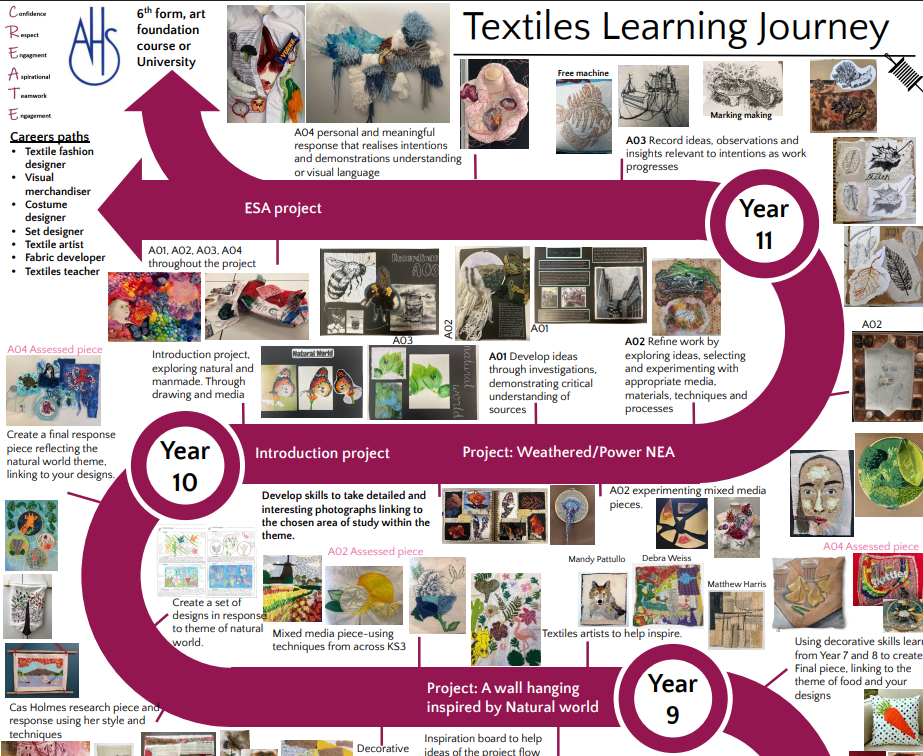
The skills covered in Key Stage 3 form the basis of learning in Year 10 and Year 11. Students begin with a stimulus for their NEA project. From there, they are allowed freedom to explore this through research and experimentation with appropriate media, materials, techniques and processes. Trips to art galleries enable students to develop their creative thinking and gather meaningful research and direction for their sketchbook. Students need to analyse textile artists and fashion designers' work accurately by looking at style, techniques, mood and meaning. This all leads to a personal, meaningful and risk-taking final outcome which brings their intentions to life and demonstrates an understanding and interpretation of the theme.
Key Stage 3 (Years 7-9) course implementation, learning journey & attainment.
Course content
| Year 7 | Year 8 | Year 9 |
|---|---|---|
|
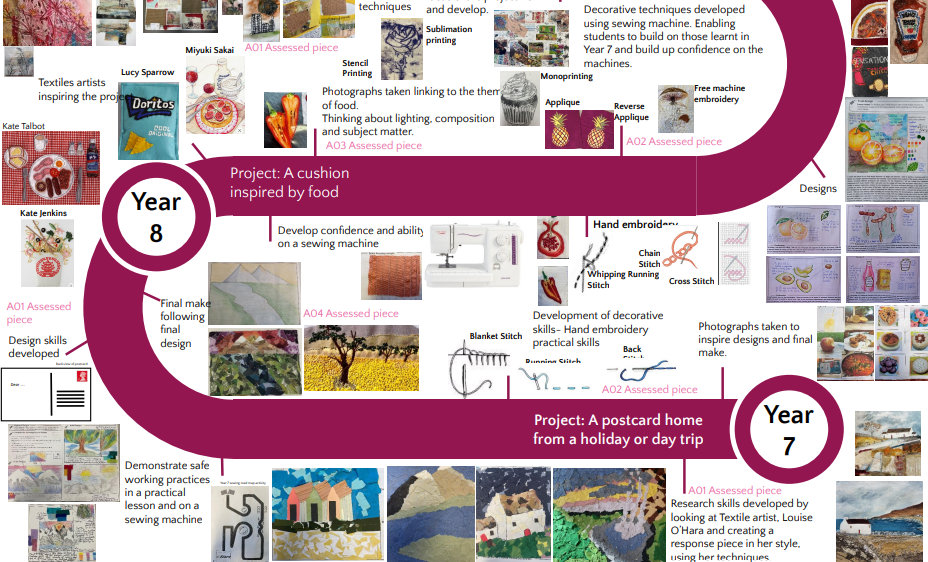
Making a holiday postcard inspired by the Textiles' artist Louise O’Hara Skills learnt include:
Key objectives of this unit are:
|
Making a decorative cushion cover using a range of decorative techniques based on the theme of ‘Food' Skills learnt include:
Key objectives of this unit are:
|
Making a ‘Natural World’ inspired wall hanging using a range of decorative techniques, influenced by the work of Cas Holmes Skills learnt include:
Key objectives of this unit are:
|
Learning Journey
Year 7 attainment descriptors
In Year 7, we split attainment into 4 areas, as illustrated in the tables.
Working Towards
| AO1 – Research and develop ideas | AO2 – Media experimentation | AO3 – Observe and record | AO4 - Final piece and response |
|---|---|---|---|
|
|
|
|
Working At
| AO1 – Research and develop ideas | AO2 – Media experimentation | AO3 – Observe and record | AO4 - Final piece and response |
|---|---|---|---|
|
|
|
|
Working Beyond
| AO1 – Research and develop ideas | AO2 – Media experimentation | AO3 – Observe and record | AO4 - Final piece and response |
|---|---|---|---|
|
|
|
|
Year 8 attainment descriptors
In Year 8, we split attainment into 4 areas, as illustrated in the tables.
Working Towards
| AO1 – Research and develop ideas | AO2 – Media experimentation | AO3 – Observe and record | AO4 - Final piece and response |
|---|---|---|---|
|
|
|
|
Working At
| AO1 – Research and develop ideas | AO2 – Media experimentation | AO3 – Observe and record | AO4 - Final piece and response |
|---|---|---|---|
|
|
|
|
Working Beyond
| AO1 – Research and develop ideas | AO2 – Media experimentation | AO3 – Observe and record | AO4 - Final piece and response |
|---|---|---|---|
|
|
|
|
Year 9 attainment descriptors
In Year 9, we split attainment into 4 areas, as illustrated in the tables.
Working Towards
| AO1 – Research and develop ideas | AO2 – Media experimentation | AO3 – Observe and record | AO4 - Final piece and response |
|---|---|---|---|
|
|
|
|
Working At
| AO1 – Research and develop ideas | AO2 – Media experimentation | AO3 – Observe and record | AO4 - Final piece and response |
|---|---|---|---|
|
|
|
|
Working Beyond
| AO1 - Research and develop ideas | AO2 - Media experimentation | AO3 - Observe and record | AO4 - Final piece and response |
|---|---|---|---|
|
|
|
|
Key Stage 4 (Years 10-11) course implementation, learning journey & assessment info.
Course content
| Year 10 | Year 11 |
|---|---|
|
Students produce NEA work which makes up 60% of their final GCSE grade. The other 40% is made up of an externally set assignment. Intro project on Natural and Human to establish students' strengths. This explores a range of assessment objectives and media. During Year 10, students will work on the project ‘Weathered’, by exploring and interpreting ideas through the media of textiles and by exploring a wide range of decorative techniques. The project begins by investigating, using observations, photographs, sketches and drawings, and practical sample experimentation work. Students would need to look at relevant fashion designers and textile artists to inform creative decisions and designs, before leading to them creating a final piece. Exam board: Edexcel Project Objectives and Assessment Objectives: A01 Develop ideas through investigations, demonstrating critical understanding of sources A02 Refine work by exploring ideas, selecting and experimenting with appropriate media, materials, techniques and processes A03 Record ideas, observations and insights relevant to intentions as work progresses A04 Present a personal and meaningful response that realises intentions and demonstrates understanding or visual language |
Students will continue to work on NEA’. They will explore the techniques of print, dye, fabric manipulation etc to build up a portfolio. They will have to use photographs and observational sketches as a starting point in order to explore and interpret the initial concept leading to a final piece. Students will also be required to complete an Externally Set Assignment, developing ideas and designs on a theme set by the exam board, culminating in a 10-hour timed practical exam. Within all projects across the 2 years, students will learn about:
|
Learning journey
This link takes you to the Edexcel specification for Textiles, which contains all the necessary course information. Assessments take place throughout the 2 years of the course, in addition to Year 10 exams and mocks in the spring term of Year 11.
How will I be assessed?
| Component 1 60% | Component 2 40% |
|---|---|
|
Students undertaking Art, Craft and Design must create work associated with areas of study chosen from at least two of the endorsed titles. Students undertaking one of the endorsed titles must create work associated with at least one area of study for that title. Students create a personal portfolio of work that demonstrates the knowledge, understanding and skills on page 7. Centres are free to devise any theme(s), project(s) or task(s) appropriate to their students and resources. They may each have a separate focus or be interconnected. This component allows students opportunities to:
The proportion of the 120 guided learning hours spent on this component should reflect its 60% weighting. Assessment overview
|
The Externally Set Assignment (ESA) represents the culmination of the GCSE course as it draws together all the knowledge, understanding and skills developed in Component 1. Students must continue to work in the same title as they did for the Personal Portfolio. Art, Craft and Design students are required to create work associated with at least one area of study for this component. Students must present personal response(s) to an externally set broad-based thematic starting point, set by Pearson in the ESA paper. This component allows students opportunities to:
Assessment overview
|
Subject impact
Key Stage 3
Assessment
Key Stage 3 is marked in line with the four assessment objectives: research; media experimentation; observing and recordings; and final piece. Work is assessed regularly throughout the projects, providing students with both a grade and written feedback. We also use effort stickers to enable students to see how hard they are working. Students are given opportunities to self-reflect and give their own targets based on marking, and there are opportunities throughout the project for peer assessment. During practical lessons, students are encouraged to show work to each other, enabling them to offer advice and use ideas of others in their own development, which prepares them for Key Stage 4.
Knowledge and skills
Each project at Key Stage 3 provides opportunities for students to build up skills and confidence on the different pieces of textiles equipment. We have developed clear links between schemes of work from Year 7 through to Year 9 that see the development of practical skills. Students become familiar with the sewing machine, and in Year 7 they learn the different parts, how to thread up and how to use it. This is then developed in Year 8 and Year 9, with students using sewing machines to build up decorative skills. In each skill lesson, to support students' learning, teacher demonstrations are presented, allowing students opportunities to recap learning.
By the end of Year 7, decorative skills learnt are:
-
Collage
-
Hand embroidery (running stitch, back stitch and blanket stitch)
-
Component embellishment
By the end of Year 8, decorative skills learnt are:
-
Applique
-
Mono printing
-
Free machine embroidery
-
Reverse applique
-
Hand embroidery (cross stitch, stem stitch and whipped running stitch)
-
By the end of Year 9, decorative skills learnt are:
-
Stencil printing
-
Sublimation printing
-
Fabric manipulation techniques
By the time students are in Year 9, they have such a wide range of knowledge and practical skills across all areas of textiles that they can use any of the skills from previous years on their final piece. This allows students to finish Key Stage 3 with the ability to produce challenging, refined and meaningful final pieces and prepares them for Key Stage 4.
Key Stage 4
Assessment
At Key Stage 4, students are assessed throughout their Non-Examination Assessment work. They are assessed in line with the GCSE specification, focusing on the four assessment areas. Sketchbook work is checked and feedback offered both verbally and written. Verbal feedback can be done as one-to-one tutorials but also as a whole class discussion.
Teacher targets are given regularly and students given opportunities to set their own targets. Students are given opportunities to address their targets in each lesson and time is built into the curriculum to allow for this. Peer assessment is built into lessons to encourage sharing of ideas and work.
Knowledge and skills
At GCSE students use all the knowledge and skills developed across Key Stage 3 to create and incorporate into their NEA projects. They will learn the importance of research into textiles artists and fashion designers to inspire the development of ideas and skills. Using their bank of practical skills learnt at Key Stage 3 they are able to create responses in the style of their chosen artists and designers, while building up further more challenging decorative skills such as:
-
Sublimation printing
-
Marble dying, glue dying and rust dying
-
Free machine embroidery into more risk-taking materials, such as, dissolvable fabric, glue, mesh wire.
-
Felting
-
Heat press fabric manipulation
-
CAD/CAM embroidery
They will understand that using a variety of media, materials and techniques can be used in relation to their own creative intentions and chosen area of study. Accumulating with a meaningful, risk-taking and challenging final piece.
Feedback in Textiles lessons
This chart explains the types of feedback that students can expect to receive for work done in geography lessons/at home.
| Activity | Types of feedback |
|---|---|
|
Assessments |
In Textiles, you are assessed against 4 assessment objectives. We use these at Key Stage 3 and Key Stage 4. A01 – Develop ideas through investigations, demonstrating critical understanding of sources. A02 – Refine work by exploring ideas, selecting and experimenting with appropriate media, materials, techniques and processes A03 – Record ideas, observations and insights relevant to intentions as work progresses A04 – Present a personal and meaningful response that realises intentions and demonstrates understanding of visual language At Key Stage 4 students are offered feedback on all the assessment objectives. During Key Stage 3 students are offered feedback on 3 of the 4 areas during the 13-week rotation. |
| Whole class feedback | After handing back marked work in the form of written feedback, there can be teacher feedback to the whole class on what has been completed well and what could be a focus for next time. |
| Self reflection | In Key Stage 3 booklets and Key Stage 4 assessment and target sheets, there are opportunities to evaluate work often and areas to reflect on teacher feedback to see what has gone well and how you can improve. |
| Peer reflections | During reflection work, there are written opportunities to peer assess each other's work. There are also times when practical work is displayed to all and students verbal feedback from each other and teacher is given. |
| Teacher comment | Written feedback is provided regularly at the end of a body of work at both Key Stage 3 and Key Stage 4. During Key Stage 4 lessons there are also one-to-one tutorials where teacher feedback is provided verbally. |
School values in Textiles
| Boundless Aspiration | Curious Engagement | Resilient Bravery | Selfless Generosity |
|---|---|---|---|
|
|
|
|
Student work
Examples of Key Stage 3 student work
Examples of Key Stage 4 student work