
Aylesbury High School
Maths
The Mathematics curriculum at AHS aims to develop students who are problem solvers and confident mathematicians who lean towards a challenge rather than shy away from it. The curriculum balances exposition with discussion, questioning and practise so that students gain the skills to work through problems and deeply understand the links and connections between different topics.
Our curriculum follows a mastery approach, meaning there is a keen focus on mathematical thinking, fluency and variation in questioning. Our students do not rely on ‘tricks’ to solve problems but are able to explain the mathematical reasoning behind the approach they have taken.
We strongly encourage students to participate in challenges that help them to see Mathematics in a different light.
Year 7 and 8 participate in the Junior Maths Challenge.
Year 9,10 and 11 participate in the Intermediate Maths Challenge.
Year 11,12 and 13 participate in the Senior Maths Challenge.
We usually have great success in these challenges with a number of students being invited to the follow-on rounds.
Two teams of Year 10 students are selected to participate in the AMSP Maths Feast against other Grammar schools in the area. They have support during lunchtimes in the run-up to the event and then attend the event hoping to win the chance of winning one or more of the rounds. Last year the team were recognised for their excellent teamwork and managed to win one of the rounds!
We are always on the lookout for new and exciting challenges for our students!
Student resources
The Google Drive, Google Site and Clickview are only available for students and teachers of Aylesbury High School. The Google Drive contains all Google-based resources used in lessons. The Google Maths Site contains extra resources and links to further learning and understanding.
The other quick links are to websites we use with extra resources.
| AHS only resources | Web-based quick links |
Web based quick links |
|---|---|---|
|
|
|
|









Extension work & wider reading at Key Stage 3 (Years 7-9)
Every lesson in our scheme of work has extension questions available to stretch and challenge students.
They are all linked on the Maths Google Sites.
UKMT challenges run throughout the year along with follow-on rounds for successful students.
Junior Maths Challenge is aimed at students in Years 7 and 8
Extension work & wider reading at Key Stage 4 (Years 10-11)
Every lesson in our scheme of work has extension questions available to stretch and challenge students.
They are all linked on the Maths Google Sites.
UKMT challenges run throughout the year along with follow-on rounds for successful students.
Intermediate Maths Challenge is aimed at students in Years 9, 10 and 11.
Extension work & wider reading at Key Stage 5 (Years 12-13)
Every lesson in our scheme of work has extension questions available to stretch and challenge students.
They are all linked on the Maths Google Sites.
UKMT challenges run throughout the year along with follow-on rounds for successful students.
The Senior Maths Challenge is aimed at students in Years 11, 12 and 13
Subject intent
The Mathematics department aims to challenge each student and has high expectations of all its students. We make full use of bespoke Google Sites to deliver the curriculum through students’ use of 1:1 devices.
Key Stage 3
In Year 7, we ensure that all students have covered and are competent in topics that are described in the Key Stage 2 curriculum by assessing their prior knowledge. This allows for a smooth transition between further Key Stages and ensures progression in teaching and learning throughout their time at AHS.
In Year 8 and 9, we build on the knowledge from Year 7 and take the concepts further in preparation for the Higher GCSE course.
We offer a variety of teaching and learning activities such as independent tasks, online activities including Mymaths and Desmos, as well as practical group tasks. This aims to seamlessly bridge the gap from Primary to Secondary level Mathematics and develop the students’ fluency in performing and applying key mathematics skills. This helps to engage and motivate our students through full participation in lessons. We typically build in extension material where students can explore enrichment opportunities both within and outside of the curriculum to enhance students’ enjoyment of Mathematics, such as UKMT Mathematics challenge problems.
We aim to nurture students’ ability to reason and problem-solve through exposure to a variety of strategies by making this a regular feature in lessons and assessments. Challenge is provided through depth rather than acceleration.
Students are assessed regularly through tests and homework where feedback is given either in lessons, orally or written onto their work. Students are organised by ability from the start of Year 8 by splitting the Year group in two to make three Set 1 groups and three Set 2 groups and this continues into Year 9. There can still be a wide range of ability within a class, so we aim to establish a classroom climate where all students feel that they can contribute and which secures their motivation and concentration. We adapt teaching strategies to keep all students suitably challenged. If intervention is required, we will provide appropriate support within lessons or suggest making use of the maths clinic to ensure students do not fall behind the rest of their peers.
All students will be given the opportunity to partake in the UKMT maths challenge events (All Year 7 and some of Year 8 do the junior maths challenge and some Year 9 students are invited to sit the intermediate maths challenge) with support given at a lunchtime club. There is also the House Mathematics competition for Year 7, which is a relay race using problems similar to that seen in the UKMT Maths Challenges.
Key Stage 4
The Mathematics department organises the students by ability at the start of Year 10. We stream the students into two set 1 groups, two set 2 groups and three set 3 groups. All students will study for the AQA Higher GCSE Mathematics with the students in sets 1 and 2 having the opportunity to study the Further Maths Level 2 qualification. The aim of this is to give students the time to become fluent in the skills at GCSE and to stretch and challenge the more able students. We have adapted our schemes of work to reflect the changing nature of Mathematics assessments by including more problem-solving activities. We regularly assess prior knowledge, allowing us to focus our teaching on areas that require the time.
We run revision sessions for selected students in Year 11 prior to their summer exams.
Students will be given the opportunity to partake in the UKMT maths challenge events with support given at a lunchtime club.
The students revise throughout Year 11 by working through past papers for homework and in class. They can seek help from the Maths Clinic at lunchtimes.
Key Stage 5
At Key Stage 5 we offer two A Levels and one AS Level: AS and A Level Mathematics and A Level Further Mathematics, following the Edexcel Specifications 8MAO, 9MA0 and 9FM0. Students are taught in small groups by two teachers where they are taught a linear programme with a deeper emphasis on developing and assessing reasoning, problem-solving skills and modelling. There is also a focus on the use of technology in teaching and learning and students will have to familiarise themselves with the more advanced statistical uses of their calculators. The large data set is referred to from early on in Year 12 so that our students become familiar with it and are able to use it throughout the course. This allows a thorough understanding by the end of the two years. Throughout the course, we aim to cover topics in Pure Maths and Applied Maths simultaneously so that our students remain confident in all core skills and are better prepared for their final exams.
We offer Further Mathematics in order to challenge our more capable mathematicians and enable them to move on to Maths and Engineering-based courses at university or to higher level apprenticeships with a strong mathematical understanding. In this A Level, students are taught a linear programme with the same emphasis as in Mathematics A Level. They will advance their knowledge of the number system to include complex numbers and explore how these can be used to solve many otherwise impossible problems. We will also extend their learning with modules in Decision Maths and Further Pure.
All A Level Mathematicians are encouraged to participate in both the individual and group Maths Challenges. We also offer two enrichment courses:
-
Statistics in context is designed to aid students who are not studying A Level Maths but are studying A Levels with a high statistical content, such as Biology, Geography, Psychology
-
Personal Finance is designed to help students understand money matters in the real world
Key Stage 3 (Years 7-9) course implementation, learning journey & attainment.
Course content
Calculators are not to be used in Year 7. We want to make sure all girls can competently perform calculations. All tests and the end of year exam will be non-calculator.
| Year 7 | Year 8 | Year 9 |
|---|---|---|
|
|
|
Learning Journey
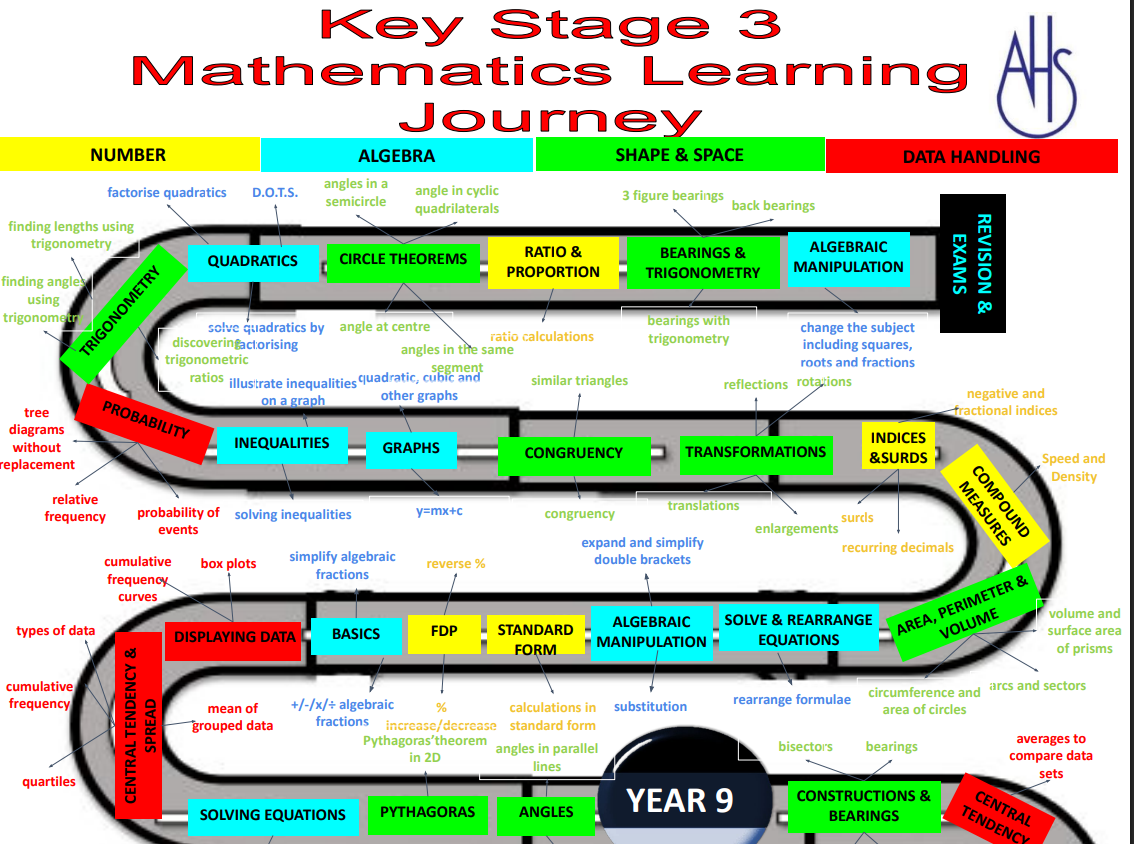
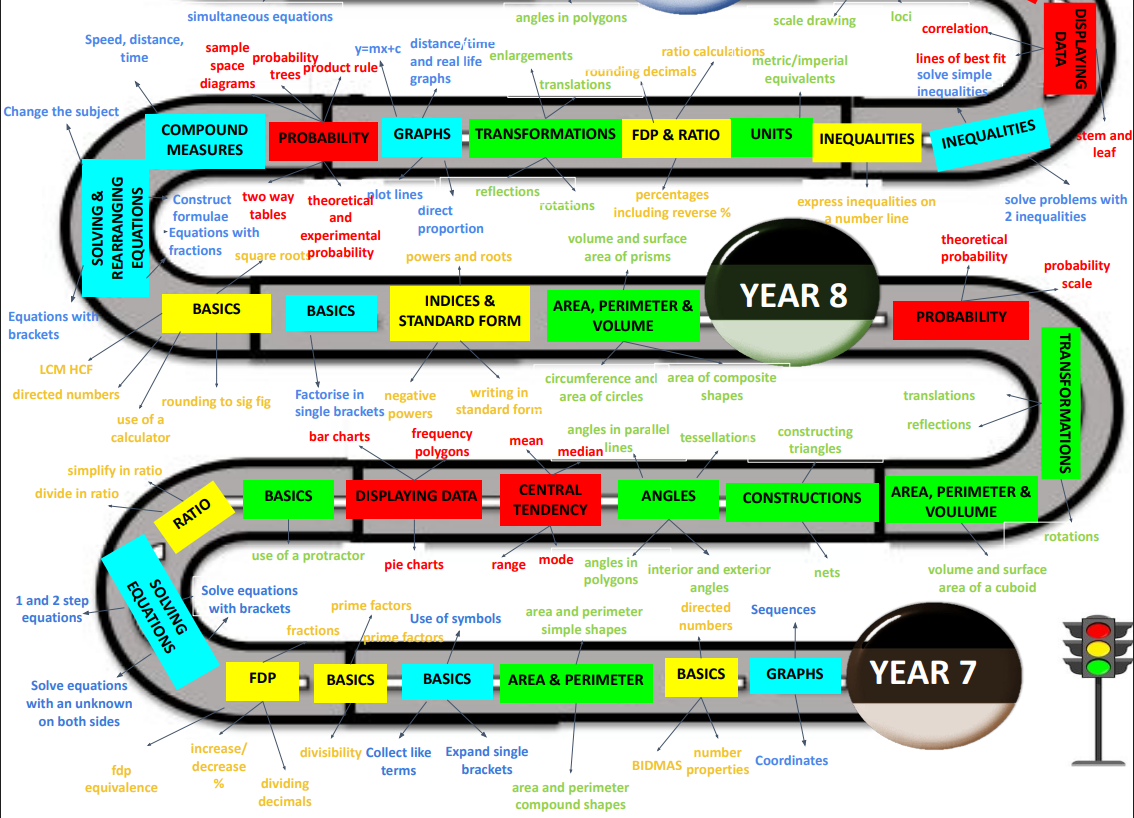
In Maths at Key Stage 3 (Years 7-9), it is not possible to write individual attainment descriptors in a way which works for the majority of other subjects. The attainment descriptors of WT/WA/WB (Working Towards / Working At / Working Beyond) are therefore based upon percentages, as you might expect!
WT: I am confident in some of the topics in this test.
WA: I am confident in most of the topics covered in this test.
WB: I am very confident in the topics covered in this test.
Key Stage 4 (Years 10-11) course implementation, learning journey & assessment info.
Course content
| Year 10 | Year 11 |
|---|---|
|
|
Learning Journey
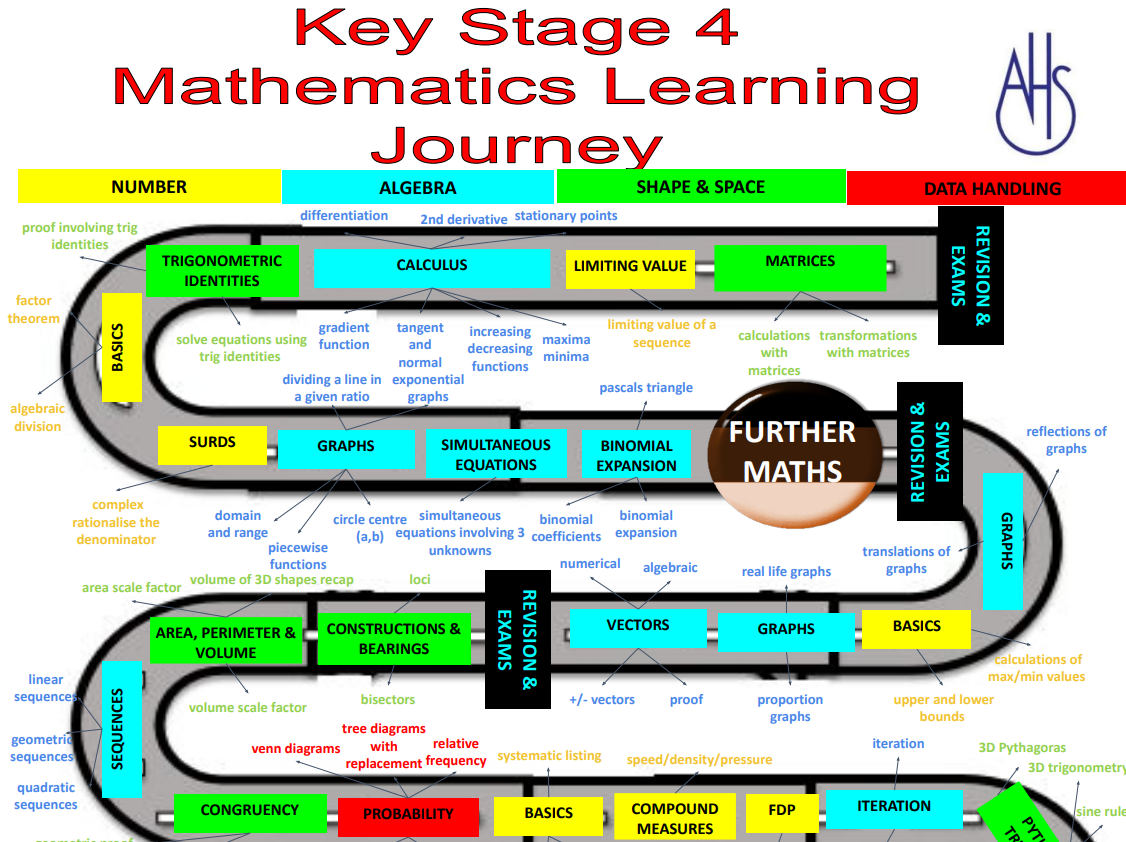
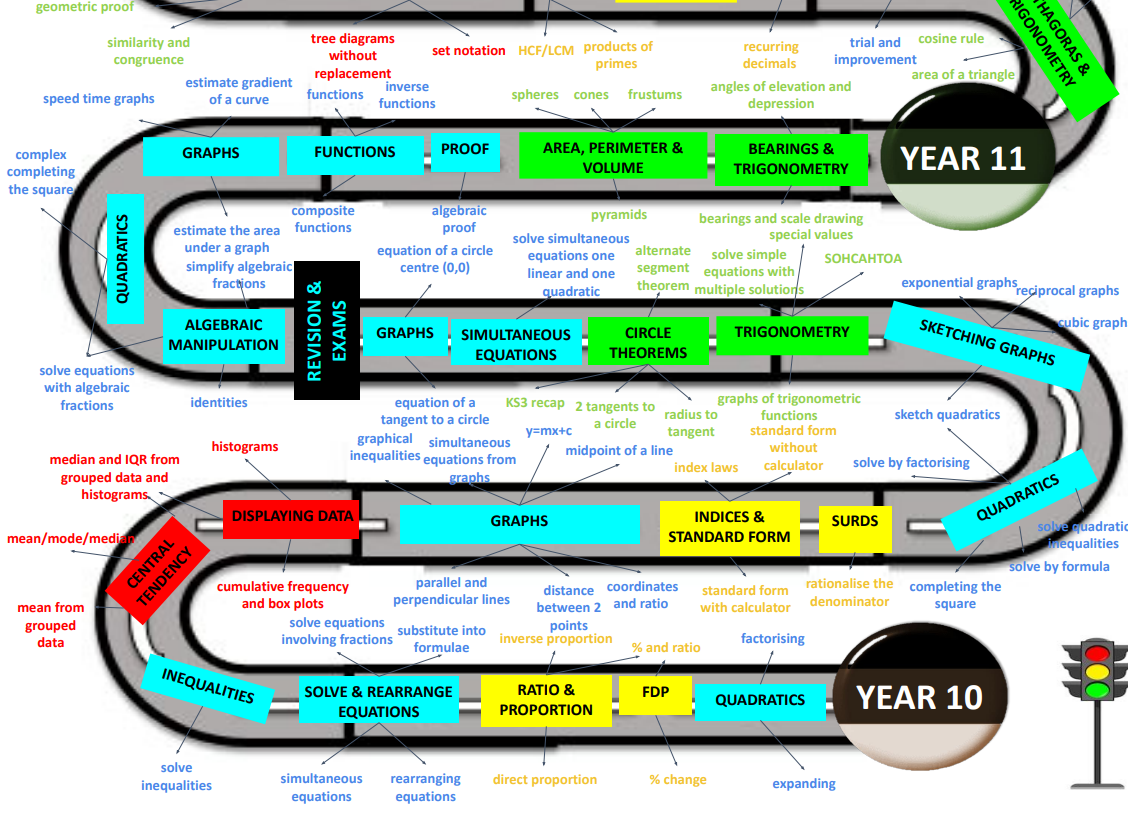
For the GCSE level, this link takes you to the AQA specification, which contains all the necessary course information. Assessments take place throughout the 2 years of the course, in addition to Year 10 exams and mocks in the spring term of Year 11.
How will I be assessed at GCSE Maths?
The following summary is based upon students doing the Higher papers.
A mix of question styles, from short, single-mark questions to multistep problems. The mathematical demand increases as a student progresses through the paper.
| Paper 1 33 1/3% | Paper 2 33 1/3% | Paper 3 33 1/3% |
|---|---|---|
|
• Written exam: 1 hour 30 minutes • 80 marks • Non-calculator |
• Written exam: 1 hour 30 minutes • 80 marks • Calculator allowed |
Written exam: 1 hour 30 minutes • 80 marks • Calculator allowed |
How will I be assessed at GCSE Further Maths?
For the GCSE level, this link takes you to the AQA specification, which contains all the necessary course information. Assessments take place throughout the 2 years of the course, in addition to Year 10 exams and mocks in the spring term of Year 11.
A mix of question styles, from short, single-mark questions to multistep problems. The mathematical demand increases as a student progresses through the paper.
| Paper 1 50% | Paper 2 50% |
|---|---|
|
• Written exam: 1 hour 45 minutes • 80 marks • Non-calculator |
• Written exam: 1 hour 45 minutes • 80 marks • Calculator |
Key Stage 5 (Years 12-13) course implementation, learning journey & assessment info.
Course content
In Year 12 and 13, we are studying the new Edexcel 8MA0, 9MA0 AS and A Level Mathematics, and 9FM0 A Level Further Mathematics courses.
| Year 12 | Year 13 |
|---|---|
|
Pure Maths:
Mechanics:
Statistics:
If you are studying further maths in Year 12 then you will also study the rest of the A Level in Mathematics and some components of the A Level Further Mathematics. Pure Maths:
Mechanics:
Statistics:
Core Pure (further maths)
|
Pure Maths:
Statistics:
Mechanics:
If you are studying further maths at A Level Core Pure 1 and 2:
Further Pure 1:
|
For A level Maths, this link takes you to the Edexcel specification, which contains all the necessary course information. Assessments take place throughout the 2 years of the course, in addition to Year 12 exams and mocks in the spring term of Year 13.
How will I be assessed for A Level Maths?
| Paper 1 33 1/3% | Paper 2 33 1/3% | Paper 3 33 1/3% |
|---|---|---|
|
Written exam: 2 hours Pure Mathematics 1 Calculator paper |
Written exam: 2 hours Pure Mathematics 2 Calculator paper |
Written exam: 2 hours Statistics & Mechanics Calculator paper |
How will I be assessed for A Level Further Maths?
For A level Further Maths, this link takes you to the Edexcel specification, which contains all the necessary course information. Assessments take place throughout the 2 years of the course, in addition to Year 12 exams and mocks in the spring term of Year 13.
| Paper 1 25% | Paper 2 25% | Optional paper 1 25% | Optional paper 2 25% |
|---|---|---|---|
|
Written exam: 1 hour 30 mins Core Pure Mathematics 1 Calculator paper |
Written exam: 1 hour 30 mins Core Pure Mathematics 2 Calculator paper |
3A: Further Pure Mathematics 1 3B: Further Statistics 1 3C: Further Mechanics 1 3D: Decision Mathematics 1 |
4A: Further Pure Mathematics 2 4B: Further Statistics 2 4C: Further Mechanics 2 4D: Decision Mathematics 2 |
Students choose either 2 options from the optional paper 1 column or a pair from the two columns.
Subject impact
Our Key Stage 3 curriculum encourages problem-solving and which prepares students well for their GCSE course. Students are more fluent in maths. They can explain their answers more proficiently and in greater depth. They appreciate the links between topics and how they relate to the real world, which enhances their appreciation for the topic.
They are more adept at problem-solving by being exposed to a wide variety of problems. They use their basic concepts to develop their skills in order to solve unfamiliar problems.
Students are becoming more confident in trying even if they may make mistakes. Class discussions allow them to share ideas and work together towards the solution.
They have worked collaboratively through discussion and tackling problems in pairs/teams. They have benefited from sharing ideas with others.
Throughout Key Stage 3, students have become used to using IT in their learning. Interactive websites such as Desmos and MyMaths allow them to visually see how the Maths works.
The scheme of work has been adapted to allow for better sequencing where the topics lead into one another more fluidly. Students regularly revisit previous topics as they extend their understanding by seeing how they can be used within other areas of mathematics. This allows students to revise topics without having to spend lessons going back over all the concepts.
Key Stage 3 students use manipulatives in lessons to physically depict the problem and use objects such as tiles, discs and cubes to solve it.
Key Stage 3 students have had opportunities for mathematical enrichment through taking part in Maths Challenges or House Maths.
Key Stage 4
Students are confident and fluent in tackling GCSE Higher Maths questions. This also supports other GCSE courses like Science, Geography, Technology. The skills learnt help students move on to A level courses such as Science, Psychology and Geography. The Further Maths course helps prepare students for A level Maths and eases the transition.
The use of exam questions in homework and assessments helps students achieve high grades at GCSE. Also, having all the resources on the Key Stage 4 Maths Google sites means students can find everything they need in one place.
The inclusion of problem-solving within the GCSE Maths course equips students with skills to tackle the types of problem-solving they might face in the workplace. Additional problem-solving is covered in participating in various Maths challenges which can help students prepare for the Oxbridge application process.
Key Stage 5
Students have secure reasoning and modelling skills.
Students are able to demonstrate their problem-solving skills through being able to tackle problems across Pure and Applied Mathematics.
Students are able to proficiently use technology and calculators to perform various numerical and statistical calculations. Their enhanced statistical knowledge allows them to analyse and interpret large real life data sets and from this they are able to draw conclusions about real world situations.
A student’s long-term memory is strategically influenced by distributing learning and retrieval opportunities over a longer period of time. A student’s mathematical confidence grows through constant interleaving within the same lesson.
Through fortnightly spot-tests, students are constantly challenged to retrieve prior knowledge.
Further Mathematicians are provided with the opportunity and skills to study Mathematics and Engineering-based courses at university.
Feedback in Maths lessons
This chart explains the types of feedback that students can expect to receive for work done in Maths lessons/at home.
| Activity | Types of feedback |
|---|---|
|
Summative Assessments |
Teacher marked → whole class feedback → student self-assessed targets |
|
Homework |
Typically self marked at the start of the lesson that it is due, time given to ask for help and for students to self-identify areas to work on. Spot tests are then set on topics covered by homework for teachers to assess how well a student has embedded the knowledge. Sometimes homework can be collected in and marked by the teacher. |
|
Spot tests |
A mixture of teacher-marked, peer-marked or self-marked with whole-class feedback given by the teacher going through the questions in the test. |
|
Exercise Books |
Organisation and completion of work checked when circulating |
|
Contributions in class |
Verbal feedback given |
|
Dr Frost or MyMaths tasks |
Automatic marking through the online platform. Whole class feedback provided for questions completed poorly. |
|
Worksheets completed in class |
Self-marked and corrected, the student is then encouraged to seek 1:1 support from the teacher on questions they are struggling with. |
School values in Maths
| Boundless Aspiration | Curious Engagement | Resilient Bravery | Selfless Generosity |
|---|---|---|---|
|
|
|
|