Chemistry
Inspiring curiosity. Building scientific thinkers.
Chemistry at our school is an exciting, hands-on journey that helps students understand the world at a molecular level. Our department blends strong academic foundations with practical investigation, scientific curiosity, and opportunities that stretch far beyond the classroom. From Key Stage 3 through Key Stage 4 and into A Level, students grow into confident, analytical, and independent scientists ready for university and STEM careers.
🔬 Learning Pathway: Key Stage 3 → Key Stage 4 → A Level
Key Stage 3: Foundations in Chemistry
Key Stage 3 introduces students to the building blocks of chemical science. Students explore particles, reactions, acids and alkalis, and the periodic table through engaging theory and regular practical work.
Key Skills Developed
-
Scientific enquiry
-
Laboratory confidence
-
Core chemical understanding
Key Stage 4 (GCSE): Applying Chemistry with Precision
At Key Stage 4, students deepen their understanding and begin applying chemistry to real‑world contexts. They study quantitative chemistry, energetics, organic chemistry, and chemical changes, supported by required practicals. From Year 9, students follow the AQA GCSE Chemistry specification.
Skills Strengthened
-
Analytical problem‑solving
-
Critical evaluation
-
Scientific communication
A Level: Advanced Study and Scientific Independence
A Level Chemistry provides depth, challenge, and preparation for university‑level science. Students explore kinetics, equilibria, thermodynamics, spectroscopy, and advanced organic chemistry. For those students who choose to progress to Key Stage 5, we offer the OCR ‘A’ A Level Chemistry course.
Skills Mastered
-
Independent scientific thinking
-
Advanced practical technique
-
University readiness
🚀 Super‑Curricular Opportunities
Our department offers a rich programme of super‑curricular activities that help students extend their learning, build confidence, and explore future pathways.
-
Chemistry Olympiad — national competition for high‑achieving students
-
Analysts Competition— hands‑on challenges in school labs
-
Cambridge Chemistry Challenge – national competition for Year 12 high-achieving students
-
Top of the Bench – competition for groups of year 10 students
-
National Scientific Thinking Challenge – competition for year 10 students
-
Alumni speakers— insight into life at university and in the workplace
-
University outreach — lectures, lab days, and mentoring
-
Research projects — EPQ investigations and science fair entries
-
Career talks — insight into medicine, engineering, pharmaceuticals, and research
Student resources
The Google Drive, Google Sites and Clickview are only available for students and teachers of Aylesbury High School. The Google Drive and Google Sites contain all Google-based resources used in lessons.
The other quick links are to websites we subscribe to with extra resources. Students have their own login details given to them by the school.
| AHS only resources |
Web based quick links |
|---|---|
|
|
|



Extension work and wider reading at Key Stage 3 (Years 7-9)
Routine consolidation
-
Finish any work you didn’t complete in class. Catch up if you have been absent. All assignments are in Google Classroom.
-
Read ahead, in preparation for future lessons.
-
Create your own notes/mind maps/flashcards/slides. Use different colours/drawings to help remember your notes. Try a range of methods to find what works best for you.
-
Use quizzes to learn specialist terminology and key ideas: e.g. Quizlet. Review your flashcards routinely.
-
Talk to people about what you have learnt, even if they know nothing about the topic. Get them to ask you questions and see if you can explain the content in simple terms.
Revision activities
Extension work & wider reading at Key Stage 4 (Years 10-11)
Extension activities
-
Wider Chemistry Reading: GCSE Chemistry Reading List
-
Magazines in the Library: such as Focus Magazine, New Scientist, Biology Today
-
Podcasts: AHS recommended Chemistry podcasts
-
Jstor: AHS has an online subscription to the academic database JSTOR, which provides access to more than 12 million academic journal articles, books, and primary sources in 75 disciplines.
-
Research videos: Chemistry Career Videos
-
Apply Chemistry to everyday life: When you see or hear claims about plants, animals and ecology made by friends/in the news/on social media, ask yourself:
Claim: What is the claim that is being made here?
Support: What evidence is being presented? How valid/reliable/generalisable is it?
Question: What questions do I have? How could I research this?
Core Resources
- AQA Chemistry GCSE Specification
- Topic List and Assessment Information
- Key Words
- Learning Mats
- PMT mindmaps
- Grade descriptors
- Online Textbooks on Kerboodle
- CGP Revision Guides and Flashcards
- BBC Sounds Chemistry podcasts (10 mins. each)
- Chemistry Clinic (Mondays)
- Chemistry Intervention ON DEMAND (book time with staff or Ambassadors, using the Google Form on the year group Google Classroom)
- Year 12 and Year 13 Student Tutors
Interested in A Level at AHS?
Key Stage 5
Students choose A Level Chemistry because they have a keen interest in Chemistry as an academic subject and/or they wish to pursue a career in a Chemistry related discipline.
The OCR A level course builds on any Key Stage 4 Chemistry course and develops further the mathematical, practical, analytical and evaluative skills in each topic.
Students also complete a series of practical assessments to enhance their experimental skills. These assessments contribute to the award of a Practical Endorsement.
-
Requirements:
-
Meet AHS entry criteria (44 points from top 8 GCSEs)
-
Either: 7 in GCSE
-
Or: Grade 7 in the Chemistry components of Trilogy (double science)
-
If you have 7 or lower in Maths, you are required to do the bespoke AHS Maths For Physical Sciences Course OCR
-
Extension work & wider reading at Key Stage 5 (Years 12-13)
In the Sixth Form, students are expected to complete one hour of independent study for every lesson studied. Here are some suggestions as to how you can spend your study periods:
Routine consolidation activities:
-
Finish any work you didn’t manage to complete in class. Catch up if you have been absent. All assignments are in Google Classroom.
-
Read ahead, in preparation for future lessons.
Ask yourself questions about your reading:
Connect: How are these ideas connected to what I already know?
Extend: What new concepts/specialist terms have I learnt?
Question: What questions do I have? Is there anything I need clarifying?
-
Create your own notes/mind maps/flashcards/slides. Use different colours/drawings to help remember your notes. Try a range of methods to find what works best for you.
-
Use quizzes to learn specialist terminology and key ideas: e.g. Quizlet. Review your flashcards routinely.
-
Talk to people about what you have learnt, even if they know nothing about the topic. Get them to ask you questions and see if you can explain the content in simple terms.
-
Extension activities (useful preparation for UCAS, interviews and university):
-
Wider Chemistry Reading: Further Reading
-
Magazines in the Library: such as Focus Magazine, New Scientist, Chem Review
-
Podcasts: AHS recommended Chemistry Podcasts
-
Jstor: AHS has an online subscription to the academic database JSTOR, which provides access to more than 12 million academic journal articles, books, and primary sources in 75 disciplines.
-
MOOCs: widen your appreciation of the subject. Future Learn is a good place to start.
-
Research videos:
-
Apply Chemistry to everyday life: When you see or hear claims about plants, animals and ecology made by friends/in the news/on social media, ask yourself:
-
Revision activities:
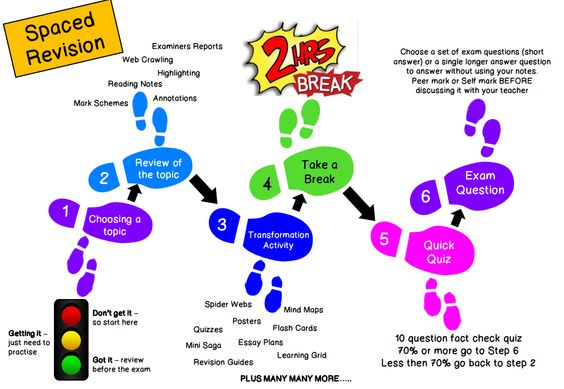
Routine consolidation of your work gives you a head start on revision. A ‘spaced approach’ to revision, outlined in the steps given below, has been shown to be effective:
1. Choose a topic
-
RAG rate different topics, prioritising revision of those you find most difficult. Use the checklists provided.
2. Review the material
-
Reading – If you haven't understood something or want a refresher, re-visit lesson slides, or see Physics and Maths Tutor for useful summaries.
-
Videos – As an alternative to reading, watching, or our own
3. ‘Transformation activity’: Engage with the material
-
Blurt: Blurt topic content on a whiteboard/A3 paper. Use a textbook to spot the gaps.
-
Create mind maps/flashcards/slides. Use different colours/drawings to help remember your notes. If you find it difficult to remember evaluation points, then prioritise these.
-
Talk to a friend/family member about your work – explaining ideas to a novice is a great way to see how much you have understood.
-
Write 6-marker plans – Plan 6 mark responses.
-
Seneca Learning – A quick and interactive way to review key content. Access for free here.
4. Take a break at this point! Then practise retrieving your knowledge…
5. Quick Quiz
-
Use Quizlet multiple choice quizzes or your own flashcards to check your understanding of a topic and your confidence with specialist terminology.
6. Exam Questions:
-
You can download past exam papers and mark schemes via the OCR website. Use the mark schemes to help further your understanding. Also, find exam questions by topic on the Physics and Maths Tutor website.
Core Resources:
-
Online Textbooks on Kerboodle
-
Clinic on Mondays in S3 1.30–2.30
Subject intent
Key Stage 4
To understand that Chemistry is the science of change, whose remit is to explain the properties of substances and, in doing so, to empower Chemists to create new substances with specific properties.
To explain and contextualise the learning objectives of the AQA GCSE Chemistry Specification, which cover a diverse range of Organic, Inorganic and Physical concepts, as well as giving extensive opportunities for practical investigation (including the completion of 8 Required Practicals).
To build upon the concepts introduced at Key Stage 3, including atomic structure and the balancing of chemical equations. To convey a genuine understanding of Chemistry, alongside any required rote learning.
To allow students to see common threads that facilitate all learning in Chemistry, rather than to see the subject as isolated topics.
To present practical investigation as an integral part of scientific endeavour and of testing models. To view Chemistry as an holistic discipline, despite the inevitable linear, topic-based teaching.
To instil the holistic and inquisitive approach needed to make progress at A Level.
Key Stage 5
As a concept, Chemistry underpins the nature of all that is around us and, by virtue of that, links to all that we materially experience. As a discipline, Chemistry requires a wide range of skills, encompassing observation (both qualitative and quantitative), factual recall and clear communication. It follows that, as a subject, Chemistry has the power and potential to engage students with a variety of attributes, but it is not forgiving of what it demands from those seeking to understand its intricacies. We aim to enlighten, support and challenge in appropriate measure, so that learners can appreciate the enormity of what is opening up for them, without being intimidated by it and so that they can build a realistically confident relationship with Chemistry.
To explain and contextualise the learning objectives of the OCR Chemistry A Specification, including the development of key laboratory and practical skills, as required by the PAG component of the qualification.
As the predominant A-Level prerequisite for many courses (including Medicine, Vet Med & Dentistry), to support suitable candidates to achieve their target grades and fulfil realistic career ambitions.
To use the principles of Chemistry, Physics and Mathematics to provide students with an understanding of the fundamental driving forces in the Universe; why do things happen?
To instil a culture of academic curiosity, inquisitiveness and independence that allows students to drive their own learning in this holistic subject, whilst ensuring they have frequent access to vital, individual discussion with staff.
To provide context, both for learning objectives and for potential careers involving Chemistry. This includes visiting speakers, promoting external talks, apprenticeship opportunities, The Cambridge Chemistry Challenge and the RSC Olympiad.
Key Stage 3 (Years 7-9) course implementation, learning journey & attainment.
In Years 7 and 8, students do science, but at the start of Year 9 they start their individual science courses for GCSE. Therefore, in Year 9, students begin studying GCSE Chemistry.
Course content
| Year 9 |
|---|
|
In Year 9, students cover the following modules from the AQA GCSE Chemistry course: 4.1– (Part 1) Atomic Theory and Separation Techniques The nature and history of the atomic model. Separation techniques which link nicely to separating compounds and molecules in the air studied in the ‘Chemistry of the Atmosphere’ topic. 4.1 (Part 2_The Periodic Table ) A study of the History of the Periodic Table, modern and reactions of groups 1, 7, 8 and transition metals 4.2 – Bonding, Structure & the Properties of Matter How matter is held together and how this affects its properties. |
Learning Journey
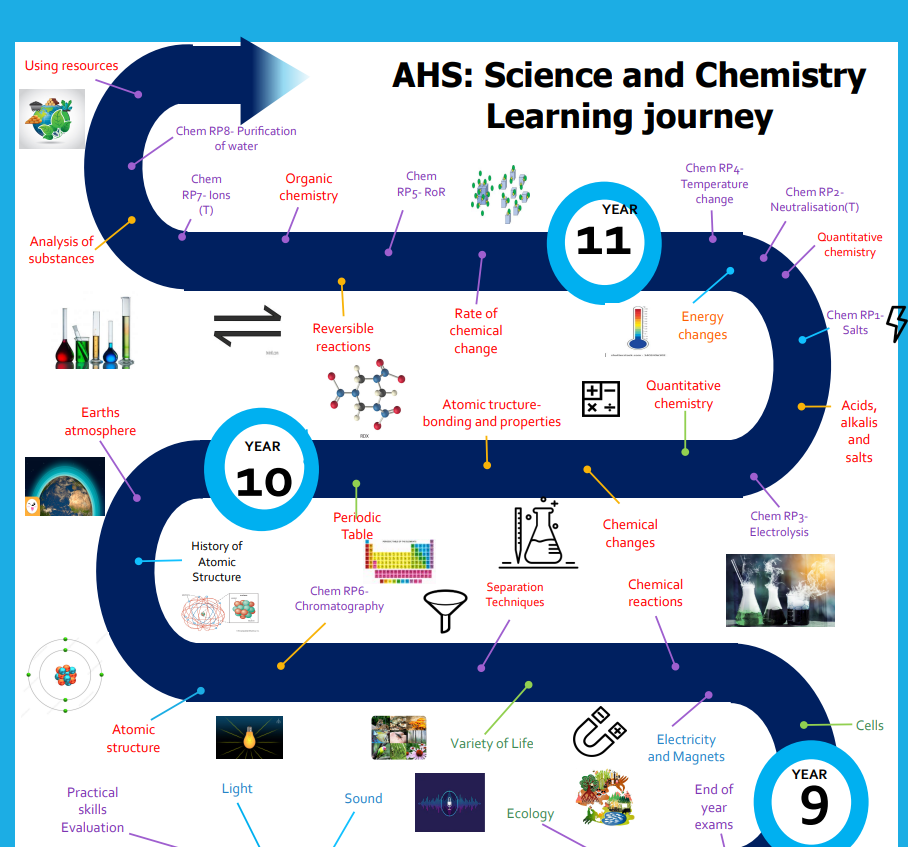
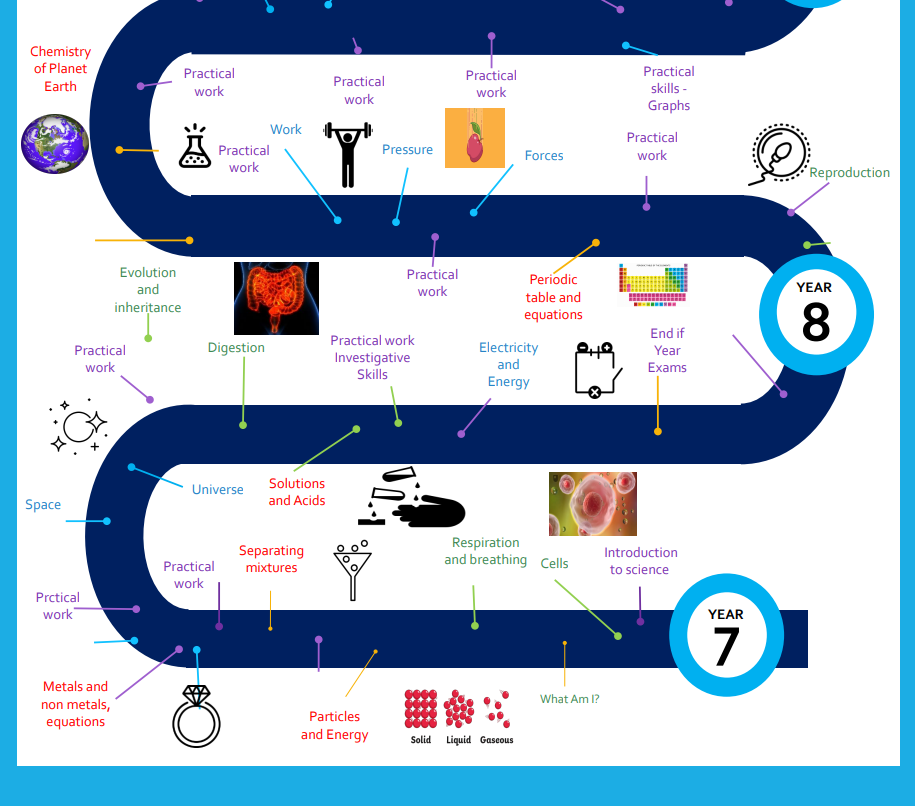
Year 9 attainment descriptors
In Year 9, even though students start their GCSE Chemistry course, we still give them WT/WA/WB attainment grades in order to fit in with the rest of the curriculum. Students are assessed on their ability in 3 key areas:
- Demonstrate knowledge and understanding of: scientific ideas; scientific techniques and procedures.
- Apply knowledge and understanding of: scientific ideas; scientific enquiry, techniques and procedures.
- Analyse information and ideas to: interpret and evaluate; make judgments and draw conclusions; develop and improve experimental procedures.
Please see the GCSE assessment requirements to further your understanding of how GCSE Chemistry is assessed.
Key Stage 4 (Years 10-11) course implementation, learning journey & assessment info.
Course content
| Year 10 | Year 11 |
|---|---|
|
In Year 10, students cover the modules that are examined in Paper 1 of the GCSE examination. In chronological order: 4.2 – Bonding, Structure & the Properties of Matter How matter is held together and how this affects its properties. 4.4 – Chemical Changes (Part 1) The reactivity of metals and electrolysis. 4.3 – Quantitative Chemistry Chemical calculations. How much will we make? 4.4 – Chemical Changes (Part 2) The reactions of acids. 4.5 – Energy Changes The transfer of energy during reactions and electrochemical cells. |
In Year 11, students cover the remaining modules that are examined in Paper 2 of the GCSE examination. In chronological order: 4.8 – The Rate & Extent of Chemical Change The rate of reactions and chemical equilibrium. 4.7 – Organic Chemistry (Part 1) Chemicals from crude oil, alkanes, alkenes & addition polymers. 4.7 – Organic Chemistry (Part 2) Alcohols, carboxylic acids, esters & condensation polymers. 4.8 – Chemical Analysis Identifying substances by practical testing and instrumental methods. 4.9 – Chemistry of the Atmosphere The changing composition of the atmosphere, pollution and climate change 4.10 – Using Resources How we use the Earth’s resources and produce potable water. Composite materials, ceramics & plastics. Over both years, students complete a series of eight ‘Required Practicals’ to demonstrate experimental skills. |
Learning journey
At GCSE level, students are assessed on their ability in 3 key areas.
- Demonstrate knowledge and understanding of: scientific ideas; scientific techniques and procedures.
- Apply knowledge and understanding of: scientific ideas; scientific enquiry, techniques and procedures.
- Analyse information and ideas to: interpret and evaluate; make judgments and draw conclusions; develop and improve experimental procedures.
This link takes you to the AQA specification, which contains all the necessary course information. Assessments take place throughout the 2 years of the course, in addition to Year 10 exams and mocks in the spring term of Year 11.
How will I be assessed?
The following summary is based upon students doing the Higher papers.
| Paper 1 50% | Paper 2 50% |
|---|---|
|
Topics 1–5: Atomic structure and the periodic table Bonding, structure, and the properties of matter Quantitative chemistry Chemical changes Energy changes. Written exam – 1 hr 45 mins
|
Topics 6–10:
Written exam – 1 hr 45 mins
|
Key Stage 5 (Years 12-13) course implementation, learning journey & assessment info.
Course content
| Year 12 | Year 13 |
|---|---|
|
A Level content is split into six teaching modules. In Year 12, students cover: 1 - Development of Practical Skills in Chemistry 2 – Foundations in Chemistry 3 - Periodic Table and Energy 4 - Core Organic Chemistry Following the Mock assessment, students cover ‘Enthalpy & Entropy’ and ‘Aromatic Chemistry’ from Module 5. |
In Year 13, students cover: 1 - Development of Practical Skills in Chemistry 5 – Physical Chemistry and Transition Elements 6 - Organic Chemistry and Analysis Over both years, students complete a series of practicals (PAGs) to demonstrate experimental skills. Completion of these is needed for the practical aspect of the A-level to be endorsed, though they do not influence the final grade. |
Learning journey
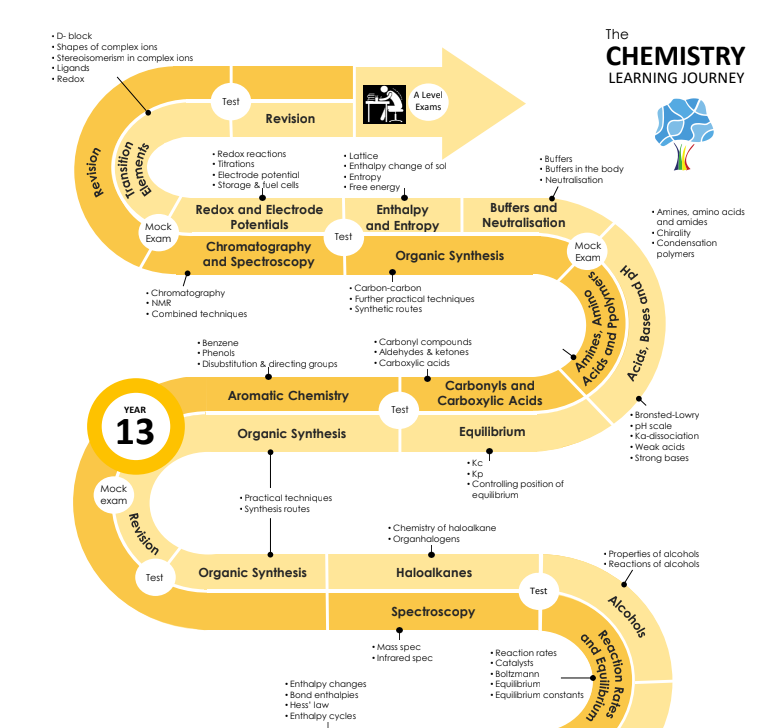
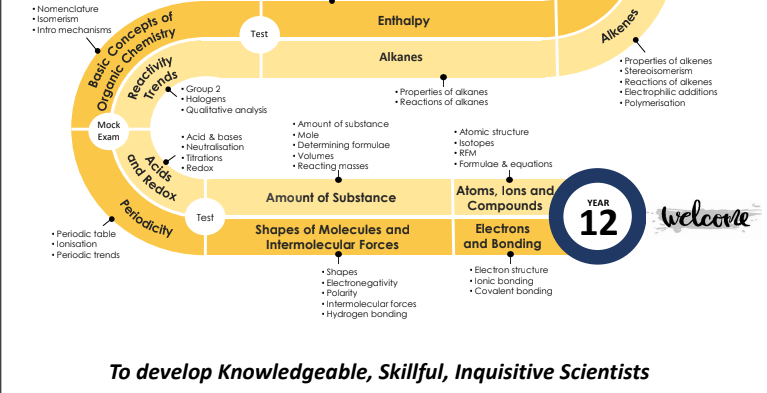
This link takes you to the OCR specification, which contains all the necessary course information. Assessments take place throughout the 2 years of the course, in addition to Year 12 exams and mocks in the spring term of Year 13.
How will I be assessed?
We do monthly progress tests as our ongoing method, along with experimental work (PAGs)
| Paper 1 - Periodic table, elements and physical chemistry 37% | Paper 2 - Synthesis and analytical techniques 37% | Paper 3 - Unified Chemistry 26% | Practical endorsement in Chemistry |
|---|---|---|---|
|
Written exam - 2hrs 15 mins |
Written exam - 2hrs 15 mins |
Written exam - 1hr 30 mins |
NEA |
Subject impact
Key Stage 3
Scientific knowledge and conceptual understanding:
Developed through the specific disciplines of biology, chemistry and physics. Our schemes of work aim to give students an understanding of the key big ideas in science: the links between structure and function in living organisms, the particulate model as the key to understanding the properties and interactions of matter in all its forms, and the resources and means of transfer of energy as key determinants of all of these interactions.
Nature, processes and methods of science:
Different types of investigative techniques that help them to answer scientific questions about the world around them. Students are taught about Working Scientifically through a range of practical investigations that are always clearly related to the science content in the programme of study. Students develop key practical skills such as the use of microscopes, safe handling of chemicals and basic equipment to carry out simple chemical reactions and measurements of time, distance and forces in different contexts.
Uses and implications:
Ensuring students are equipped with the scientific knowledge required to understand science, today and for the future. Evaluation and critical analysis of information is encouraged, especially on behaviours that could have an impact on the environment. In recent years, we have taken opportunities to incorporate topical issues into our teaching; our teaching of sustainability and the environment links directly to our SOWs.
Booklets help EAL students and templates are also provided. Glossaries are used as a tool to encourage the learning of scientific vocabulary.
We also provide a science lunchtime club for Key Stage 3 students to provide a more holistic approach to the teaching of science.
Key Stage 4
Our curriculum at AHS goes far beyond what is taught in lessons, for whilst we want students to achieve the very best examination results possible, we believe our curriculum goes beyond what is examinable. As a department, we provide a lunchtime science club for the younger students and a Chemistry clinic for those in Year 9 and above. Enthusiastic and motivated teachers and Chemistry Ambassadors give up their own time to go above and beyond for students. We also offer one-to-one mentoring using our Chemistry ambassadors.
Creative teachers produce quizzes, logic problems, projects, practical sessions and interactive lessons with hands-on tasks. We have recently introduced links to careers related to topics being taught and further links to the impact the processes being studied has on the environment.
-
Our topic booklets ensure that students can spend more time applying knowledge rather than copying notes. They also provide a detailed checklist of the content for that particular part of the course. We also ensure that progress is monitored with frequent end-of-topic tests.
The department, including the technical support staff, is co-operative and works as a team with discussions every day, sharing ideas and offering each other help and advice. As a knowledge-engaged curriculum, we believe that knowledge underpins and enables the application of skills.
The AQA separate science course provides students with a firm foundation from which to progress on to their A Level studies. The mix of Inorganic, Organic and Physical topics gives them an insight into the A Level course which builds on the knowledge and skills acquired at Key Stage 4.
Investigative and practical skills acquired in Key Stage 3 are built on by students using the Required Practicals as an important tool for linking practical and theoretical work.
Key Stage 5
As a department, we provide a lunchtime science club for the younger students, lunchtime drop-in sessions for older students, and lunchtime sessions to help Year 9 -Year 12 students who are struggling with the demands of the course.
We enter Year 12 students for the Cambridge Chemistry Challenge competition and Year 13 students for the RSC Chemistry Olympiad. We also provide personalised mock interviews for those applying to universities where interviews play an important role in the application process. Year 13 students, with the support of the Biology Department, provide a lunchtime meeting for those wishing to study Medicine at university where Year 12 students can go along and gain information about the application process from Year 13 students. Our Chemistry Ambassadors are key to helping with the running of our lunchtime Chemistry clinics but will also help our Year 10 and 11 students on a one-to-one basis.
The OCR course provides a solid foundation on which students can move on to Chemical Sciences, Medical Sciences and Biological Sciences. The PAGs provide students with the practical skills required to move on to studying a Science subject at a higher level and the questioning adopted by OCR encourages students to apply knowledge and to ‘think outside the box’. The reintroduction of Organic, Physical and Inorganic Chemistry topics which have been met in Key Stage 4 are built on in Year 12 and again in Year 13, hence the basic understanding at Key Stage 4 is vital for the smooth transition from GCSE to A Level. We have a detailed Transition Programme which starts at the end of year 11 and consists of 14 lessons to help gain the key skills and knowledge to ease the transfer from GCSE to A Level.
As a knowledge-engaged curriculum, we believe that knowledge underpins and enables the application of skills; both are entwined. As a department, we define the powerful knowledge our students need and help them recall it by providing detailed checklists for the topics we teach. Weekly quick quizzes help the students to recall key knowledge from previous topics as well as from the previous lesson. Each student from Year 9 upwards has a login for Kerboodle and many of our homework assignments are set on Kerboodle, where tasks are set involving interactive quizzes, crosswords, drag and drop exercises which are intellectually demanding enough to challenge our A/A* students. End of topic tests are set frequently and provide a tool to monitor progress. The introduction of a more synoptic element to tests later in the course has helped students make those intrinsic lateral links across topics, vital if they are to gain a high grade at A Level.
Feedback in Chemistry lessons
This chart explains the types of feedback that students can expect to receive for work done in geography lessons/at home.
| Activity | Types of feedback |
|---|---|
|
Assessments - end-of-topic tests |
Teacher marked → whole class feedback Reflection sheets provided for target setting Mid-topic practice sets KS4 Spot checks KS5 |
| Mid-topic assessments |
Short tests self self-marked students can set targets |
| Oral contributions in class | Verbal feedback |
| Mini whiteboard activities | Verbal feedback |
| Class work | Verbal and written feedback |
| Exercise books/booklets | Certain pieces of work are marked, written feedback. Sometimes marked or checked during the lesson |
| Kerboodle quick tests | Self-marking, written feedback |
| Homework | Written feedback |
| Class work | Verbal feedback |
| e-revision | Self-marking, written feedback |
| Research | Peer-marked or teacher-marked |
| Quick quizzes | Peer or self-marked, individual feedback, target setting |
School values in Chemistry
| Boundless Aspiration | Curious Engagement | Resilient Bravery | Selfless Generosity |
|---|---|---|---|
|
|
|
|
